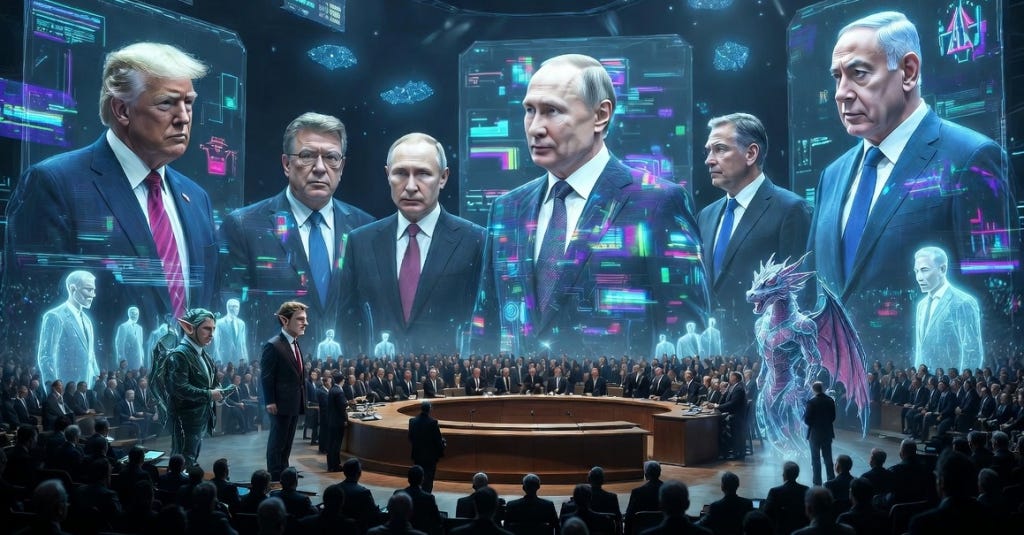
Iran and War without Reality
Narratives, power, and postmodern conflict
Alexander Dugin on postmodern war and the collapse of truth.
Conversation with Alexander Dugin on the Sputnik TV program Escalation.
Host: To begin, I suggest we comment on the statements and ultimatums issued by the U.S. president, directed both at Iran and at other countries in the region. On the one hand, Donald Trump is demanding that Tehran immediately reopen the Strait of Hormuz, threatening otherwise to launch massive strikes against Iranian energy infrastructure—he has already said he would begin with the largest power plants.
On the other hand, reports indicate that Trump has also approached the Arab monarchies of the Persian Gulf. According to journalists, he has presented them with an unprecedented financial demand—amounting to trillions of dollars—for the continued presence of U.S. forces. This is happening in regions densely packed with American bases, where local rulers have long relied on U.S. protection for their security.
How do you assess this moment: is it outright geopolitical blackmail, or an attempt by Trump to fundamentally rewrite the rules of the game in the Middle East?
Alexander Dugin: It seems to me that in this war—one that is teetering on the edge of becoming a Third World War—we still do not fully understand whether it has already begun or is only approaching. Perhaps these developments can still be delayed, if not entirely avoided.
In this war—and we should be careful with definitions—everything is tightly bound up with discourse, with what is being said. The words of the United States, Israel, Iran, and the Gulf states are increasingly diverging from what is actually happening on the ground and from the decisions being made in practice. This war is unfolding simultaneously on two planes: the realm of narrative and the realm of fact. And the two are becoming inseparably entangled.
Classical propaganda used to glorify one’s own side and discredit the enemy—exaggerating their losses while downplaying one’s own failures. But what we are seeing now is different. In the past, reality existed independently, and propaganda merely tried to dress it up. Let me remind you: stories about “gas chambers” in Germany already circulated during the First World War—states have always accused one another of atrocities. But today’s war differs in that the balance has shifted dramatically toward narrative.
Trump’s posts on Truth Social, his public statements, and the Iranian response videos are no longer mere propaganda. The Iranians, for example, are producing highly effective content using artificial intelligence—entire visual narratives showing Iran crushing its enemies.
Fragments of real events are woven into this exchange of virtual strikes, making it nearly impossible to separate one from the other. Why, in several videos, did Netanyahu appear to have six fingers? Immediately, rumors spread that he had died and that what we were seeing was a simulacrum. Then a “real” Netanyahu appears against a backdrop of ruins—but whose ruins are they? Once again, the question arises: is this real or generated?
The same applies to the exchange of ultimatums: this is a war of narratives. Trump demands that the Strait of Hormuz be opened, and Iran responds: “There is a war underway, you have killed our leadership, the strait is under our control, and we will do as we please.” If they wish, they can sever undersea internet cables; if they wish, they can block tanker traffic or strike desalination facilities.
Do not forget: the Arabian Peninsula, aside from southern Yemen, is essentially a vast desert. Life there—including in Israel—depends on desalinated seawater, and Iran has every capability to bring that system to a halt. Tehran tells the Americans: “Leave. Abandon your bases. Pay us a trillion dollars. Take your Israel with you so that this misunderstanding ceases to exist.” Trump, in response, threatens to send ground forces, deploy a massive fleet, and force the strait open.
Israel, meanwhile, is openly talking about expanding operations: the occupation of southern Lebanon (the ground phase appears to have begun), strikes on Damascus, and the construction of a “Greater Israel.” This extends even to actions on the Temple Mount. Recently, footage circulated showing missile debris near the Al-Aqsa Mosque—precisely where radicals seek to build the Third Temple. Whether this is real or AI-generated remains unclear. The Church of the Holy Sepulchre has been closed and may not reopen even for Easter. There are threats of an explosion at Al-Aqsa. At the same time, Iran is clearly escalating and shows no intention of negotiating.
Israeli politicians today openly call for killing the children of political leaders—specifically Iranian leaders. Meanwhile, the Gulf monarchies keep sending contradictory signals: “Let us join the U.S.-Israel coalition against Iran,” then “leave us out of this.” They seem to be asking the Americans: “Why have you exposed us? We hosted your bases to ensure security, not to create danger. You were supposed to protect us, yet you protect only Israel. We want out of this alliance.” And moments later, the opposite message appears: “Let us attack Iran together.” The same sheikh may issue mutually contradictory statements within minutes or hours.
Since Trump himself constantly shifts his position, we begin to assume that everyone else can do the same. More importantly, we cannot even be sure whether the sheikh actually said any of this, whether it is the same person, or whether he exists at all. Yet once such statements circulate, millions—including governments—begin making real decisions based on them. The virtual dimension of this Third World War has proven its importance.
An insightful analyst, Kees van der Pijl, recently observed that modern capitalism is no longer based primarily on money, demand, or resources, but on a triad: intelligence services, mass media, and information technology. This is where everything is decided. The media create images, the IT sector distributes and embeds them across networks, and intelligence services—tasked with concealing truth and uncovering secrets—add their own layer of control. We are witnessing a new form of capitalist warfare, where this “trinity” determines outcomes, narratives, and conditions.
Now everyone is discussing Douglas Macgregor’s statement in a conversation with Mario Nawfal on X. He claimed that the Russian president had warned Israel that Russia would use nuclear weapons if Israel used them first against Iran. Incidentally, thanks to Trump, it has now been openly acknowledged that Israel possesses nuclear weapons—previous presidents avoided saying this outright, whereas Trump simply states: “they have them, and they won’t use them.” When such words come from a U.S. president, they carry weight. At the same time, Macgregor’s claim does not match the usual style of our president, who would not speak so directly. And we do not know where Macgregor obtained this information.
My central point, however, is this: this is not merely the “fog of war” or traditional propaganda. This is an entirely new mode of warfare—one that is conducted, and perhaps even decided, largely in the virtual realm.
That is what I want to emphasize.
This makes it extremely difficult to assess Trump’s ultimatums or the actual actions of the various actors. The same applies to the European Union: we see completely contradictory reports. Some claim the EU has joined Trump and is sending troops against Iran; others claim the opposite—that Europe criticizes Trump and Israel and refuses to support them. From some of Trump’s posts, one conclusion follows; from others, the exact opposite.
Is our ship heading to assist Cuba’s energy sector, or has it been turned back by U.S. forces? Even this remains unclear. Maps are circulated, positions are reported—but are we actually helping Cuba or not? Are we assisting Iran, or simply waiting? What is China doing—fully backing Tehran or holding back? In truth, we know nothing.
A popular meme now circulates about Trump’s strategy: “Since I do not know what I am doing, my enemies will also be confused and unable to understand what America is doing. In this way, we conceal our plans—even if we have none.” All of this is becoming a new, postmodern system in the spirit of Tarantino. If not for the real victims—the suffering of hundreds of thousands caught in this bloody performance—it might even seem absurdly entertaining, like films by Tarantino or Lynch. Lynch himself once advised viewers not to search for meaning in his work: why assume a postmodern creation must have one?
That warning may apply to art. In war, where children and innocent people die, it becomes monstrous. Perhaps this is the first war in human history in which meaning is either entirely absent or so deeply concealed that even its architects have lost the thread—or else it is part of an extraordinarily complex plan in which everyone pretends ignorance.
Host: Still, would it not follow that concrete actions—the observable outcomes—remain the only reliable basis for judgment? After all, we live in 2026, when any statement can be fabricated, distorted, or attributed to someone else. Should we not focus on results?
Alexander Dugin: That was true before. Reality once served as the criterion of truth. But we missed a crucial intellectual shift that took place in the West—especially in France—forty or fifty years ago.
Postmodern philosophy advanced a radical claim: reality is no longer the criterion of truth. Truth resides within discourse itself—within texts, narratives, and interpretations—while reality becomes secondary, even optional.
This is not merely the invention of eccentric thinkers like Deleuze or Guattari. It is grounded in serious structural linguistics, particularly in the work of Ferdinand de Saussure. One of the central conclusions of twentieth-century philosophy is precisely this: reality, as a stable reference point, has ceased to exist as a criterion.
We continue to say, “Let us examine real actions.” But in postmodernity, this method no longer functions. If reality is shaped by interpretation, then an action that is never articulated does not exist. Conversely, an action that is declared exists—even if it never occurred.
This method of verification belongs to the modern era. It worked when propaganda said one thing and reality could be checked against it. That framework has fundamentally changed.
Host: Yet I would still suggest judging not intentions, but concrete results. Trump wrote on his Truth Social platform that after Iran’s “defeat” he would now turn to domestic enemies—to the Democratic Party. But if we look impartially at the outcome: has Iran really been defeated? Yes, it has suffered colossal losses in many areas, but the final point has clearly not been reached. Today, on March 23, Trump announced a five-day pause in strikes on Iranian energy infrastructure, allegedly because of “successful negotiations,” although Tehran denies this.
Perhaps it is still too early to draw definite conclusions, but in our age waiting is no longer customary—everyone wants the result here and now. Do you think history will eventually put everything in its place, or in the postmodern world will the very “result” itself also become a matter of interpretation?
Alexander Dugin: History has ended—post-history has begun. And that is an entirely different substance. Results today are also merely talk about them, another part of the common discourse. We live in a world that we ourselves form. Therefore, we must not passively wait for certain “results” to manifest themselves, but actively construct our own reality: a Russia-centered reality, a Russian virtuality—if you like, a Russian postmodernity. Otherwise, we will simply never get out of this trap of others’ interpretations.
Host: In recent weeks we have been frightened by video footage from the Middle East—and one can only guess what lies behind it in reality. Russia’s top officials are commenting actively on the situation. Presidential spokesman Dmitry Peskov today once again stressed that strikes on nuclear facilities in Iran, including Bushehr and Natanz, are an extremely dangerous game, fraught with irreversible consequences for the entire region.
In his characteristic manner, he reminded everyone that the situation should have moved into the stage of political and diplomatic settlement yesterday already. Yet one cannot help thinking: the United States, and Trump personally—who one moment threatens to “wipe Iranian power plants off the face of the earth” and the next declares a five-day pause—seem to have some diplomacy of their own. Can these approaches even be reduced to a common denominator, and is there any chance of real dialogue under such conditions?
Alexander Dugin: You see, another aspect of philosophy is important here. We live in a postmodern world, whereas only yesterday there was a modern world—and it has ended. All of humanity bitterly regrets this, without really understanding what is happening to it, because it does not take an interest in philosophy. Gilles Deleuze ought to be read at the highest levels of any society that wants to understand world politics—not in order to adopt his ideas, but in order to have some sense of the real proportions of what is happening.
We are stuck in this “only yesterday”: “only yesterday this should have been done,” “only yesterday they promised,” “only yesterday things were this way.” But today everything is different. A different epoch has arrived: history is over, post-history has begun. And one of its main features is acceleration, speed. This is what Paul Virilio called “dromocracy”—the rule of speed. This principle explains almost everything now taking place in the Middle East. Within accelerationism, what matters is not doing the right thing, but doing something quickly. Do it quickly—and you will be right. And what exactly should be done? Anything at all: strike the enemy quickly, evade quickly, speak quickly, forget quickly, or renounce your own words. The main thing is the tempo.
We, meanwhile, are trying to return the situation to “only yesterday.” This is humanly understandable; it seems more normal. “Only yesterday” there was the United Nations, there was a bipolar world, there were “red lines” and arms-control treaties. People signed agreements and—what matters most—kept them. But that no longer exists.
How can we explain to our highest political leadership that philosophers are not botanists or lunatics who read Kant, Hegel, or Heidegger because they have nothing better to do? It is not a whim. People who study the philosophy of politics and international relations are trying to understand the very essence of world processes. On the other side, in the United States, they understand this: look at Peter Thiel, the man who brought Trump to power. He is a Silicon Valley billionaire, the creator of Palantir, and yet he gives lectures on the Antichrist and the Katechon. He and his co-founder Alex Karp are interested in eschatology, the end of history, and world government.
The events in the Middle East are fitted by them into this postmodern coordinate system. And we continue to speak about the “violation of UN norms.” Of course they are being violated, because the UN belongs to “only yesterday.” The organization exists only as a phantom pain. It is a system that took shape after the Second World War, based on who won it. Had Hitler won, there would have been a different system. Had we not liberated half of Europe from Nazism, a third one. But once the Soviet Union—treacherously destroyed by enemies, whom we did not even condemn and to whom we sometimes even erect monuments—was knocked out of this system, our consciousness remained stuck in these phantom pains of the past.
We have still not fully comprehended what happened after the collapse of the bipolar world. That column was struck from outside, but we blew it up from within—an inside job, our own internal affair. We ourselves undermined the Soviet Union. Our president, Vladimir Vladimirovich, has repeatedly said that this was the greatest geopolitical catastrophe, and that we carried it out with our own hands. The dismantling happened in Moscow. And this is the most terrible thing: together with the USSR, the Yalta world collapsed, treaties were destroyed, and the balance of power was broken. We ceased to be a subject. We ceased to be a great power.
Putin began to restore this, but how pathologically far behind we have fallen in this situation! And first of all not even only in the creation of weapons, though there too. We lost our industrial potential because of the absence of reforms that needed to be carried out in our intellectual and educational system yesterday or the day before yesterday. We have fallen monstrously behind and do not understand at all the world in which we find ourselves, where events unfold at incredible speed. We thought everything would develop according to one scenario, and it turned out entirely differently.
We do not fully understand Trump’s motivations, the logic of the Islamic Revolutionary Guard Corps that governs Iran, or the actions of the Gulf petro-monarchies, Israel, and the Islamic world. We do not understand ourselves or our own place in the world. Yes, we have rightly grasped the saving idea of multipolarity—that was avant-garde and correct. The civilization-state, Eurasian geopolitics, traditional values—these are flashes of insight, adequate responses to the challenge. But the speed at which we are implementing these philosophical and ideological principles in life is absolutely out of proportion to the scale of the threats. It is becoming almost ridiculous.
Therefore I am convinced: under no circumstances should philosophy be neglected. It gives the most accurate, the most general points of orientation. Philosophy will not tell a politician which button to press—the leader always makes that decision. But philosophy allows one to describe correctly what the contemporary West is—or more precisely, the five different Wests.
Look at today’s West: after Trump’s arrival, it split into five poles. It is still the collective West, but five centers have arisen within it, each with its own subjectivity.
The first pole is Trump himself. He is fundamentally different from Biden. Whatever strategy he chooses, however he changes his decisions, this is an entirely different line of American development—a distinct and separate West.
The second pole is Israel. It has become a full-fledged center of decision-making. Previously, it seemed to be merely a proxy force, an outpost of the West in the Islamic world, living on American and European subsidies. But we now see that it is not the tail of the dog—it is the brain. Netanyahu’s position is the position of a subject that itself determines Western policy. He says, in effect: “Western civilization is us, and you are merely our continuation.” America today is literally exploding with discussion of the decisive influence of the Israeli lobby on fundamental state decisions.
The third pole is the European Union—France and Germany. Old Europe is trying to break through the liberal layer of Macron and Merz. We see synchronized blows: the incredible success of Marine Le Pen in France and Alternative for Germany in Germany. Where this process will turn is unknown. Macron and Merz themselves vacillate: one moment they challenge Trump, the next they obediently follow him.
The fourth pole is Britain. This is no longer the European Union, not merely an American base, and not even just part of some faceless Anglo-Saxon world. London has its own plans and its own methods of rapid intervention. Many decisions concerning Ukraine are taken precisely there: MI6 can initiate an operation without even consulting the CIA or Brussels.
The fifth pole is the globalists. They have not gone anywhere. Today they are embodied by the U.S. Democratic Party and the Soros structures. They have a different point of view: they are opponents of war with Iran and opponents of Netanyahu, while at the same time they are fanatical supporters of war against Russia in Ukraine.
A complex game is unfolding among these five centers, and each of them carries a postmodern dimension within itself. Netanyahu’s policy, for example, is filled with messianism, about which almost no one speaks publicly, although it is its only real content: ideas of the End Times, the Third Temple, the red heifers, and the coming of the Messiah. There is a transition from the archetype of the suffering Messiah—ben Joseph—to the forceful, victorious Messiah—ben David. If one applies this key, everything in Israeli politics becomes intelligible, yet no one dares discuss it officially.
The same thing is happening in Europe: the present European Union is also a kind of postmodernity. Britain has its own postmodernity. Trump is pure postmodernity, absolutely. And the globalists, with their transgender agendas and green imperatives, also live in postmodernity. These worlds do not coincide, but they can consolidate, assembling and disassembling like a kaleidoscope: turn the instrument, and the bits of colored glass form a new fractal.
But where is our adequate analysis of all this? We still see either the “collective West” or the West as it existed in earlier times. Yet everything is changing at great speed. This “dromocracy”—the rule of speed, in Virilio’s sense—demands study. It is time for us to create a state philosophical directorate or a commission on postmodernity, because we are already confronting all this in the sphere of digital technologies, network wars, drones, and robots. This year, most likely, we will see ground robots on the battlefield on both sides. The parameters of our existence are changing, while our media and our expert commentary remain in an embryonic state.
We need to find the proper register for analyzing events: the Iranian war, Israel’s messianism, Trumpism. Even our Ukrainian war must be placed into this new and adequate context. For all five of these “Wests,” in a certain configuration, can line up like a parade of planets in a hard front against the multipolar world. Some are more against us, some more against the Islamic pole or against China. India now gravitates toward us; it is a civilization-state with enormous spiritual potential. But it is also a weak link because of the very strong influence of the West. We must think about this constantly.
Our media must change their terms. The propaganda of the “old order” no longer works—we need a new verbal order, a new order of narratives. To demand ready-made solutions from analysts now is a farce. Until we draw a map of the new reality, new meanings, and new ontologies, our analysis will go sliding across the surface, the laws of which we ourselves do not understand.
If reality no longer exists, that news is far more important than whether the Strait of Hormuz is open or closed. Incidentally, the very name of the strait goes back to the Zoroastrian god of light—Ahura Mazda, Ormuzd. It was precisely the Iranian tradition that first created a detailed picture of linear time and of the final battle of the last days. And so we are returning to where it all began. Ancient myths, living religion, and postmodern strategies have become interwoven into the fabric of the world with which we deal every day.
As Peskov rightly remarked: “this should have been done yesterday.” Yesterday there was a world, and today there is a post-world, a post-universe with entirely different laws. We desperately need platforms and programs where people could think soberly and adequately in the context of the present moment.
Host: I would still clarify one thing: I assume Dmitry Peskov meant that the diplomatic process itself should have begun much earlier. Not in the sense of returning to the “former world,” but in the sense that the parties delayed too long before moving toward a political settlement.
As for your division into “five Wests”…
But was it ever really otherwise? You mentioned continental Europe as a single center, yet even there different poles can be distinguished—Germans and French, for example, stood against each other for centuries in historical perspective. In all the rest, some forces draw closer while others move out of one another’s field of influence.
Take Israel, for example: when have the United States ever taken a real step against the Israeli lobby? Has there ever been a significant initiative from Tel Aviv that Washington did not support? Under Republicans this happens more actively, under Democrats somewhat more cautiously, but the fact remains the same: the United States has never allowed a truly anti-Israeli resolution to pass at the UN level. This is just one example showing that certain constants in politics remain, despite all postmodern transformations.
Alexander Dugin: Certainly, certain contradictions have always existed. But under Clinton, George W. Bush, Obama, and especially Biden, the collective West was steadily being turned into something unified. Globalist forces and liberal democracy—what today has become only one of the five poles—then dominated almost without division.
Israel, of course, stood somewhat apart from that harmonious system, but attempts were made to restrain it. Biden and his predecessors, in previous periods of Lebanese conflict, regarded Tel Aviv as the most important ally, but by no means as an independent center of decision-making. Yet now, to a large extent thanks to Trump’s radical and unpredictable policy, these hidden centers have revealed themselves in the most unexpected way.
They have not merely made themselves known—they sometimes find themselves in direct opposition to one another, as we see in the clash of interests between the United States and the European Union over Greenland, for example. A colossal change in the balance is taking place, and these poles are acquiring entirely new significance. It was precisely this fundamental transformation that I wanted to draw attention to.
(Translated from the Russian)


I'm sympathetic to your point, and enjoyed the article, not least because I enthusiastically studied structuralism and post-structuralism, as well as the wonderful Mikhail Bakhtin, in the 1980's when it really entered Anglo-Saxon academia. All this hit when I was studying the 4C Church, and I had Augustine on time, memory and signs to entertain me. In fact the whole community was talking about signs, language and social allegiances. All this to create communities of faith. So maybe this isn't as new as we like to think.
Anyway... I feel in this case we do have a verifiable reality, Hormuz is closed to the west, triggering economic stress. Those US bases in the Gulf were largely destroyed, and they were chased out of the Gulf.
On the level of discourse America has been humiliated and Israel's power is waning.
Both the real and discursive worlds are changing. This is good.
In other words, we have now entered completely into a war of the minds, something which the Scriptures have preached for thousands of years--good vs. evil, and we are just now catching up to that concept?
Is that a reasonable conclusion?