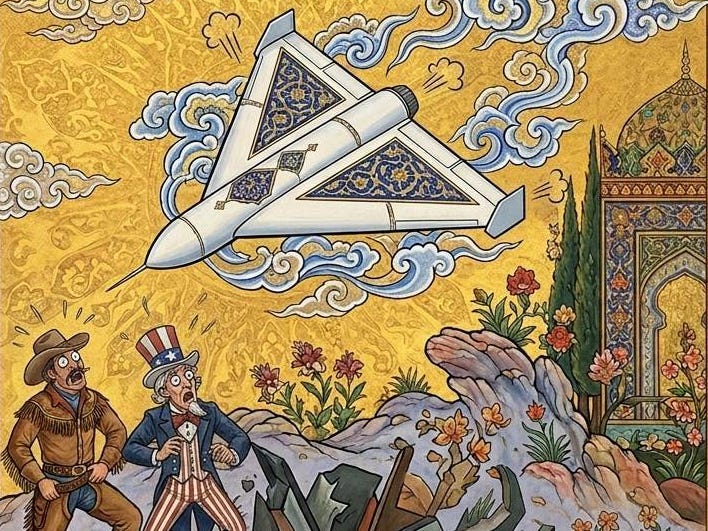
Iran and the Tragedy of Telluric War
by Ali-Mohammad Mohajer Nasser
Ali-Mohammad Mohajer Nasser on the West’s nihilism and the metaphysics of resistance.
The 2026 Ramadan War lasted forty days. When it ended, the strategic establishments of the Atlantic world confronted a silence their algorithms could not process. They had predicted the collapse of Iranian infrastructure within seventy-two hours, the disintegration of command-and-control, the inevitable fracturing of a society under the weight of combined air and naval assault. None of this materialized. The standard post-mortems invoked familiar variables: an overestimation of stealth platforms, an underestimation of dispersed missile batteries, the perennial arrogance of imperial general staffs. All of this is true, and all of it misses the point. What the West encountered in Iran was not a superior military doctrine in the technical sense. It encountered an alien mode of being-in-the-world, one for which its own intellectual and spiritual tradition has no surviving vocabulary. This essay is an attempt to name that mode and, in doing so, to diagnose the sickness that renders the West incapable of recognizing it.
I. The Pathology of the Spectacle: Western War as Active Nihilism
We must begin by discarding the comforting fiction that the Western way of war is “rational.” It is, in its deepest structure, profoundly pathological. Martin Heidegger, in his 1954 essay The Question Concerning Technology, identified the essence of modern technics not as a neutral instrument but as a mode of revealing what he called Gestell—enframing. Under enframing, all beings—human, animal, mineral—are reduced to Bestand, standing reserve: resources to be ordered, optimized, processed, and discarded. What Heidegger diagnosed in the hydroelectric dam on the Rhine, we may now diagnose in the kill chain of the American bomber. The enemy ceases to be a subject with whom one is locked in a political struggle; it becomes a target set, a data point in a battle damage assessment, a node in a logistical network awaiting destruction.
This is nihilism, but not the passive nihilism of Schopenhauer’s resignation or the melancholy exhaustion of the late Roman senatorial class. It is active nihilism: a joyous, self-annihilating will to nothingness that takes the spectacle of destruction as its only remaining source of affect. The 2026 war rendered this nakedly visible.
Observe the conduct of the American political class. Donald Trump did not merely authorize bombing sorties; he performed them. When a B-1 bomber demolished an unfinished bridge, Trump posted the footage to his social media platform with the taunt: “More coming!” He described watching the kidnapping of a foreign head of state as being like “watching a television show.” Pete Hegseth, his Secretary of War, dismissed the entire edifice of international humanitarian law—the accumulated sediment of centuries of Christian just war theory, however secularized—as “stupid rules of engagement.” This is not strategy. This is gamification. The war becomes a consumer product, an immersive action film in which the act of killing is structurally indistinguishable from entertainment.
The phenomenon is even more acute in the Zionist entity, which serves as both the laboratory and the vanguard of this form of life. During the Gaza extermination campaign and the subsequent strikes on Iran, an Israeli academic wrote publicly: “Kill the Iranian children. Bomb their children, not their infrastructure. The parents deserve to see their children die.” He added, with clinical pride, that it had taken two years to perfect this methodology in Gaza. This is not an aberration, not a lapse of decorum. It is the logical terminus of enframing. When the enemy population has been stripped of every trace of sacred aura—when it is nothing but Bestand—the death of a child ceases to be a tragedy and becomes a metric, a quantifiable unit of psychological warfare. The West no longer bothers to drape its wars in the vestments of humanitarian intervention. The mask is off because the face beneath it has rotted away.
The Ukrainian Symptom
To grasp the full scope of this pathology, one must extend the gaze beyond the Persian Gulf to the black earth of the Donbas. The Western proxy war against Russia in Ukraine is not a counter-model to the nihilism described above; it is the most complete expression of it.
Consider what the West has actually offered Ukraine. Weapons, certainly: HIMARS, Storm Shadows, Abrams tanks, the endless flow of matériel that sustains a grinding war of attrition. Sanctions on Russia, a financial war that has backfired spectacularly. A narrative of “European integration” that is, in practice, a promise of perpetual debt peonage to Brussels and Washington. But what the West has not offered, and cannot offer, is a metaphysics of sacrifice. It cannot tell the Ukrainian soldier why his death matters because the West itself no longer believes that any death matters. The European Union is a managerial apparatus for the administration of markets. It has no nomos, no sacred foundation, no destiny. It is, in Oswald Spengler’s precise sense, a civilization: the inorganic, soulless, post-cultural phase of a once-living organism.
The Ukrainian soldier, in this framework, dies not for a homeland in the telluric sense, not for a sacred history or a covenant with the dead, but for a bank transfer and a tweet from a Brussels functionary. NATO officers view the terrain of eastern Ukraine as a coordinate grid; they speak of “shaping the battlefield” and “managing escalation ladders” in a language that is indistinguishable from corporate risk assessment. The Russian combatant, whatever else one may say of him, fights on ancestral soil against an encroachment that has been advancing for three decades. He fights, however imperfectly, as a telluric being: rooted in land, memory, and a specific Orthodox civilizational inheritance. The Ukrainian soldier, by contrast, has been conscripted into a war that is not his own, a war fought for the abstract principle that “borders must not change by force,” a principle the West itself has violated whenever expedient.
One need not romanticize the Russian Federation to recognize that it has, in this conflict, become what Carl Schmitt called the Katechon: the restrainer, the force that, however compromised, holds back the total dissolution of the world into a single, homogenous, market-governed space. The West’s rage against Russia is not a moral response to a violation of international law. It is the rage of the nihilist who encounters a people that still believes in the reality of a destiny greater than individual consumption.
II. The Metaphysics of Faithful Combat: Iran’s Ontological Intensification
Against this void—this active, spectating, commodifying nihilism—stands what can only be called a metaphysics of faithful combat. This phenomenon resists any reductive reading. It is not merely “religious fanaticism,” as the Western press reflexively claims. It is not a tactical innovation to be reverse-engineered and incorporated into the next Marine Corps field manual. It is an entirely different relationship to mortality, to community, and to the ground upon which one stands.
To approach it, we must turn to a body of thought that the West has systematically ignored: the tradition of Iranian Islamic philosophy, and specifically the doctrine of al-harakat al-jawhariyya—substantial motion—as developed by the 17th-century sage Mulla Sadra Shirazi. Substantial motion posits that reality is not a static substance that undergoes accidental change. Rather, substance itself is in motion. Existence is a perpetual, intensifying flow. A being does not simply have a history that happens to it; a being is its history in the mode of continuous self-deepening. This is not a metaphor. It is an ontology.
Iran, as a bumiyyat—an autochthonous being, a rooted, place-bound historical entity—is the living embodiment of this principle. Iran does not merely have a long history. It is that history in motion. At each moment of existential threat—from Alexander’s incineration of Persepolis to the Mongol sack of Baghdad, from the eight-year war with Saddam Hussein’s Western-backed regime to the 2026 Ramadan War—the Iranian essence did not dissolve into trauma or fracture into mere survivalism. It intensified. It returned to its roots, not to repeat them in a sterile, nostalgic cycle, but to recreate them at a higher level of existential density. This is the meaning of ishtidad—intensification.
The mechanism of this intensification is tadhakkur: remembrance. But this is not the remembrance of a schoolchild memorizing dates. Tadhakkur is an active, ontological recall that collapses the linear, empty time of the modern West—what Walter Benjamin called “homogenous, empty time”—and opens a portal to a qualitative temporality. When the Iranian combatant steps onto the battlefield, he does not merely recall the battle of Karbala in the 7th century. He synchronizes his moment with it. He becomes a contemporary of Husayn ibn Ali. The martyrdom at Karbala, a military defeat that was a cosmic victory, is not a past event from which lessons are drawn. It is a living, eternal reality in which the combatant participates through the act of sacrifice.
This is why the Western intelligence agencies, with all their data and all their behavioral models, were caught utterly off guard during the 2026 war. They expected that the sheer weight of aerial bombardment, the “shock and awe” that had cowed lesser states, would fracture the Iranian populace, would turn them against their government, would produce the longed-for “color revolution.” The opposite occurred. On the second day of the war, without any state directive, without any official call to mobilization, tens of thousands of Iranians spontaneously poured into the streets of Tehran. They knew these streets could become kill zones at any moment. They came anyway. They had already, in the language of the tradition, slaughtered death at the foot of the Absolute.
Consider the final note of a senior Iranian commander, martyred in the opening days of the war. He wrote: “The world is a bad thing because if you gain all of it, you have gained nothing. But this is also its virtue: if you lose all of it, you have lost nothing.” This is not fatalism. This is not “death worship,” as the Western psychological-operations apparatus would have it. This is the statement of a subject who has so completely identified his existence with a sacred reality that biological death becomes a tactical transition, not a terminus. The martyr, in this ontology, does not die. He emigrates from the visible to the invisible realm, from the terrestrial to the celestial garrison, from which he continues to fight alongside his comrades. This is the meaning of the Qur’anic verse: “Do not say of those slain in the way of God that they are dead. Nay, they are alive, but you perceive it not” (2:154).
Against this, what does the Western combatant have? A paycheck. A VA loan. A “mission” that changes with every electoral cycle. His death, should it occur, is not a sacrifice but a logistical error, a failure of risk management. His enemy is not a subject engaged in a political struggle; it is a “high-value target” to be processed. He operates from an aircraft carrier—a floating island of American jurisdiction, a sterile, placeless machine that belongs to no nomos, no earth, no sacred geography. The Iranian combatant operates from the mountain. The Zagros range is not a topographical feature for him; it is a weapon, a shield, and a sanctuary. The West fights against geography—flattening it, burning it, denying its tactical relevance. Iran fights with geography—embedding itself in the mountain, moving through the hidden wadi, launching missiles from the very rock that the West’s precision-guided munitions cannot penetrate.
III. The Strait of Hormuz as Metaphysical Theater
This ontological divide finds its most concentrated expression in the Strait of Hormuz. The strait is not merely a “chokepoint” in the banal language of naval strategy. It is the symbolic frontline where two nomoi, two modes of ordering the earth, collide.
The Western, thalassocratic nomos sees the sea as a void to be crossed, a space of flows to be secured for commerce. The strait is a passage, a bottleneck to be managed, a problem of force projection. The Iranian, telluric nomos sees the sea from the perspective of the land that encloses it. The strait is not a passage; it is the threshold of a home. The late Iranian defense official who told the TV channel Al-Mayadeen in the days before his assassination that “the Persian Gulf is our home” was not uttering a propaganda slogan. He was articulating a metaphysical claim that the West is constitutionally incapable of hearing: that some spaces are not empty, not neutral, not “global commons,” but are saturated with the presence of a people whose covenant with that geography extends back millennia.
This is the Schmittian distinction between land and sea made flesh. The United States Navy, the supreme instrument of thalassocracy, operates on the assumption that the sea is a domain of universal access. Iran operates on the assumption, ontologically prior and historically vindicated, that the sea near its shores is an extension of its telluric being. When an American destroyer enters the Strait of Hormuz, it does not merely enter Iranian territorial waters in a legal sense. It enters a different mode of spatiality, one in which the land is the dominant element and the sea is its dependent. The missile that strikes the destroyer is not an act of aggression in a symmetrical naval battle. It is an act of home defense, fired from the concealed coastal battery, from the mountain that overlooks the sea, from a geography that has been weaponized by a civilization that never forgot how to do so.
The West cannot understand this because its own relationship to geography is purely extractive. It inhabits space, but it does not dwell. Its aircraft carriers are technological marvels, but they are homeless. The Iranian combatant, embedded in his mountain fastness, is at home in a way that no amount of standoff precision can neutralize.
IV. The Tragedy of the West: A Spenglerian Coda
The 2026 Ramadan War was not a final victory. It was a single, terrifyingly costly battle in a war that will span generations. The West has not been defeated. Its industrial base, though hollowed out, remains formidable. Its capacity for destruction, for the export of its inner void, has not been exhausted. It will rearm. It will find new proxies. It will refine its techniques of enchantment and subversion. The war is not over. It has only just begun.
But something has been revealed that cannot be unseen. The West has disclosed its essence. It still fights for oil, for strategic chokepoints, for the material sinews of hegemony. The old imperial interests have not vanished. Yet what the 2026 war exposed is that these interests are now pursued in the absence of any civilizational or moral horizon. Deprived of a sacred canopy, warfare no longer serves a higher political end; it becomes its own end—a spectacular, mediated, gamified ritual that administers death while generating viral content. This is what Spengler foresaw: a civilization entering the phase where money triumphs over blood, the trader over the warrior, causality over destiny. In such a phase, even material gain ceases to point toward a meaningful future. The West no longer believes in the future it claims to be building. It has the spectacle of the present, the dopamine hit of the kill notification—and the oil fields, still burning.
The multipolar world, the world of telluric powers reclaiming their sovereignty against the thalassocratic empire, must understand this. You cannot defeat this form of nihilism with better nihilism. You cannot answer the Western Gestell with more smartphones, more neoliberal reforms, more integration into the very market structures that dissolve all tradition. The only durable response is the one Iran has embodied, however imperfectly: a return to bumiyyat (autochthony), the cultivation of ishtidad (existential intensification), and the discipline of tadhakkur (remembrance). This is not nostalgia. It is not religious zealotry. It is the cold, hard recognition that a people that forgets why it is worth dying will soon forget why it is worth living.
The West screams into the void: “We will bury you.” But it cannot bury what it cannot see. And it cannot see the soul. That is its tragedy. That is the only hope of the besieged.


Nihilism? Yes, it is true that the American-Zionist war against the world seeks only to destroy. That is what hatred does.