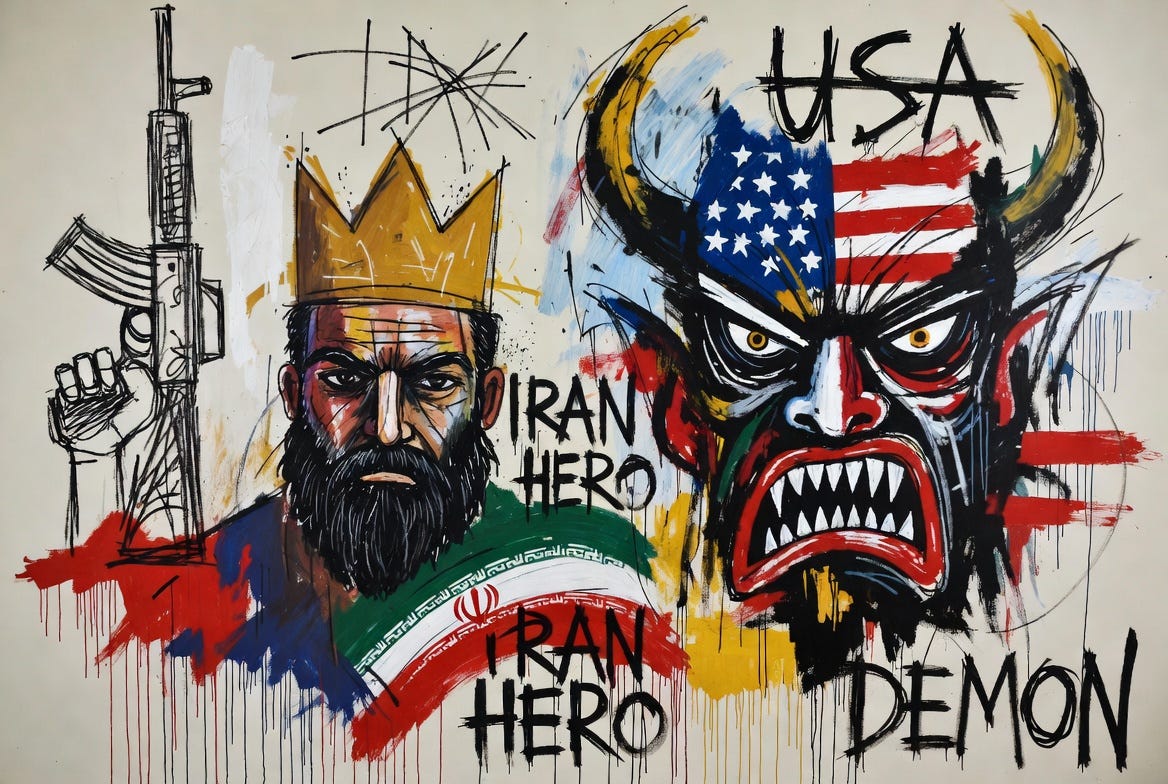
Iran and the Agony of the Unipolar World
War, hegemony, and multipolar Resistance
Alexander Dugin argues that Trump has stripped away diplomatic illusions and revealed the raw, brutal essence of American hegemony, turning the conflict with Iran into a decisive battle for the future of multipolarity.
Conversation with Alexander Dugin on the Sputnik TV program Escalation.
Host: Let us begin our discussion with Iran. Breaking news has just come in from the Islamic Republic’s Foreign Ministry: its official spokesperson, Esmaeil Baghaei, stated that Tehran has already formulated its response to the proposals from international mediators regarding a ceasefire.
At the same time, we are observing a parallel process: Donald Trump’s ultimatum, whose deadline expires today, April 6. In his usual style, the American president is threatening Iran with having to live “in hell” if it does not agree to a deal and reopen the Strait of Hormuz.
What is actually happening right now on the diplomatic front between Washington and Tehran? After all, only recently the Iranian side insisted that no negotiations were taking place, and today we’re seeing clear signs of movement and discussion of a possible framework agreement, reportedly prepared with mediation from Pakistan and China. How do you assess this situation?
Alexander Dugin: There is so much disinformation surrounding this war that it is extremely difficult to rely on anyone’s statements. We see negotiators being killed in the very course of the process, and any agreements are violated immediately. There is a sense that with Israel and the United States it is equally difficult both to conduct negotiations and to refrain from them—perhaps the former is even more dangerous. I think the Iranians have already learned this.
The fact that Trump went so far as to post an obscene message on Western Easter clearly shows whom they are dealing with. On the day when Catholics were celebrating the Resurrection of Christ, the U.S. president wrote that the coming Tuesday would be a day of destruction for all of Iran’s bridges and energy systems. I quote: “You’ve never seen what’s going to happen on Tuesday.” This is followed by a profane demand to open the strait and a direct threat: “You crazy bastards will live in hell.” And the final, utterly blasphemous note: “Praise be to Allah. President DONALD J. TRUMP.”
This is a literal quotation from his post on Truth Social. Even many American analysts saw in this signs of a rapidly developing clinical condition: no U.S. president in history has ever allowed himself to speak this way either to enemies or to allies. It shows complete disregard both for his own religion and for the feelings of others.
We are confronted with unprecedented diplomatic conditions. There are no longer any obligations, red lines, rules, or norms. What we are dealing with is harsh, crude, and utterly infernal aggression, where no word carries any weight.
Some might say that something extraordinary is taking place, whereas I would argue that there is nothing fundamentally new here. If we look at how the United States behaved under previous presidents, they expressed themselves diplomatically, politely, observed etiquette and norms. Of course, the current behavior is unprecedented: some kind of “animal” now occupies the White House. But it is important to emphasize that Americans have always behaved this way. The presentation was different; the essence remained the same.
The West, led by the United States, has always sought to strengthen its hegemony, and when that hegemony began to slip away, it preserved it by any means: demonizing opponents, relying on brute force, and justifying this afterward with false arguments. Trump has introduced nothing essentially new into American policy. He has simply discarded the “humanitarian veil,” the diplomatic camouflage. His methods, ultimatums, and negotiating style are no different from those of his predecessors, whether on the right or the left.
Trump is engaged in a kind of political pornography: he tears away all coverings and says, “Look, this is how things really are—coarse and brutal.” Some like this, others do not, but we have shifted into a blunt, street-level language of international relations. At the same time, the substance of Western policy has remained unchanged.
We had hoped that Trump would change this course, that he would focus on America’s internal problems. But he did not. Internal problems are mounting rapidly; nothing has improved—everything has only become worse. In foreign policy, there are no changes either, except for one: the manner in which actions are presented and, if you will, a peculiar, frightening honesty.
Trump is the embodiment of the aggressor’s “honesty.” He speaks directly: “I will kill you like dogs. Whether you are guilty or not does not matter—I will destroy everything. I will crush you, trample you underfoot. I will control your oil and appoint your leaders. You are nothing, you are my slaves, and if you resist, then you are rebellious slaves.” He behaves this way with everyone—but in fact, this is how all American presidents of recent decades have behaved. I repeat: the form has changed radically, but the essence has not changed one bit.
And this is the most dangerous thing: Trump has not become something fundamentally new in American history. He continues the same aggressive, hegemonic, rigidly unipolar policy as his predecessors—he simply packages it differently. Hence tomorrow’s ultimatum to Iran. Does Trump truly intend to destroy the country’s entire energy system? We know that the Americans have a certain superiority in the air; the extent of their control is significant. We can expect ground operations on islands and massive bombardments.
I believe that very little now depends on negotiations. The Iranians will not acknowledge defeat and will not capitulate before the brute force of a bloody aggressor—they simply cannot do so by their very nature. Most likely, they will advance their own “vigorous Shiite project.” Shiites have often lost in material terms throughout history, yet they have survived under horrific conditions for centuries as a persecuted minority.
For them, they are shaped by the ethic of Karbala: a readiness to accept earthly defeat for the sake of a great spiritual victory, like the early Christian martyrs. This is a particular culture of sacrifice and endurance. And when Trump attacks this society with such open cruelty, he receives in response not fear, but the utmost consolidation and courage. The heroic Iranian people today stand united against pure, unalloyed evil coming from the West.
Host: On the day of Western Christian Easter, such messages appear especially symbolic and ominous. Let us return to your thesis that Trump has merely cast aside politeness and begun to speak “more honestly,” while remaining within the familiar pattern of American imperial policy.
But does it not seem to you that such bluntness drastically reduces his room for maneuver? After all, this kind of “candor” in diplomacy could alienate even those U.S. partners who for decades tolerated Washington’s hegemony so long as it was wrapped in the softer rhetoric of his predecessors. Is Trump not pushing himself into isolation, depriving himself of the ability to use the “soft power” that other presidents wielded so skillfully?
Alexander Dugin: Yes, absolutely. This manner alienates many people and creates a strong wave of opposition. This applies both to Democrats and to a significant portion of his former supporters from the MAGA movement, who sincerely believed his promises of a return to traditional values and a rejection of aggressive wars. Today, Trump is turning away a vast number of people—from ordinary Americans and Europeans to the globalists themselves.
Moreover, look at what the ideologues of neoconservatism—the very same Kristol and Kagan—are saying online. In essence, Trump is now embodying their own program: open, unapologetic U.S. hegemony in its harshest form. After all, they always wanted war with Iran, pressure on Russia, a reduced role for European NATO partners, and aggression in the Pacific region. Yet even these theorists of the “iron fist” recoil in horror at how Trump is carrying it out. They say: “We wanted this, but the wild and crude manner in which it is being executed discredits our own plans.”
It is striking: even those who formulated the current agenda of the White House do not accept the savagery with which it is being implemented. I often ask myself: why is that? If he behaved just a bit more carefully, calmly, and simply more decently—at least within the bounds of minimal diplomatic protocol—he could avoid a great many problems within his own camp, among those who stand on the same side of the barricades as he does.
Why does he not do this? I think the reason lies solely in a shortage of time. Trump is striving to complete a certain global program by 2028, ignoring any obstacles. In essence, he adheres to a policy of accelerationism—a philosophical and political theory of artificially accelerating historical and social time. He simply pays no attention to details, goes all in, charges forward with eyes shut toward the realization of his objectives, regardless of the colossal opposition from all sides.
But what are these objectives? Gradually, a clear and coherent logic begins to take shape in Trump’s behavior—monstrous though it may be.
The first point is the restoration of the United States’ weakened influence in the Western Hemisphere. We see this in the pressure on Venezuela and Cuba, in the intense confrontation with Mexico and Colombia. Trump wants to establish direct control over Latin America in the spirit of a renewed Monroe Doctrine, which they have openly declared in their new national security concept.
The second point is the restoration of total control over the Middle East through its proxy, Israel. It can be debated at length who the true initiator is—Washington or Tel Aviv—but the objective is clear: to destroy the main poles of sovereignty in the Islamic world. The number one target here is Iran. And next in line is Turkey. A war with it is effectively already built into their plans for the next stage.
Next (we skip the third point—you’ll see why): the fourth goal of Trump’s presidency in this framework is an inevitable war with China in the Pacific region. Beijing is his most fundamental competitor. Trump’s plan is simple and terrifying: to win all the preceding smaller wars in order to unleash a full-scale strategic war against China by the end of his term.
And here arises that very missing third point: what is to be done about Russia? After all, Russia is also one of the most powerful poles of the multipolar world. And here Trump diverges fundamentally from the globalists. Trump believes that Russia, in itself, is not a fatal problem for him. He hopes that Moscow will ultimately accept U.S. terms—for example, open its airspace to American missiles directed over the North Pole against China, and refrain from interfering in the final stage of global reordering.
If Russia shows resistance, they plan to pressure it from the European side: to provoke a military escalation around Kaliningrad or intensify strikes on energy infrastructure and ports. We already see such attacks, which are clearly backed by American operators. Trump believes that we can be forced into vassal status, mistakenly interpreting our willingness to negotiate as weakness and capitulation. If Russia does not yield, it will be further pressured—but for him this is not an end in itself, only the removal of an obstacle.
For the globalists and liberals, by contrast, Russia appears as the most dangerous opponent, one that must be destroyed first. This is their key difference. Therefore, at the third stage, Trump does not want to expend unnecessary effort: he does not make grand gestures in support of Ukraine, believing that we will be dealt with anyway. For him, the main target is China.
If we combine all four points, we see a strategy of radically preserving a unipolar world through the destruction of the poles of sovereignty: Russia, Iran, and China. The main blows are aimed at our prestige and independence, because the Americans understand that if we endure and grow stronger, the rest of the world will follow us.
And here, behind what appears to be Trump’s erratic behavior, a clear and coherent logic emerges. This is a total war against the multipolar world, a struggle to preserve Western hegemony through the sequential—precisely sequential—destruction of opponents. Each next actor in line is given a false promise that it will not be affected. First they say: “Do not interfere in Venezuela and Cuba.” Then: “We will deal with Iran; this does not concern you.” Then: “We will subdue Russia, and you, China, wait—we respect you.”
The strategy is simple: once we, one way or another, cease to represent a sovereign force and assert our sovereignty, Washington will turn its full force against China. This is a rational policy, albeit one expressed in hysterical, harsh terms, with a brutal, inhuman character and infernal aggression. What stands before us is a plan—a strategy that may be backed by an even deeper state than the one Trump promised to fight.
Trump himself, with his accelerationism and his particular manner, proves to be merely an instrument of the monstrous agony of the unipolar world. And this agony is extremely dangerous. Many of us believed that Western dominance was already in the past and that multipolarity was an accomplished fact. But it seems we were just as premature as Francis Fukuyama was with his “end of history.”
The multipolar world has not yet arrived—the struggle for it is happening now. If we endure and prevail, humanity will win the right to a multipolar future. But we must be clear-eyed: in this battle, we also have a chance of losing.
Host: A question from our listener, “Alexander, how do you assess the likelihood that Donald Trump might use nuclear weapons in the conflict with Iran? And what exactly did the U.S. president mean when he promised Tehran ‘a real hell’”?
Alexander Dugin: I do not think that Trump is currently directly threatening Iran with nuclear weapons, although their use cannot be ruled out. While we have only spoken about readiness for nuclear tests, the United States has already begun conducting them—this once again shows how rapidly they are implementing their policy. Both Washington and Israel are technically capable of such a step, but for now, “hell for Iran,” in Trump’s understanding, takes a different form.
What this primarily refers to is the total destruction of Iran’s industrial and logistical infrastructure: bridges, transport hubs, and energy facilities. This implies massive bombardments, missile strikes from all sides, and, most likely, the beginning of a ground operation aimed at forcing open the Strait of Hormuz.
However, the question of the use of nuclear weapons remains open. If events do not unfold according to the American scenario, then at the next stage of escalation—and the intensity continues to rise—the nuclear arsenal may be brought into play. I do not think this will happen tomorrow, but the threshold for using force has been dangerously lowered.
Host: Another question concerns the capacity of the United States to sustain a prolonged conflict. Many experts and analysts are already calculating the cost of the current operation: according to some reports, in the first few days alone, spending on munitions has exceeded five and a half billion dollars. There are claims that stockpiles of certain types of missiles—such as Patriot interceptors and precision-guided munitions—are being depleted faster than the defense industry can replenish them.
How prepared is America, in reality, for a long, exhausting war if the diplomatic track fails and Iran does not respond to Trump’s ultimatum? Does Washington have sufficient resources to sustain such a pace of escalation without undermining its combat readiness in other regions?
Alexander Dugin: In my view, America is technically prepared for a long war—perhaps even longer than many of us assume. Despite the “fog of war,” the United States retains vast resources for conducting a large-scale and prolonged conflict with Iran. However, such a strategy will inevitably bring serious political consequences within the United States itself.
We see how the number of Trump’s opponents is rapidly growing. For him, a prolonged war represents a major risk, especially given the approaching midterm elections for Congress, which will take place this fall on November 3. Any prolongation of hostilities will work against him domestically. Therefore, Washington’s technical readiness for a long war is one thing, while its political stability under such conditions is quite another.
Host: We have discussed in detail Donald Trump’s global strategy for his current term. And here is what is notable: right now, in the midst of a large-scale conflict in the Middle East, we are witnessing an unprecedented shake-up of the top U.S. command structure.
Why is Trump taking such a risk and changing horses in midstream during a war with Iran? Is this part of that same plan to dismantle the “deep state,” or is there another, purely military necessity behind it?
Alexander Dugin: Within the U.S. leadership, especially in the military sphere, Trump has a vast number of opponents who disagree both with what he is doing and with how he is doing it. Among the military, more balanced and composed figures tend to prevail. But when Trump renamed the Department of Defense as the Department of War and appointed Pete Hegseth—a radical Christian Zionist, a fanatic with a skinhead-like ideology—as head of the department, career American generals were deeply alarmed.
These people have been through many wars; they are not soft, they are globalists and supporters of American imperialism, yet even they saw that nothing like this had ever happened before. Even Joe Kent, the former head of the Counterterrorism Department who personally participated in U.S. operations in the Middle East, reacted with outrage. Neither he nor the dismissed multi-starred generals are opponents of American power. On the contrary, they believe that Trump’s actions are undermining that power.
Here we see the same situation as with the neoconservatives we discussed earlier in the program. Trump is carrying out their program, yet the theorists themselves watch in horror at the methods of its execution. He seeks to strengthen hegemony, while the military—who have devoted their lives to serving that hegemony—are appalled by the methods and the results. This view is widespread. It is also important that among those dismissed was the head of the chaplain corps: what is happening in the White House today is a full-blown frenzy of so-called evangelicals.
This is a group of extreme Protestant fundamentalists, mainly Baptists and Calvinists, who are convinced that we are living in the end times. For them, the battles and military actions around Israel signify the Second Coming of the one they call Christ. Of course, this has nothing to do with our Lord Jesus Christ, but they use the same name. In their model, this “Protestant Jesus” is supposed to arrive almost in flying saucers to save the “born again.”
In this dispensationalist worldview, the main enemies are declared to be Iranians, Muslims, and Russians. In the White House, they are now conducting outright rituals: speaking in tongues, shouting incomprehensible phrases, frantically blessing Trump and calling him a new messiah. Traditional Christians—above all Catholics, but also more rational and measured Protestants—are horrified by what is happening in the corridors of power and in the new “Department of War.”
In place of the previous functionaries, overt maniacs and possessed fanatics are emerging, who shriek and writhe in hysteria. They shamelessly flatter Trump, deify him, and call him the second incarnation of God. This is no longer politics, and not even religion in the usual sense—it is a kind of dark, ecstatic force that has seized control of the world’s most powerful state.
And of course, in this situation, Pete Hegseth is trying to bring this frenzied, pseudo-religious eschatology directly into the American military. This runs counter to the logic and mindset of career officers, who completely reject it. That is why the head of the chaplain corps, Major General William “Bill” Green, has been dismissed, along with combat generals, including Chief of Staff Randy George. They disagree with Trump, but for him this is part of his own logic.
Previously, he hosted a show in which, after each segment, he could dance around waving chicken drumsticks. But today, when we say that clowns rule the world, these are no longer merely bloody comedians like Zelensky. We are now dealing with figures far more terrifying. After performing in his “Trump show”—this cheap and repulsive parody of The Muppet Show—Trump would usually end each episode with the phrase: “You are fired.” And he would indeed dismiss an employee of his corporation. That was the climax: “You’re fired—get out!” It did not matter that you had served faithfully and done everything required.
Now he has brought this show into the White House. If something displeases him—“You are fired.” That is how he treated Attorney General Pamela Bondi, who had been his loyal lawyer, covering up his scandals and lying relentlessly, provoking widespread hatred. Recently, he told her: “You’re fired, ma’am.” In other words: get out. He treated Kristi Noem the same way, and he acts likewise with combat generals. For him, this is simply an extension of the television screen, where real people and the fate of entire countries are nothing more than props for his endless show.
Alexander Dugin: For Trump, kicking someone out the door isn’t just a gesture; he doesn’t even need a reason. You can be endlessly loyal to him, you can grovel before him and fulfill his every whim, but the moment something shifts in his mind, he delivers his trademark line: “You’re fired.” That is exactly how he is now treating combat generals in the midst of the Iranian campaign, triggering a growing wave of resentment within the military.
At the same time, however, the logic we spoke about earlier is becoming increasingly clear. It seems that the real situation in the West is far more dire than we imagine. They are, in fact, hanging by a thread. If the global governing structures have handed power to a man who acts in this manner—swiftly, charging ahead, disregarding all decorum—then they simply have no other choice. There is no longer time for liberal illusions, for humanitarian façades, or for talk of human rights. Trump no longer even pays lip service to such things. Everything now comes down to one thing: “Destroy everything in our path, because our power has been shaken, and we must hold on to it.”
The real forces that govern the West have decided that this is precisely the kind of instrument they need at this moment. Later, Trump will be blamed for everything and accused of every possible sin. If he himself has not already passed from this world by then, he and his entourage—these corrupt sadists like Kushner, Witkoff, and others with thoroughly compromised reputations—will be dragged through courts and prisons. His entire retinue will be subjected to massive, demonstrative punishment. But the task will have been completed: using them, they will attempt to cement a collapsing hegemony.
And in this, in my view, lies the only rational explanation for what we are witnessing. These brutal, humiliating dismissals even of the most loyal associates—this is his default mode. He does not simply fire people; he seeks to trample and humiliate them. We saw how he threw out Pamela Bondi, who had been his shadow and shield; we saw how he treated Kristi Noem. This is also how he deals with Europeans: for him, they are not allies, but slaves, whom he doesn’t even bother to encourage.
For now, Trump tries to avoid Russia and China in terms of such direct personal insults, but it is clear that he could lash out at any moment. For him, this is no problem. And there is a certain logic in this: apparently, by no other means than such blunt, accelerated, and extremely aggressive hegemony can the West preserve its unipolar order.
They simply do not have time to create illusions, to maintain politeness with “noble vassals.” There is no time for liberalism, human rights, and other pseudo-values that once served as a cover for the same harsh dictatorship. The global forces have chosen a man capable of carrying out this dirty, unpopular mission—for humanity as a whole and for American society itself—as quickly and ruthlessly as possible. Trump’s true mission, long concealed behind the glitter of his showmanship, is becoming ever clearer: it is a final, desperate attempt to keep the world under a single master’s control.
Today, I even published a post about my conversation with Tucker Carlson, which took place exactly two years ago. At that time, Trump’s full election campaign had not yet even begun, and we assumed that his main opponent would be Biden. We discussed the future with Tucker, and he admitted that what he feared most was the influence of the neoconservatives on Trump.
When we turned to the prospects of a multipolar world, Tucker paused for a moment and said: “I think Trump will not accept multipolarity.” At that time, Carlson still supported him, seeing in him a defender of traditional values and an opponent of liberalism. Incidentally, Tucker has a very negative view of Ukrainian nationalism and hoped that Trump would shift the U.S. position in our favor. Nevertheless, on the question of multipolarity, he already had his doubts.
Today, Tucker Carlson is in open opposition to Trump within the United States, even though he was one of those who helped bring him to power. Now Tucker openly says that he did not realize who Trump would turn out to be. He believed in him, shared his ideas, but Trump betrayed the MAGA movement and his supporters. Many of them are now in opposition, although Tucker is still occasionally invited to the White House despite his criticism.
Even then, Carlson foresaw that Trump would have problems with the multipolar world. And yet multipolarity is the only form of a truly just world order and the only way to put an end to Western hegemony. Most of those who initially supported Trump agreed with this: they only wanted America to take a worthy place in this new world. But at a certain point, Trump declared war on multipolarity. And this is no longer a lie, not an accidental gesture, and not a nervous outburst. This is the core of his policy—a ruthless struggle against the multipolar world.
How might this end? Either Trump will inflict critical damage on multipolarity, pushing this process back by decades—such a scenario cannot be ruled out, given his extreme aggression. Or, on the contrary, his extremely harsh actions will accelerate the collapse of Western hegemony, generating chaos and division within NATO, potentially even leading to civil war within the United States itself. The stakes have been raised to the limit: Trump has put everything on the line, forcing us, the supporters of the multipolar world, to do the same. In this game, it is impossible to remain on the sidelines—those who do not participate simply allow others to make decisions for them.
Trump is going all in to preserve U.S. hegemony at any cost. And we have no choice but to accept this logic of escalation. There is no way to evade it. Much is said now about negotiations, but can the Iranians—a great and proud people with a millennia-long history of the Achaemenid and Sassanian empires—really accept the role of “miserable slaves” that Trump assigns to them? I cannot imagine it. Even a small nation would not tolerate such a tone, let alone a great civilization.
Trump does not need negotiations. His ultimatum to Iran is a clear warning to China and to us: “This is what will happen to you if you dare to resist.” This is a direct war against us, and we cannot remain mere observers. It is impossible to pretend that nothing is happening in Venezuela, Cuba, or the Middle East while sanctioned attacks are being carried out against our territory, and our ports and tankers are being blocked.
We are now at the third of the four stages of Trump’s plan. At the end lies war with China. Beijing hopes to delay this moment, but the Americans will strike when it suits them. Right now, Iran is what stands between China and the fate of the others, and between us and the fate of Venezuela. Trump apparently believes that we will never dare to use our nuclear arsenal, and therefore he keeps for Washington the right to decide how and when force is to be used. Either he truly does not regard us as a fatal threat, or he is skillfully pretending, postponing the final reckoning for the time being.
Host: Iran today sets an example for many: our fellow citizens sincerely admire how steadfastly Tehran is resisting enormous pressure. I would like, in conclusion, to touch on the issue of strikes on infrastructure, but now in relation to our own region.
Very recently, just days ago, an attempted terrorist attack on the TurkStream gas pipeline was prevented. And now a significant development: several countries—Russia, Turkey, Hungary, and Serbia—have agreed to create a coalition to ensure the physical security of this pipeline.
Is this not a direct response to the aggressive policy of the West and, in particular, to the methods in which the United States may be involved?
Alexander Dugin: I am convinced that this cannot be an initiative of the Ukrainians. Ukraine is merely a compliant instrument, a technical executor of American policy. It is obvious that the sabotage of the Nord Stream pipelines was in Washington’s interest. Now, against the backdrop of the blockade of the Strait of Hormuz, the United States is trying to create a situation in which Russia will not be able to benefit from a sharp rise in energy prices. Strikes on our infrastructure and ports are a direct initiative of the United States.
As for the coalition to protect TurkStream, with all due respect to its participants, we need to understand how limited their sovereignty is. If the Americans decide to blow up this pipeline, they will do so without paying any attention to the protective alliances of semi-vassal European states. In an extreme case, they will simply replace the governments there if those governments prove too persistent.
The situation is critical. It is one thing to fight Ukraine or even the European Union, and quite another to confront the United States, which stands behind them. Although it may seem that Washington is reluctant to enter into direct conflict, all fundamental decisions are made there. Under Trump, only the façade has changed; the essence remains the same: rigid, uncompromising hegemony.
We must recognize the radical nature of this moment. And Iran truly offers an example worth following. Today, humanity faces a stark choice: either you are Iran—that is, resistance—or you are Hitler in a new form of American and Israeli Nazism, which the world is now confronting in full measure.
There is no third path in this escalation.
(Translated from the Russian)


“We are Iran.” We are Iran.
Exactly how I see it - a 75 year old Armenian Muslim revert who has studied and observed American politics and international affairs since the early 60s. Thank you Dr. Dugin.