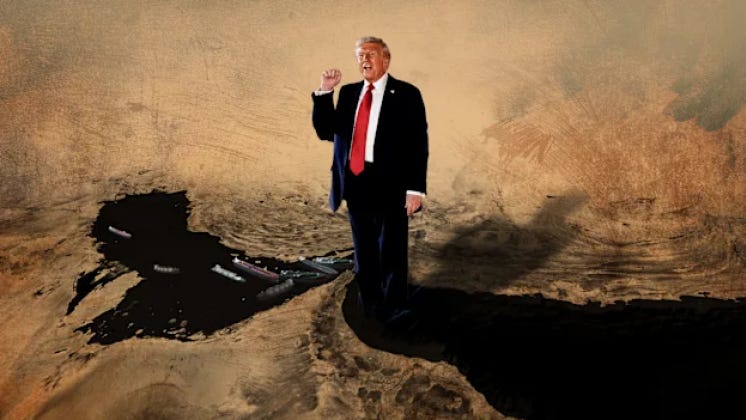
How Iran Won the War Against Israel and America
The new Middle East reality
Alexander Dugin explains how Iran has emerged victorious in its war against Israel and the United States, and why this dramatic shift creates a unique window of opportunity for Russia to launch a decisive offensive and finally win in Ukraine.
Conversation with Alexander Dugin on the Sputnik TV program Escalation.
Host: In the first part of the program, I’d like to discuss what are commonly called “strikes of retribution” on military targets in Kiev. The Defense Ministry has published a list of the targets that were hit. As has often been the case lately, there is also a significant amount of photo and video evidence of these strikes: what was hit, where, how, and the results. There has already been an international reaction. The most important thing now is to highlight what stands out, what deserves attention, and whether these strikes are already what a significant portion of people are writing about, demanding, wanting, and hoping for. How should we view all of this?
Alexander Dugin: In my view, these are very positive shifts and welcome changes.
The fact is that from the very beginning of the special military operation, attentive people — and a very large part of our people, who, to be honest, are far wiser than is commonly believed, understand world processes much more deeply, and have a more nuanced grasp of both international and domestic politics... I want to say that our people are intelligent. They have their own distinctive way of expressing how they see the world, but on all essential matters, the Russian person understands very well.
Dostoevsky expressed this nicely in The Gambler: there are peoples who, if you flick them on the nose, become terribly offended, yet fail to notice a deeper, spiritual injury. Russians are the opposite. You can flick them on the nose and they won’t pay much attention, but when it comes to conscience, truth, depth, and reality, the Russian person understands it profoundly.
That’s why, when the special military operation began, our people — not just individual experts, but the nation itself — understood that this was serious. This was war. It was a war with the West, a war of civilizations, a war for Russia’s very existence. And that’s why people went to fight. They went to the front lines first and foremost because they realized this, felt it with their deep Russian consciousness, and understood in their hearts that the matter was grave. This wasn’t some technical event or operation that could be left entirely to the state; people needed to get involved. It was a people’s war, a serious war.
And that’s essentially how the people have thought about it for more than four years now — as a war, not as some technical cleanup operation against certain terrorist formations (which is what modern Ukraine is), but as something far more substantial and vital to our entire historical destiny. That’s why, for a long time, the people’s will for a serious response has been steadily growing. With this will, and with this bewilderment if you will, the people initially waited in silence, calmly.
The late Vladlen Tatarsky, who was killed by terrorists, used to say: “I have a feeling that we’re about to really let them have it.” For a long time, that feeling remained just an expectation. Vladlen is no longer with us, but the Russian people’s sense that we will finally start fighting properly, that we will deliver a real response — it has only grown stronger.
The authorities, for their own very deep reasons (I won’t presume to judge them here), up to a certain point made it clear that we hadn’t really started yet, that we were still just warming up.
A great deal of time has passed. Naturally, we have suffered many losses and a great deal of suffering; we have endured and borne much. So many families, so many cities, so many loved ones we have lost. And yet the feeling remained that, on the whole, there had been no proper response. In society, a deep inner discontent began to grow: when will we finally start fighting in earnest?
I think that with this delay, this postponement, these hopes placed in Trump, in a ceasefire, or in the idea that the enemy would simply get tired and collapse on its own, we have reached a critical point. We can no longer drag this out any further. It seems to me that we are beginning to realize that we can no longer postpone full-scale action. We cannot simply respond to the enemy’s latest terrorist provocation with symmetrical strikes. We must act on a large scale, methodically, every day — destroying the enemy’s main centers of resistance and striking everywhere we can reach, against strategically important and symbolic targets.
This is what our society demands: do not stop the process, do not negotiate on unfavorable terms, do not fall for false ceasefires. We need to act with full force. Are we beginning to do so? I think yes. The authorities understand that further delay on decisive steps is impossible, or it will lead to negative consequences for us. It is clear that we are strong, that we are a vast country with many trump cards, but it is time to play them. Otherwise, the model of terrorist warfare against us will continue to give the enemy new opportunities. They manage to achieve some things, even though they are weaker and more immoral. But they do achieve them! And something must be done about that.
The enemy must not be allowed to achieve anything. There must be no remaining capabilities or structures capable of issuing orders for new attacks on Russian territory, including Novorossiya. Their communications must not work, their transport must not function, nothing that sustains their war machine must operate. This is what serious, deep, genuine action looks like — and it seems to me that we are obliged to pursue it. This decisive phase is, in essence, only just beginning to unfold.
But are our more resolute attacks on the enemy the start of this process? God willing. It’s possible. However, if we think that demonstrations with the “Oreshnik” missile without a special warhead, or a few hypersonic missiles that the enemy’s air defenses truly cannot intercept, are enough, then we are mistaken.
There is a military term — “intimidation” — which means instilling in the opponent the firm conviction that we so overwhelmingly surpass him in strength and power that any resistance is utterly futile. This is not mere intimidation; it is the deliberate destruction of the enemy’s will to fight through the demonstration of overwhelming might. We must begin to engage in this kind of intimidation systematically.
And most importantly, our actions must cease to be reactive. When we constantly say “this is for that” and “this is for the other thing,” it only causes bewilderment among our own people. It is time to stop making excuses. This approach shows a misunderstanding of the psychology of both our own people and our enemy. The opponent doesn’t care about our explanations, and in the West the entire narrative is built on the idea that Russia is absolute evil. Since that’s what they believe, our task is to win — and we can explain our reasons later.
What matters now is not what they did, but what we will do to completely deprive the opponent of the potential to resist and to inflict damage on him that is incommensurate with his continued military-political existence. And that, after all, was the original goal of the special military operation. If those goals could not be achieved through the previous technical methods, then the approach itself must change — we must raise the status of our actions to the full conduct of war. War in the literal sense of the word against the collective West on Ukrainian territory.
All attempts to postpone this issue, all expectations that the situation in the world would somehow change on its own and automatically put us in the position of victors, have not been justified. There is nothing left to wait for. I hope that we are cautiously beginning this turn. We must support the army and participate in this process with all our strength, because this war is our common cause. It is being fought everywhere: at the front, in the economy, in politics, in culture, and in education. We must engage in this struggle at all levels.
Host: Allow me a small clarification — or rather, not so much a clarification as a suggestion, something to throw into the discussion.
Russia has been living under very serious social and informational pressure for quite a long time now. And practically any thesis that resonates emotionally with the people — whether in kitchens or on the internet (and these are different spheres where one can work with this) — becomes a lever of pressure, a tool for potential influence on society and the country as a whole. To provoke in people an outburst of discontent or the desire to “finally start” — isn’t this, in essence, an attempt to drive a wedge between what a person is repeating in his head and the actual plans of Russia’s military and political leadership? Isn’t it dangerous to view everything solely from the standpoint that the majority has finally decided, that the majority has matured and made up its mind?
Alexander Dugin: The majority matured long ago and made its decision long ago. We have no other option except victory. We wanted to win wearing white gloves, with surgical, pinpoint strikes, trying not to cause any collateral damage — we failed at that. And therefore the majority understands that victory must now be achieved by different means.
Of course, there is a certain discontent in the country with the indecisiveness in the conduct of hostilities on the part of the authorities. That is a fact. And naturally, Western technologies, social engineering, and attempts to manipulate this discontent and radicalize the process are being layered onto this objectively rising wave of misunderstanding. This must certainly be taken into account, and allowance must be made for the special psychological operations the enemy is conducting against our society.
But when we say that a wave is rising from the people, who are dissatisfied with the lack of clear signs of victory, and that this is being manipulated, we forget about the other side. Is the enemy not exerting the same kind of psychological, networked influence on our military-political leadership? Is he not whispering to them: “It’s okay, we’ll come to an agreement now, a ceasefire is coming,” thereby restraining them from the decisive actions they must take?
At the same time, the absence of these decisive actions is being used with the other hand to split society and to pit the growing discontent in the country against the slow pace of certain steps. It is an attack from both sides.
When we blame everything on war correspondents, on the people’s fatigue, or on the “turbo-patriots,” there is some truth to it, because the enemy skillfully manipulates these sentiments. But we are missing the second side of the process. The enemy is exerting influence not only on our society and ordinary people — the enemy is also exerting influence on our ruling elite, on the very top. And there the methodology and the arguments are completely different — the exact opposite. They are sending false signals that Western emissaries will arrive and everything will end, that Trump supposedly intends to resolve this conflict on acceptable terms. There is some basis for this; it is not pure theater. But in any case, the West is restraining the elite from decisive action, while simultaneously inflating popular discontent over the absence of these decisive actions. This is a classic operation, a classic network war — and we have been living under these conditions for more than a decade.
We lost our country because of the success, unfortunately, of forces hostile to us that stole our statehood and stole the Warsaw Pact from us — also through color revolutions and social manipulation. The technologies change, but the essence remains the same.
Therefore, in my view, what is needed now is unity between society and the state. We cannot say that the state is waging the war however it wants and however it pleases. We are all waging this war; we are all paying for it — including with our lives. The state does not have a mandate to do whatever it likes: to start a war, to end it whenever the mood strikes, after shedding so much blood beforehand. No.
Victory is a demand. It is a demand of history, a demand of the people, a demand of society, a demand of both the living and the dead. Our state is obliged to win this war. This is a matter of principle. We cannot reason in this way: if I want to, I will achieve victory; if I want to, I will conclude a ceasefire; if I want to, I will simply withdraw unilaterally. The political leadership has no such powers or such a right.
Now, while the war is going on, we know how lost or unfinished wars end. They end with this top leadership simply disappearing. This is very serious. But with it, to our great regret, the state itself and the people disappear as well. We must not go down this path; we must not make the same mistake again. The people and the authorities must now conclude a pact of victory between themselves. This is necessary. We must take the steps required to save the Fatherland and to achieve victory over this terrible enemy. Any delay, any postponement — even if justified by tactical or strategic calculations — in some cases is less important than the need to take society’s position into account. The voice of society is becoming more important than these calculations.
I do not want to cite sad examples, but they exist in our history. When the people and the authorities are united, we win. When the war becomes a people’s war, when our entire society gets involved, then we achieve victory over any opponent, even one superior to us.
But when there is no unity between the authorities and the people, we can lose even conflicts and wars that seem relatively easy to resolve. In ancient times, people believed that war was the judgment of the gods. The Hellenes believed that the outcome of a war depended on the inner state of society, and that the gods grant victory to those who are purer, more resolute, more courageous, more self-sacrificing, and more right in the highest sense. And it is this inner righteousness — not only technical preparedness, but precisely this inner righteousness — that is the core which unites the people and the authorities and constitutes the true path to victory.
We have many loose ends that have not been cleaned up. We are carrying colossal layers of alienation and hostility from the elites from our recent past, along with the penetration into our society of alien, hostile networks that are either already activated or will be activated. There are quite a few unresolved problems and issues in our society. We cannot paper them over, postpone them, or claim that everything is wonderful — even in the conditions of war. Because this war is also about that: about the purification and transformation of our people and our state.
And in general, the problem of how the people and the state relate to each other is a profound philosophical question. Someone may say that we have a purely technical solution, but that is a deliberate lie. There can be no technical solution to such a deep, historical, and fundamental question. And during war everything becomes sharper: problems are exposed, and conversely, everything that is best in the state and the people also comes to the surface.
What we need now, it seems to me, is precisely a determined effort of will. Without effort we will not be able to go further — we are unlikely to hold out by inertia alone. We must make this effort. And if we are already making it — as evidenced by certain real successes at the front and our attacks — then that is excellent. Yes, in many spheres the processes are still stuttering: movement proceeds in jerks, as if the computer freezes and then starts moving again. God grant that we are nevertheless moving in the same direction. After all, we are not retreating. Yes, it is painful for us, yes, the enemy responds very effectively, meanly, and cruelly, but let us increase the quantity, quality, and precision of our strikes. I think we have far from exhausted our potential. We are moving toward Victory, but right now we need to make this decisive step.
Host: Here is some fresh news: quite unexpectedly for European time and for Moscow, a signal has sounded that, possibly connected with Donald Trump’s birthday, Iran and the United States have both confirmed that an agreement will be reached and the deal will be signed within a few days. There are even reports about who exactly will sign it. From the American side it will be Vice President Vance, and from the Iranian side — Foreign Minister Arakchi and Parliament Speaker Ghalibaf. Various reports are being published about the details of this deal. If you read between the lines, it feels as though Iran is getting, on many points (I won’t say all, but on very many), exactly what it wanted and what it probably could hardly have counted on even at the beginning of the year. How do you assess this rather unexpected turn in U.S.-Iran relations, and more broadly not only in the Middle East region but on the planet as a whole, in connection with what will specifically happen at this point in space?
Alexander Dugin: The most sober and balanced American analysts right now — if you listen to them beyond the propaganda — acknowledge the following: Iran has won this war. Strange as it may sound, Iran has won this war. I am not even giving my own or our personal point of view here (I would be more cautious), but referring specifically to American experts who recognize this fact. Iran has won and can now dictate terms.
But if we compare how Iran describes this agreement, this deal, and how Trump himself describes it, these are simply two mutually exclusive documents.
Iran says: “We agree to certain shifts for de-escalation in the region on our terms.” And this is the Iranian version; this is what they are prepared to sign. At the same time, they do not trust the West, they will verify everything, they are keeping their mining capabilities, maintaining their armed forces and full control over the Strait of Hormuz, and now everyone will pay them. The Americans and the United Arab Emirates are unfreezing Iranian accounts. And this is precisely victory, because the winner sets the terms for ending military actions. So if they go along with these terms, it will be a consolidated Iranian victory.
At the same time, Trump is painting a completely different picture to his own population: supposedly Iran has capitulated on everything, stopped enriching uranium, unconditionally opened the Strait of Hormuz, oil will now flow freely, and everything will be wonderful. “We did not cede any positions to the Americans, we destroyed them all, we are now great,” Trump broadcasts in his aggressive, cowboy style.
In essence, on such grounds and with such diametrically opposed descriptions of what they are about to sign, it is impossible to conclude a real document. We should assume that either the Iranians or the Americans are simply lying shamelessly right now to solve their internal political tasks. And I think we will soon be convinced of this. It won’t be long before both sides can no longer maintain this “poker face.” Sooner or later these agreements will either be made public in their true form or will collapse, and humanity will see for itself: are tankers sailing through the Strait of Hormuz or not, are they exploding or not, are bombs flying or not.
But there is one moment here that seems rather serious to me: tectonic shifts within the Zionist lobby in America itself. Until recently this was an extremely powerful structure. It has turned out that this is one of the main political forces in the United States — although earlier only anti-Zionists spoke about this, and it was considered a “conspiracy theory.”
It is now obvious that Israel possesses a colossal degree of influence and a colossal lobby inside the United States, one that can force America to do things it does not want to do and that run counter to its national interests. But in recent days, after the leak to Axios of the phone conversation between Trump and Netanyahu — in which Trump, using obscene language, essentially told Netanyahu to go to hell, accusing him in the crudest terms of complete disobedience, threatening him and pressuring him — the situation has changed.
That this is true is confirmed by the reaction of Zionists close to Trump. Figures such as Lindsey Graham or Laura Loomer — the core of American pro-Trump Zionists — have suddenly fallen into despair in recent days. They say: “How can this be, this is unacceptable, Israel is good after all, Netanyahu is the best ally, you yourselves said so.” This confirms that a rift has opened between Trump and Netanyahu.
Earlier it seemed they were acting in complete unison. But Trump is clearly burdened by this war — a war that is half-lost, though certainly not won. Iran has suffered serious losses, this should not be downplayed, but it has not been broken; it is mobilized and now looks like a model for the entire Islamic world. Against this background, other Muslim countries in the region that took a passive position have largely lost face, appearing as manageable pawns. But Iran stood firm, without softening its anti-Israel position in the slightest.
At the same time, Netanyahu continues the offensive in southern Lebanon. According to the terms of the deal with Iran — and even Trump does not deny this despite the differences in versions — a ceasefire in Lebanon and the withdrawal of Israeli troops from there are a necessary part of the agreement, which Tehran insists upon. But Netanyahu does not want to do this, because he conceived the whole thing as preparation for the creation of a “Greater Israel,” and now it turns out that a compromise has been reached and Iran has not been destroyed. As a result, we are seeing complete outrage from Netanyahu’s radical allies such as Itamar Ben-Gvir and Bezalel Smotrich, who are already beginning to say: “Who the hell are the Americans anyway? Why should we listen to them?”
In other words, the main military and eschatological core of Israel is categorically dissatisfied. There is now outright anti-Trump, or at least anti-American, rhetoric emerging. Meanwhile, Trump needs to conclude this peace agreement on any terms, because the midterm elections are approaching soon. Everything will be decided there.
The unpopularity of this war in the United States is enormous. Trump has already lost many of his supporters; some are leaving his administration. And it turns out that this is in fact a hopeless, futile war with no prospects of victory. It began, of course, very brutally, but the results of this brutal attack were gradually neutralized by the heroic resistance of the Iranians. It turns out that Israel is also losing. And when one side is losing, discord and contradictions begin among the participants in the failed operation, with each trying to shift the blame onto the other. That is exactly what is happening now.
Therefore, it seems to me that in the Middle East we are dealing with Iran, which has undoubtedly won — at least morally. Iran has affirmed that it remains sovereign, that the world is multipolar (this is very important), and that it, rather than the passive Arab countries, is the true pole. This is beginning to be recognized by the Saudis, by Qatar, by Turkey, and even by the United Arab Emirates, which have suffered significantly from this war. It turns out that Iran is the moral victor.
Israel, despite its enormous ambitions and radicalism, has not achieved any major successes and is simply trying to sabotage the deal and desperately drag the United States into a major war against Iran. That is where we stand now. Today the collective West — in the person of Trump and Israel — is losing in the Middle East. This is obvious. The conflict between Washington and Tel Aviv, between Trump and Netanyahu, is growing. It may yet be contained, we shall see, but right now that is exactly how it looks.
Host: Could I ask you to elaborate a bit more on exactly this? There is already a statement from Israel’s National Security Minister Ben-Gvir, who says that you, the US and Iran, can make your deal, but Israel is not bound by your agreement in any way.
You rightly emphasized and reminded us that the pro-Israel lobby in America has reached an incredible level lately, although it should be added that America has always stood up for Israel. The US has always vetoed any UN Security Council resolutions that somehow affected Israel’s interests. And interestingly, under Republicans it has defended Israel even more fiercely than under Democrats. And here we have Trump — a Republican president.
So what happens next in this sense? Can Israel say: “Fine, you made your deal, but we will continue”? Or will the phone conversation between Trump and Netanyahu that you mentioned, along with their personal relationship, still play some role?
Alexander Dugin: You know, it probably all depends on Iran. Iran continues to insist that a ceasefire in southern Lebanon is one of the most important, indeed a necessary condition for concluding the deal with the United States. Trump neither confirms nor denies this, but he is clearly inclined to accept this line. This goes directly against Netanyahu’s interests. But Netanyahu is not all of Israel.
The pro-Israel lobby in America is incredibly powerful. Earlier, when opponents of this lobby said that it could force America to act against its own national interests, no one believed them — they were considered marginal. Now this is acknowledged by all sober, objective commentators. What was once unmentionable has become commonplace. But this pro-Israel lobby does not mean that it fully and entirely supports Netanyahu specifically. Many people in Israel itself and within this lobby do not share his position. Supporting Israel is one thing; supporting radicals who are eschatologically oriented toward building the Third Temple and creating a “Greater Israel” from sea to sea, like Ben-Gvir, Smotrich, or Netanyahu himself, is another. This is far from the entire lobby, and half of the Israeli population does not agree with such a policy.
Therefore, for Netanyahu the situation is very serious. If the war ends, he faces extremely difficult domestic political repercussions. He has only one path left — to continue this war at any cost, to sabotage any agreements, to insist that he will continue fighting independently in southern Lebanon, continue strikes on Gaza, and perhaps on Iran. The current leadership, in the person of Netanyahu, simply has no opportunity to end this war and accept this compromise agreement from the American side.
For Trump, this is not a matter of life and death. It is a matter of prestige and proof that he can influence the global economy. Previously his slogan was “drill, baby, drill,” and he claimed that America was independent of anyone. But now he has realized that this formula looks ambiguous, because Americans will have oil while others will not. And now Trump says: “Let the oil flow.” For him, restoring stability to the markets is already important. For Netanyahu, this is completely irrelevant.
So here we see a new divergence between these poles of the collective West. I think we have said in our program that there are currently five: the Trumpist United States separately, Israel separately, Britain separately. By the way, Starmer is in complete disaster there. I think the Labour Party may not win a single seat in parliament; they are being wiped out by the Conservatives and the far right, who have also formed a whole bloc there and are competing with each other. Starmer is finished in Britain, which means Britain will be taken out of the game as well.
It is hard to say what is happening in the European Union. They are still clinging to their globalist agenda. These are two more poles, as we said — the British and the European. And the globalists in the US are now clearly thinking about how to return to power after the midterm elections this autumn. But their plans are unclear too, because the collective West is wavering. And now, within this collective West, everyone is somewhat on their own.
And here a window of opportunity opens for us. Since America and Israel, even if they are not losing completely, are facing difficulties in the Middle East, and Iran is tying down their attention, they are not in a position to put maximum pressure on us with the full power of all these five or four centers. Their points of view are diverging. This conversation and our president’s congratulations to Trump on his 80th birthday are also important. The more division and disagreement there is in the camp of our enemies, the better it is for us. We can send one signal to one side, another signal to another, a third to yet another. As long as they do not all gang up on us at once. Of course this is dangerous. We must be prepared for that too, but it is a real danger.
But a window of opportunity is opening for us. Right now, it seems to me, we should use this important possibility arising from the divergence and splintering of the five centers of the collective West — to deliver a crushing blow to our enemy, to liberate Novorossiya, and to put an end to the Kiev regime. We need to act quickly here, because the situation is unique right now.
It was different before. For example, in the first days of this war in the Middle East, when Trump and Israel demonstrated strength, determination, and power, it seemed that Iran would soon fall apart from within — color revolution, Shah-style unrest, destruction of the political leadership... In such a situation, with such Western power and unity, it was of course more difficult to act in Ukraine. But now it is not. The conditions have changed, and it seems to me that now is the right time. Although the time to win is always, but by different methods and taking different factors into account. Right now there is a unique situation for Russia. The West as a whole is weakened. Of course, it is still very strong, dangerous, aggressive, cruel, inhuman, mean, and deceitful. But it already somewhat resembles agony. And that is an important sign. If this is the case, then we should certainly take advantage of it.
Host: But in exactly this sense... It’s not that I don’t believe it, but is it really possible that Trump and America are ready to back down so easily? And those points of the agreement that are now appearing in the press — about returning frozen assets to Iran, about certain investments in the country’s reconstruction — are they really true? Under what guarantees, under what reciprocal steps from Tehran, is Trump and America ready to provide all this to Iran?
Alexander Dugin: It seems to me that this is also unlikely. It all sounds like fantasy — both in the Iranian version and the American one. The Iranians will not accept the American version, and the Americans will not accept the Iranian version. Incidentally, the current situation suits Iran quite well. For them, such a radical environment is, if you like, a solution to many internal political problems. There has probably never been such consolidation of Iranian society as there is now, at least since the time of Khomeini. A very united people, ready to staunchly defend its sovereignty. And against this background — on the contrary, discord in the West. Therefore, in the Middle East, Iran is winning, and for it the conclusion of this deal is by no means a matter of life and death.
But for Trump, this is definitely a critical issue. He needs to resolve something soon. He got involved in this adventure, although everyone warned him: “Don’t do it, you will lose.” Joe Kent, for example, the head of the counterterrorism department, even resigned because of it. Tulsi Gabbard has now been removed. So Trump pushed this hard line, but there is no positive effect, only negative results. Therefore, he wants to end it. But of course he cannot simply accept the Iranian conditions — that is obvious.
On top of that, Netanyahu is constantly pouring oil on the fire, sabotaging the situation every day. In short, it continues. Therefore, I would not overestimate hopes that this conflict is exhausted. It is not — far from it.
(Translated from the Russian)


I would urge caution in believing Iran has won. Both Israel and the US are such corrupt and devious entities that I would never trust anything they say. If Iran sticks to their guns they can win, but it must never let their guard down.