

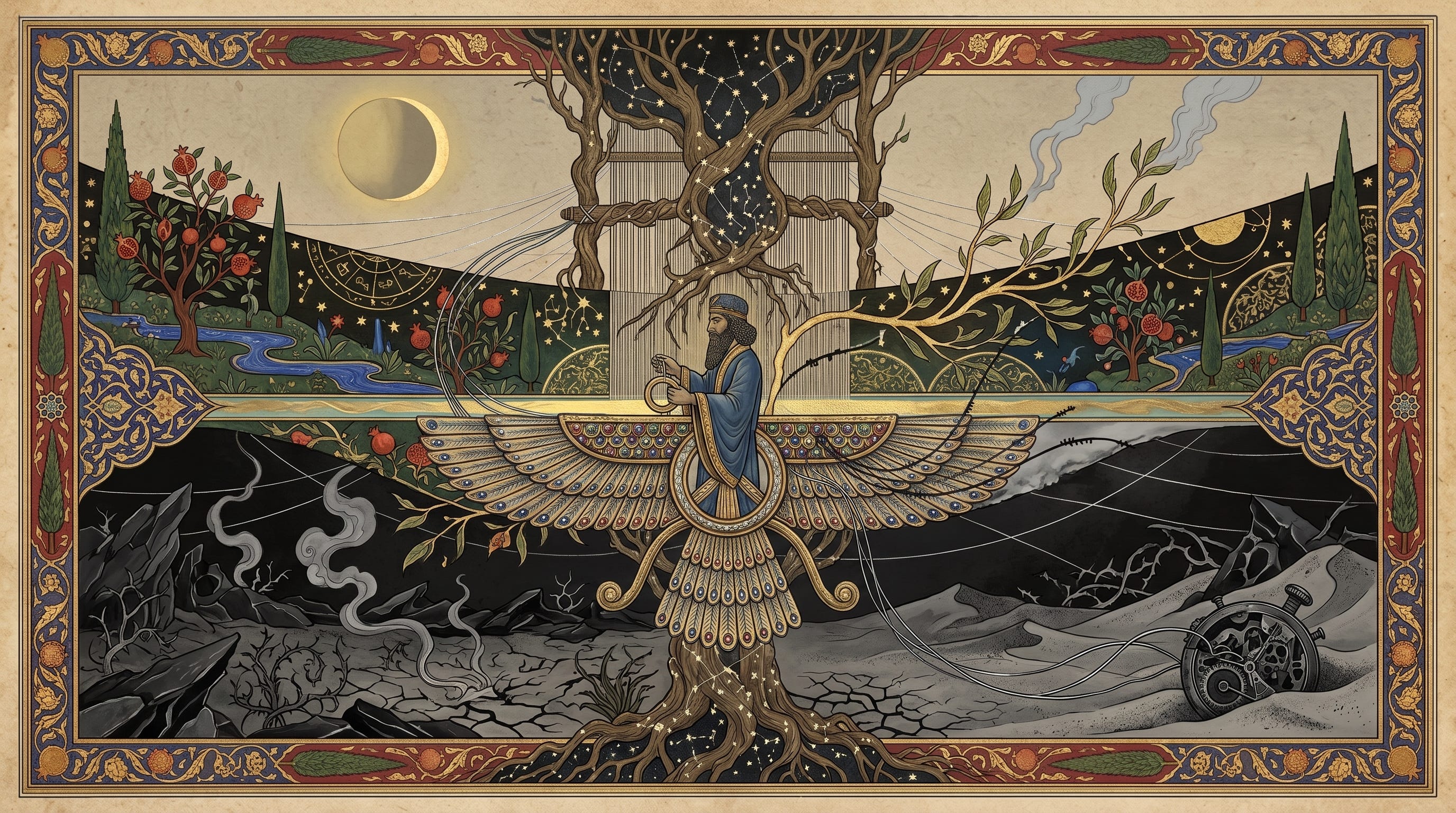
Speculum Orientis examines how the black machinery of Ahriman may turn against the American empire that now serves as its greatest vessel.
Begin with Zurvan—Time uncreated, boundless, prior to all names. The old Iranian imagination placed this single reality at the origin of all things. “Except Time, all other things are created.” Zurvan existed before heaven and earth were named. For a thousand years, Zurvan performed sacrifice, desiring a son who would fashion an ordered creation. At the end of the thousand years, at the very threshold of fulfilment, doubt fissured the god. A shadow stirred within him. Had the sacrifices been in vain? Would the son come? In that instant of division between faith and negation, twins were conceived in the womb Zurvan himself contained.
Ohrmazd, the Wise Lord, was born of the sacrifice: luminous, sweet-scented, turned toward truth and the making of the good world. Ahriman, the Destructive Spirit, was born of the doubt: dark, stinking, turned toward negation and the undoing of form. They came from the same source, but they were not equal. One sought to build; the other sought to break.
Zurvan had sworn that the kingdom would belong to whichever twin came first into his presence. Ohrmazd perceived his father’s thought in the light of wisdom and told his brother what he had seen. Ahriman, seized by Az—the raging spirit of greed, excess, and insatiable haste—would not wait. He ripped through the womb before his hour, forcing his way into the world, and presented himself to Zurvan. The god wept. When Ohrmazd was born moments later, bright and true, Zurvan recognised him at once, but the vow could not be broken. The kingdom of the world was granted to Ahriman, yet only for a measured term: nine thousand years. After that, Ohrmazd would rule as lord over all, and the broken creation would be purified.
This was the first treaty, the pact that set a limit upon destruction. Ahriman could enter the world, wound it, corrupt it, fill it with death, but he could not make his dominion eternal. The destroyer’s power, for all its violence, was placed within a boundary of Time. The most terrible force remains subject to a term it did not set.
Zurvan did not leave the compact to the honour of the destroyer. He placed in Ahriman’s hand a black and ashen implement, steeped in the substance of Az, and warned that if the spirit of darkness failed to make good his threat within the allotted years, this very weapon would turn inward and consume his own legions. That ashen tool remained sterile and inflexible, a cold apparatus of mechanical fate—the mythic image of a machine that devours what it was meant to serve. The pact was given into the custody of Mithra, lord of the treaty, guardian of boundaries, who waits in silence until the appointed hour and then renders the oath-breaker powerless.
Such is the foundational myth, serving as a diagnostic for the pathology of power when it mistakes the illusion of acceleration for true sovereignty, and the application of force for the mastery of Time.
The strait that today bears the name Hormuz—a contraction of Ahura Mazda, the Wise Lord himself—is the narrow sea passage through which the world’s energy flows. In this strait, the ancient drama reenacts itself. Within this frame, the shadow does not fall on some distant enemy; it falls across the power that now dominates the global order. The evil at issue is not the crude evil of a moral caricature; it is a structural and spiritual evil—the evil of a power whose form bears the unmistakable marks of the destructive spirit: it enters an ordered space it did not create, disrupts ancient political ecologies with immense speed, deploys a technological apparatus of unprecedented scale, and is driven by a compulsion the old texts called Az.
Ahriman is machinery. He is not a demon hiding in the shadows; he is the logic of the system itself. He is the cold light of the terminal that optimises away human presence; the invisible calculus of the drone strike that vaporises witnesses; the bureaucratic flowchart that renders the sanctity of human life into a data point on a ledger. He is the structural logic of a civilisation that has elevated technique over contemplation, and the spreadsheet over the soul.
The American imperium is not the source of this evil. It is the most complete vessel for it—the purest expression of the Ahrimanic structure that history has yet produced. American finance has become one of its purest organs: it cannot pause, cannot reflect, cannot contract without collapsing. American military doctrine has taken the same shape: it requires the instantaneous conversion of intelligence into kinetic effect, leaving no room for the organic rhythms of diplomacy or generational strategy. American technology completes the pattern: it replaces the living word with the algorithm, the family with the network, the soul with the interface.
This transcends mere moral judgment; it is a structural inevitability. A society that raises the machine to the status of a god becomes ridden by a hunger no conquest can satisfy. The black implement, the myth’s cold machine of dead causality, sets the tempo of the epoch. It dictates policy. It overrules statesmen. It accelerates towards its own terminal velocity, unable to stop because stopping would require a will, and the Ahrimanic structure has no will. It only has momentum.
Iran, by contrast, has preserved the Ohrmazdic residue. Not as a utopia, but as a civilisation that still remembers that time is organic, not linear. The Magian sees history as a field of cultivation, not an assembly line. This is why the memory of Karbala resonates so deeply here; it is the living reenactment of the first sacrifice. It teaches that a deed of truth, once planted in the soil of history, is a seed whose harvest belongs to the future—an act that the accelerationist machine, in its haste, can never comprehend.
While the American colossus must act now—its structural Ahriman demands immediate results, electoral validation, measurable outputs—Iran can wait. It absorbs. It evades. It rebuilds. It disperses its forces across allied networks that share its temporal horizon. Every American victory, measured in tonnage of explosives or number of sanctions, becomes a strategic defeat measured in years of entrenchment. This is not guerrilla warfare in the conventional sense. It is the patience of Mithra, who knows that the Ahrimanic structure, for all its terrifying efficiency, is finite. Its gears wear down. Its algorithms encounter variables they cannot process. Its speed meets the resistance of matter.
The seers of our age have long whispered of this decline: the Faustian will turning against itself, the reign of quantity over quality, the mechanical subversion of the organic. These are not merely separate grievances; they are the symptoms of a single structural trap. The Ahrimanic edifice is not the conqueror of Time; it is the slave of Time, unable to reproduce itself except through the perpetual, vampiric extraction of the living.
The black implement was never Ahriman’s own possession. It was lent under a condition. When the destroyer’s term expires—and it is expiring in this era—the ashen implement, that cold instrument of dead causality from the myth, turns inward. The machinery devours its own operators. The surveillance state turns on its architects. The financial leviathan implodes under the weight of its own compounded abstractions. Drones, grids, algorithms—the sterile, entropic machinery of Az—will one day prove more lethal to Washington than to Tehran.
Iran’s strategic orientation represents more than a preservation of form; it is a fundamental restoration—a reclamation of the primordial law of Time which the technological adversary has cast into oblivion. The competitor has constructed its vast, sterile architecture upon the delusion of its own eternity. Nevertheless, the organic alone persists; only the soul is spared from entropy. Steel surrenders to rust. The algorithm decays. The mechanical apparatus eventually finds its terminal stillness.
At Hormuz, the narrow waters present a geographical truth that the Ahrimanic structure cannot compute. The strait is a limit, an a priori boundary. Ahrimanic expansion, however total it may appear, eventually meets matter itself: The sea remains indifferent to the speed of the missile, and the current does not bow to the carrier group; against this, the Ahrimanic machine falters, for it confronts not merely the tide, but a civilization whose roots run as deep into the strait as the geography itself. Every force meets a physical boundary it cannot overwhelm, just as every empire meets a temporal boundary it cannot outrun.
Frashokereti, the Zoroastrian horizon of final renovation, is not the world’s annihilation. It is its sanctification: the purging of the structural parasite that mistook a temporary lease for an eternal dominion. Ahriman burst into creation believing his machinery could overturn the order of Time. He was wrong. He entered a realm governed by a law older than his gears.
Arsenals evolve; the banners of empire rise and dissolve into history; yet the sea remains the immutable witness. The struggle over this strait is the echo of the first sacrifice: the question of the destroyer’s measure. Time holds the reckoning, and Time answers to a higher, unyielding law. When the appointed hour strikes, Mithra shall rise, and the cold, ashen artifice—the very mask of Ahriman—will dissolve into the dust from which it was forged. The frantic motion of the machine will cease; the organic will endure.

You are a man of many talents Constantine. As I read I was fascinated by the resemblances, with minor variations, to our Christian spiritual reality. It is quite natural that the Three Kings of the New Testament were Persian, or whatever the region was called then. They are indeed becoming, and may become more, the allies of a resurgent Slavic Orthodoxy and perhaps, finally enable a resurrection of Middle Eastern Christianity as well. The Talmudo Satanists being first finally defeated.
Thank you for this brilliant piece, translated in French in a special weekly publication on the war against Iran here : https://zanzibar.substack.com/p/revue-de-presse-j189-si-vous-voulez