Will Tell explores how Highlander transforms immortality into a paradox of sexuality, sterility, and generational rebirth, revealing the stages of human life concealed within an existence beyond time.
Sex, Generations, and the Ages of Man in Highlander
There is something about Highlander that has always struck me as strange. The films are famously incoherent in the way they reveal their narratives. You get twists and turns that do not make much sense when compared with the limited information you were given beforehand. Nevertheless, certain things remain almost accidentally solid, behaving more like elements of a progressively revealed story arc. A story outside the story itself. One of them is the almost generational pattern of “emotions” that appears to govern Connor MacLeod as the audience meets him and experiences his changes over time. Nothing physical changes, of course; he is immortal. What changes are the emotional states we perceive. The audience experiences “time” even if the Highlander himself is timeless. A traditional story should not contradict itself, of course, unless you are David Lynch. But the Highlander franchise managed to contradict itself so much, it is amazing to some of us that it has fans at all. And yet it does because the contradictions people point out, in the several different versions of Connor MacLeod, found in movie to movie and in the TV series, really are not the point.
In the first film, in Madison Square Garden, we encounter a genuine beginning stage. It is not the beginning of his actual life, but a beginning from the perspective of the film’s audience. The protagonist is presented almost as a teenager. He sits silently in the dark, observing rules, confusion, and masculinity on display: bright light above ground, low light below ground. This contrasts with the notion of an “eternal return,” as though Connor is seeing a forgotten past in the contest between these men. It calls to mind the temporal dislocation of Mark Twain’s A Connecticut Yankee in King Arthur’s Court. Connor appears not so much to be remembering his past as future-dreaming his way toward a higher, lost, and forgotten state. This is very much the position of the powerless teenager.
It resembles the adolescent discovery that the adult world presented to children is partly spectacle. Beneath its games, costumes, and official rules lie real competition, sexuality, danger, and death. Connor does not merely leave the wrestling match; he descends into the hidden world beneath ordinary consciousness. It therefore makes sense that this is followed by a duel in the darkness, where he fights and beheads Iman Fasil and experiences the Quickening. This might appear vulgar and irreligious to some, but I see something even more primordial and distinctly pre-Christian in the concept of the Quickening, something at which modern readers, both from the Left and the Right, may cringe: it strikes me as a sexual experience.
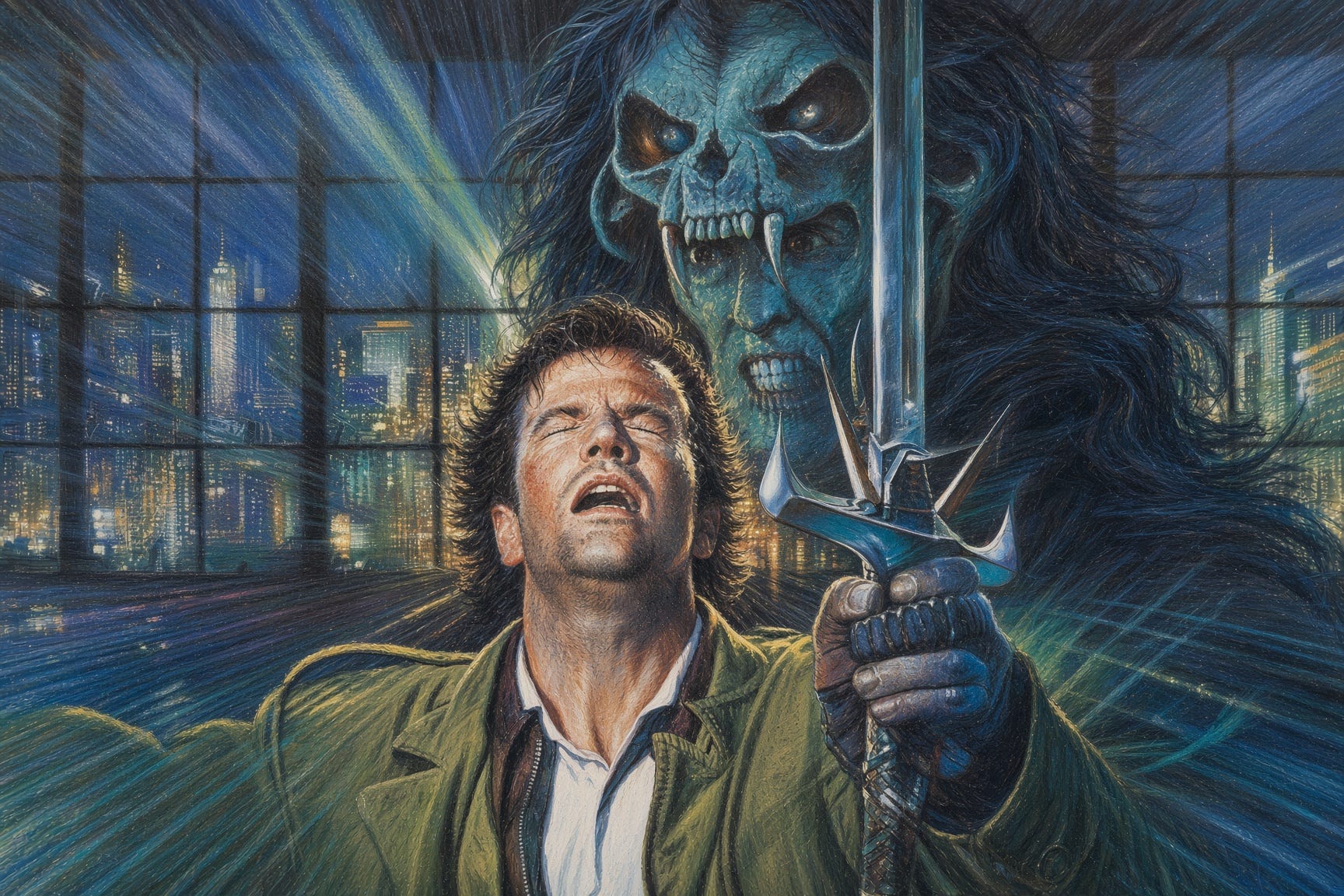
The Quickening is filmed like an overwhelming climax. Energy enters and possesses the victor’s body. He convulses, cries out, loses ordinary bodily control, and becomes the centre of an explosive electrical discharge. The environment itself appears to participate: lights burst, glass breaks, metal twists, water falls, and the entire enclosed space seems unable to contain what has been released. It is pleasure and pain, penetration and discharge, union and destruction compressed into a single event. Yet it produces no child. It is sexual energy cut loose from biological generation. The thing that makes this interesting to me is the contrast between the suffering of ordinary men and what a “superman” might suffer. A superman might well feel cut off from ordinary generations.
The term “Quickening” makes this reproductive interpretation considerably stronger. In its traditional obstetric meaning, the quickening is the moment when a pregnant woman first feels the movement of the fetus within her womb, the first subjectively perceptible sign that another life is moving inside her. Historically, it could also be treated as the moment at which the unborn child has become animated or “ensouled.” The term chosen for the immortals’ transfer of power is therefore not merely a generic word for acceleration or excitement. It is an old word for life announcing itself within the body. The immortal Quickening becomes a fetal movement without a fetus, a pregnancy without a child, and a birth-force that produces no genuinely new being. Life is felt to begin, but only because another life has been consumed.
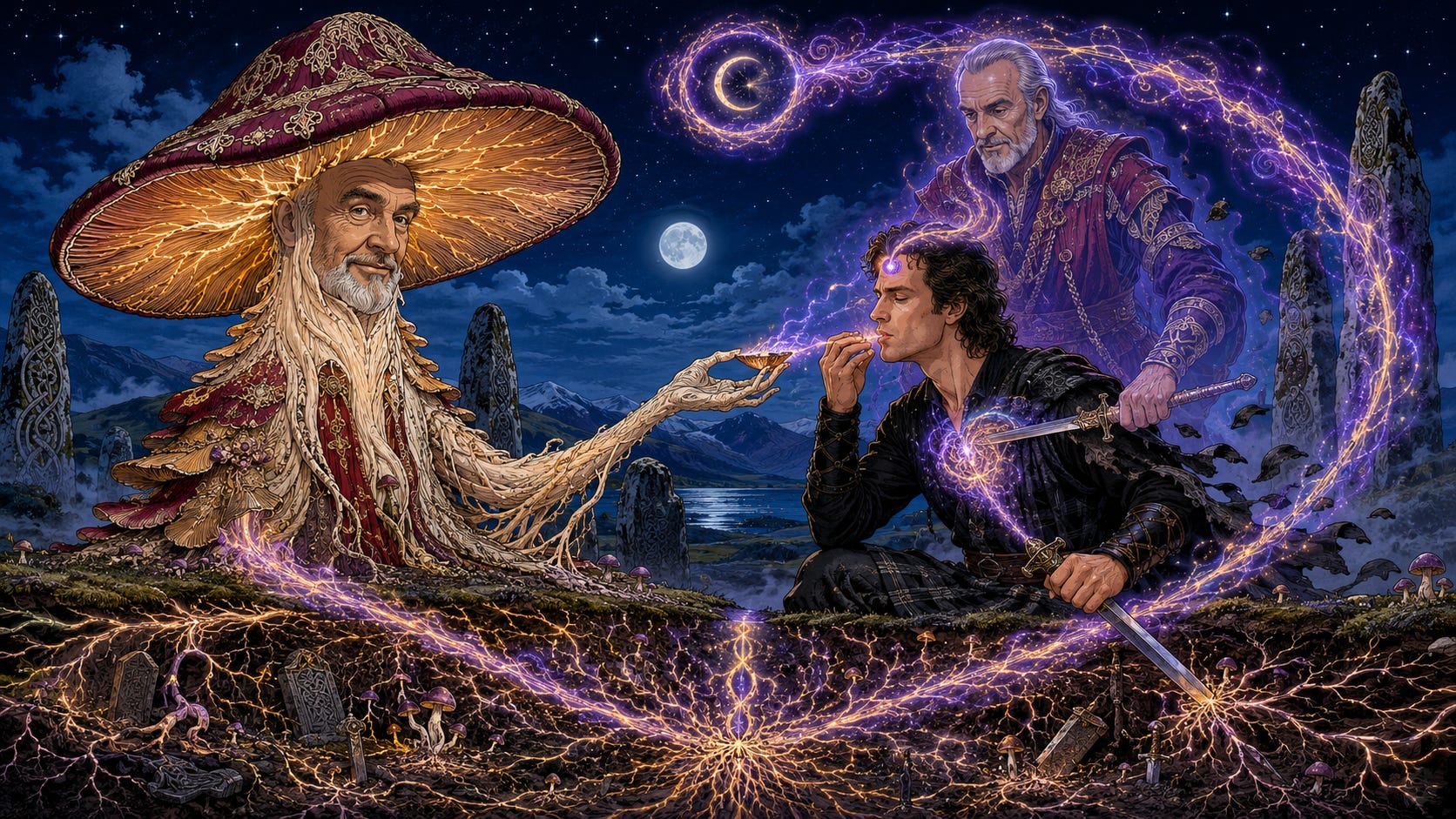
The film also suggests that this murderous transfer is not the Quickening’s original or highest form. During Ramírez’s lesson with the stag, Connor learns to feel the animal’s blood and heartbeat inside his own consciousness; Ramírez calls this the Quickening and describes it as unity with all living things. Only afterward does he explain that one immortal can seize a greater share of this power by taking another’s head. There are therefore at least three forms of the Quickening: the natural Quickening, which participates in life; the predatory Quickening, which consumes and concentrates life; and the redeemed Quickening of the Prize, which finally restores Connor’s connection to life as a whole. This, more precisely, is yet another reason I see Connor as the narrative representative of a teenager growing up throughout the movies; it is a coming-of-age story about “how to grow.” Of course, one may say that I am reading far too much into this. It is possible that none of these distinctions were intended. But this is one possible way of explaining the contrast between the immortals.
That adolescent pattern becomes even clearer in the police station scene. Having undergone a secret and overwhelming bodily initiation that he cannot possibly explain, Connor is hauled before institutional authority like a teenager called into the principal’s office after a forbidden fight. The authorities know that something happened, but they cannot prove exactly what he did. They pressure him to confess, ridicule his account, and even taunt him with a crude sexual explanation for the killing. This is less about killing and more about “something sexual” that they have never experienced themselves. The “high school cops” are subconsciously enraged that the un-cool kid had sex. Connor answers with sarcasm, asks whether he is actually under arrest, and then walks out. The sequence transforms a supernatural awakening into an immediately recognizable adolescent progression: the forbidden contest, the overwhelming bodily climax, and then the humiliating summons before adults demanding an explanation.
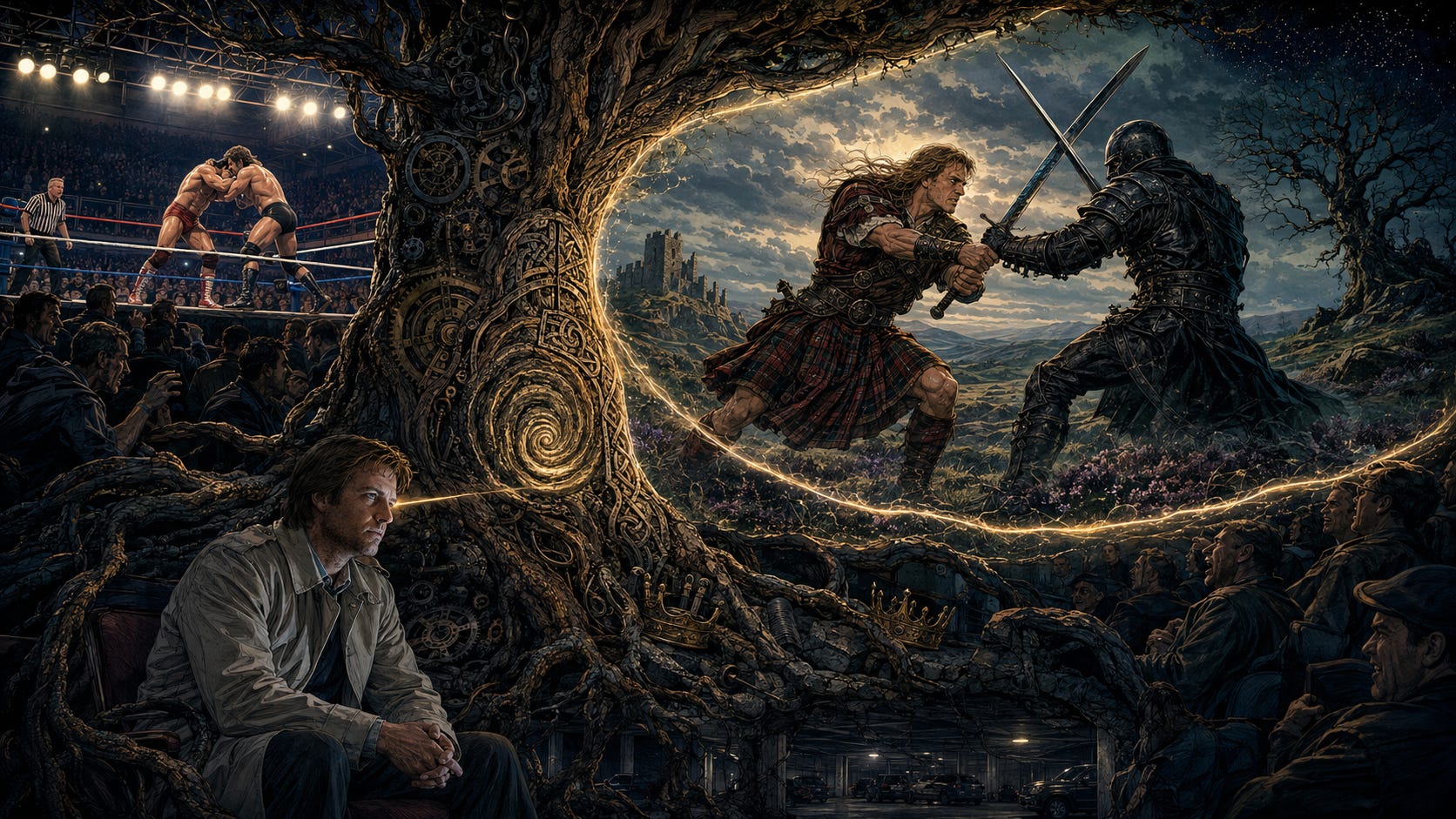
Returning to the idea that the Highlander can be understood as an immortal person fluctuating through generational emotional states, I would read the Quickening as an orgasmic experience, but also as an experience that permits transitions between the “generations” of his immortal existence. Consider, for example, how, after his first near-death experience, the interrupted, pseudo-Quickening in which the Kurgan is poised to claim his head in Scotland, Connor is instantly excluded from the tribe when he awakens. I see in that a clear image of puberty.
Strictly speaking, this Scottish resurrection is not yet a Quickening. Connor has suffered his first death, but the Kurgan has been prevented from taking his head and absorbing his power. Symbolically, however, it acts as a preliminary or interrupted Quickening. Connor’s body has changed without his consent, and the change is immediately visible to the social world around him. Like puberty, his resurrection simultaneously grants power, destroys innocence, and expels him from childhood’s unquestioned community. He goes to sleep as a recognized son of the tribe and awakens as something frightening, sexually suspect, and no longer assimilable to the household that formed him. In many ways, he is precisely a vampire to be driven away, just not an actually possessed one.
Highlander strikes me as brilliant because it speaks to us, as if both the immortal and we, the viewers, are being “possessed by history.”
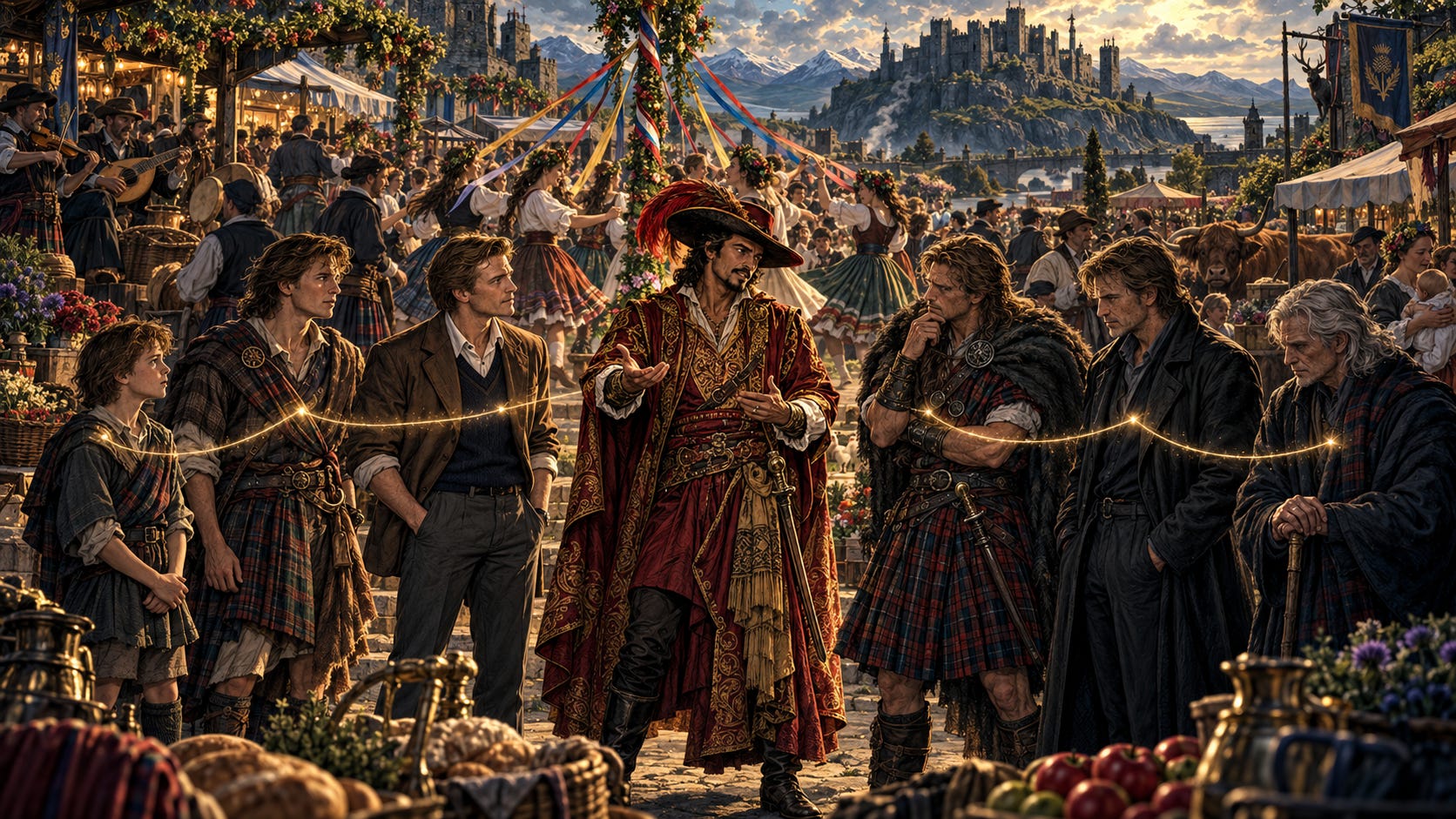
The subsequent stages of the first film continue this generational progression. Ramírez arrives as teacher, initiator, older brother, and substitute father. Heather introduces Connor to marriage. Her aging forces him into the emotional condition of middle age and then widowhood, even though his own face remains young. He cannot physically accompany her into old age, but he is made old in grief. His annual candle for Heather becomes a ritual substitute for the shared aging that immortality denied him. The scene in which Ramírez reveals the immortals’ sterility reinforces this meaning visually. Connor learns that he can have no children while standing in a crowded market filled with women, animals, food, music, commerce, courtship, and ordinary human abundance. Immediately after Ramírez announces their childlessness, girls dance around a maypole, one of the oldest and most obvious European images of seasonal and sexual fertility. Connor is not merely informed of a biological defect; he is shown the entire reproductive world from which immortality has excluded him. This, likewise, makes some sense of the absurdities and incoherence so many people dislike the Highlander films for: the whole reason for the “end of immortality” gimmick that causes conflict between fans. Is immortality better than mortality or vice versa? The film, I suspect, is not about this; it is about generational transformation itself. This adds to its dark 1990s feel.
Highlander as a movie, after all, appears precisely in the era when the world turned from a world with two powers, America and Russia, to a clear winner: a unipolar world. This might even be the subconscious background to the darkness of the film.
Rachel adds an even stranger generational inversion. Connor rescues her as a child, adopts her because he cannot have biological children, and becomes her father. Decades later, Rachel has grown into a middle-aged woman while Connor still appears to be a young man. The child begins to look old enough to be the parent of her own father. Their relationship therefore changes direction in visible time even though its emotional origin remains intact. Connor achieves fatherhood without reproduction, while Rachel supplies him with a generation that his immortal body cannot produce. Adoption becomes his humane alternative to the Quickening: instead of stealing another adult’s life to extend himself, he protects a child and allows her life to unfold independently of his own.
Heather, Rachel, and Brenda, likewise, represent three different relationships to generation. Heather makes Connor a husband who cannot age with his wife. Rachel makes him a father who cannot beget a child. Brenda offers the possibility that sexual love might finally be joined to mortality and future children. This is why the Prize at the end of Highlander is not merely greater power. Connor’s real reward is the end of sterile immortality. After absorbing the accumulated power of the dead immortals, he can become mortal, grow old, and father children. Horizontal transfer can finally give way to vertical descent. The Game consumes an entire immortal generation so that ordinary human generations may begin again.
Connor’s succession of false identities offers another version of this sterile fatherhood. Because he cannot have biological heirs, he periodically declares one identity dead, assumes the identity of a child who died at birth, and leaves his possessions to himself under the new name. He manufactures an artificial genealogy in which every apparent son is secretly the same ageless father. The investigation exposes the absurdity when the handwriting of several supposed generations proves identical: the immortal who cannot produce descendants has been forced to become his own descendant.
This false genealogy finally ends when Connor recovers his proper name. “Russell Nash” belongs to the administrative machinery by which the immortal repeatedly dies without dying, inherits from himself and conceals himself from historical time. “Connor MacLeod of the Clan MacLeod,” by contrast, identifies him through birth, place, ancestry and membership in a people. It is therefore significant that he asks Brenda to call him Connor MacLeod precisely when he can return to Scotland, become mortal and imagine a genuine future: recovering his name, birthplace and capacity for descent are all parts of the same return.
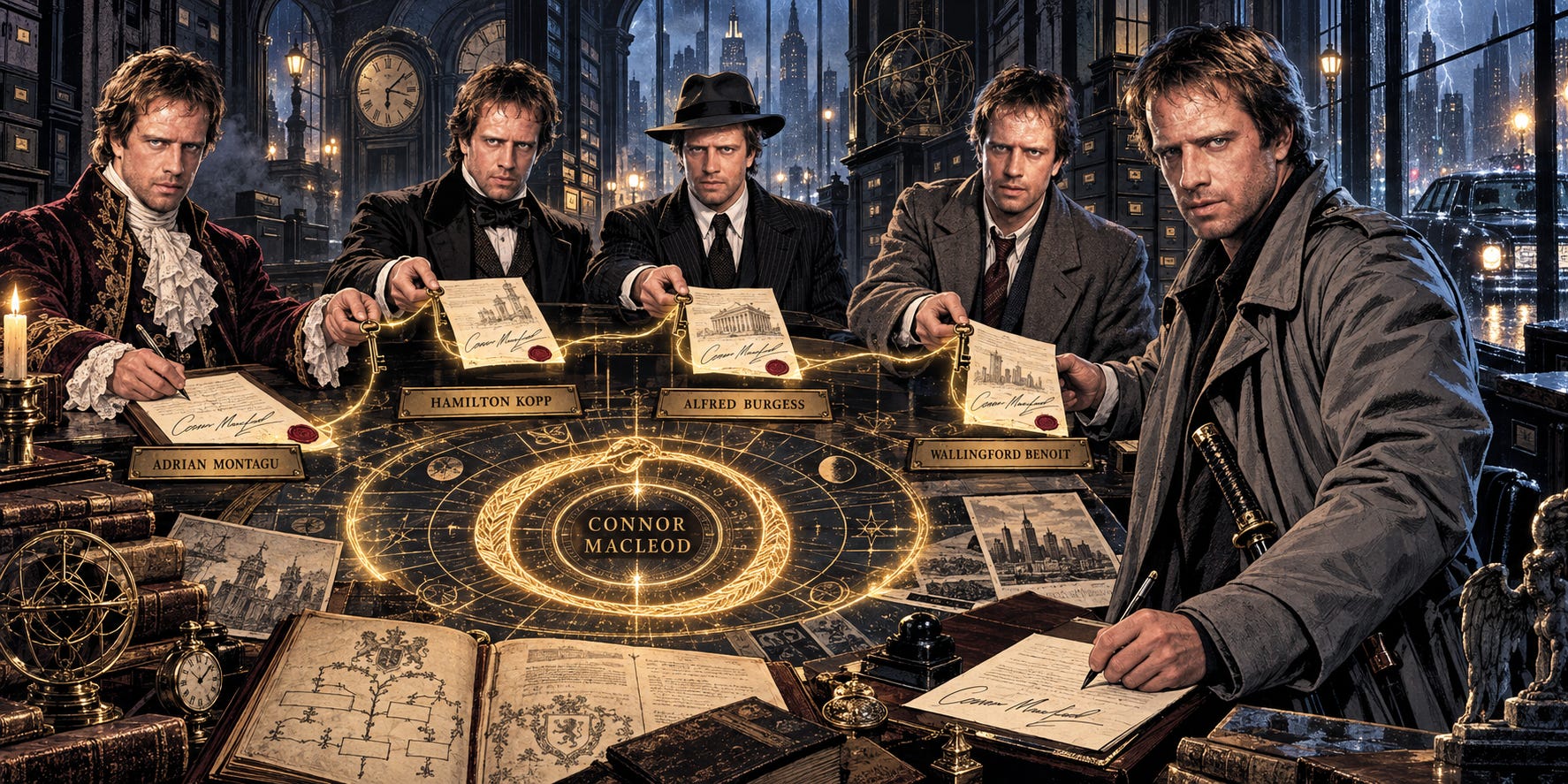
The original screenplay actually makes this generational meaning astonishingly explicit during Connor’s reception of the Prize. His body passes through the forms of Ramírez, Fasil, the Kurgan, and other people absorbed by the Game, until he experiences himself as “generations being born and dying.” The final Quickening does not leave him as one triumphant individual standing upon a pile of extinguished lives; it temporarily makes him the living form of the generations that have passed into him. “There can be only one” therefore produces the paradoxical result that the One becomes the Many: an entire extinguished genealogy is concentrated inside the final survivor. This is yet another proof of my theory, that Connor really represents “the generations of man,” and more specifically, “the ages of a man.”
This also distinguishes Connor’s sexuality from the Kurgan’s. The Kurgan remains trapped in the most predatory form of adolescence: appetite without care, power without fatherhood, sexual domination without generation. For him, both sex and the Quickening are forms of conquest. Other bodies exist to be penetrated, humiliated, emptied, and incorporated into himself. Connor’s sexuality, by contrast, gradually moves through attachment, marriage, grief, adoption, and finally the possibility of children. The two men therefore represent rival sexual economies. The Kurgan can only consume life; Connor must learn how to transmit and protect it.
Nature itself appears to pass judgment upon the Kurgan’s way of life. When Ramírez describes the Kurgans throwing children into pits with hungry dogs, the original screenplay immediately notices a blue jay returning with food for its young. The ordinary animal performs the parental duty that the “perfect warrior” has repudiated: it expends its strength to feed weaker and dependent life rather than sacrificing the weak to entertain the strong. The Kurgan is consequently not merely uncivilized; he is anti-generational, even by the elementary standards of nature.