

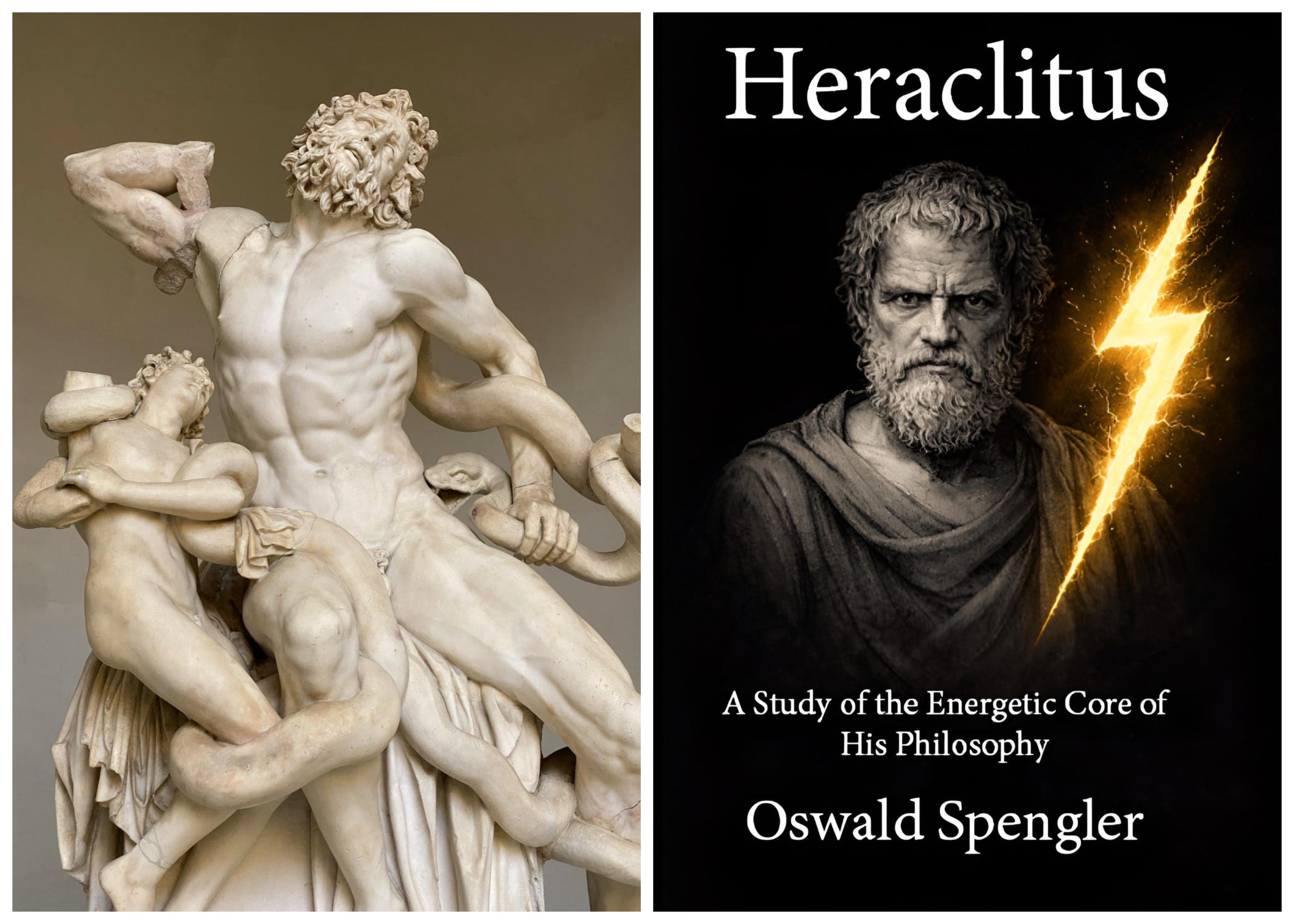
Constantin von Hoffmeister situates Spengler’s Heraclitus within the living flux of history, where cultures rise, transform, and give way to the inexorable law of becoming.
This is the Translator’s Preface to Oswald Spengler’s Heraclitus: A Study of the Energetic Core of His Philosophy (Multipolar Press, 2026).
This translation brings before the reader a youthful work by Oswald Spengler that already carries the stamp of his mature vision. The study of Heraclitus stands as a key to Spengler’s later morphology of history. Here thought moves in plain lines, guided by observation rather than ornament. The aim of this preface is to situate the text for a present age shaped by uncertainty, motion, and strain, an age that senses its own turning yet seeks words to name it.
In his doctoral dissertation from 1904, Spengler approaches Heraclitus as a thinker of process. Being appears as becoming, order as measure, and truth as logos grasped through form. This stance rejects any picture of cultures as fixed substances. Civilizations arise, unfold, harden, and pass on their force into new shapes. History, in this view, reads as a record of growth and decline governed by inner law rather than by choice or plan. Such clarity gives Spengler his lasting power.
The contemporary West finds itself within this same logic of becoming. Many observers search for remedies, programs, or reversals. A Spenglerian eye sees a different scene. The West has reached a late phase marked by repetition, technique, and exhaustion of symbols. Energy flows onward, yet its direction has shifted. What once grew now circulates. What once created form now administers remnants. This condition follows from structure, rather than error. Within such a phase, projects of remigration rest on a misunderstanding of historical movement, since peoples and cultures continue to form through motion, mixture, and pressure rather than through return. The parallel dream of building ethnically homogeneous refuges inside a declining civilizational space mistakes enclosure for renewal and treats late-stage administration as though it could still generate a living beginning.
Within this frame, peoples and races appear as living formations shaped by time. They change through contact, conflict, and fusion. Ethnogenesis continues as an active force, driven by migration, struggle, and adaptation. Any attempt to freeze identity into a final image misunderstands life itself. Flux governs blood, language, and memory alike. Every culture bears within it the seed of transformation. In this sense, the Russian historian and ethnologist Lev Gumilev’s insight into ethnogenesis as a phase-bound surge of collective energy aligns with Spengler’s morphology, since both treat peoples as temporal formations rather than permanent substances. What rises through passion and pressure also fades as that energy disperses, giving way to new configurations formed under different historical conditions.
Heraclitus offers the deepest image for this truth. The river flows through the same banks while its waters differ at every step. Spengler applies this image to history as a whole. Cultures share outward similarities across eras, yet their inner meaning differs each time. Forms repeat, spirit changes. Recognition of this pattern frees thought from illusion and sentiment. Today, mass immigration and rapid demographic change illustrate this process in plain view, as inherited institutions persist while the population that inhabits them brings different memories, habits, and expectations. Cities retain familiar names and layouts, yet daily life, social trust, and symbolic reference points shift under the pressure of scale and speed. Recognition of this pattern frees thought from illusion and sentiment, replacing nostalgia and moralism with a sober reading of historical movement.
From this perspective, the fate of the West lies beyond ethical renewal and political intervention. Decline carries its own dignity when faced with clear eyes. Late cultures still act, build, and fight, yet their actions belong to a closing chapter. Spengler calls for acceptance of this course as history itself, as one accepts night after day, neither with despair nor with hope, but with understanding. He calls for recognition of this phase for what it is and for conscious presence within it.
This translation seeks precision over flourish. The language aims at firmness and restraint, following a style that values fact, proportion, and direct statement. Such a tone suits Spengler’s intent. His thought gains force through clarity rather than through excess. Each sentence strives to carry weight through sense alone.
Readers who approach this work today meet a mirror held up to their own moment. Heraclitus teaches that change rules all things. Spengler teaches that cultures share this rule. Together they offer a discipline of seeing, one that replaces comfort with insight. In an age of motion, this remains the truest service a translation can offer.
Everything is always in flux.
Spengler’s lecture on the historical importance of the chariot, which follows the text on Heraclitus, should be read as the concrete counterpart to the metaphysical vision that opens this volume. If Heraclitus reveals a cosmos governed by lawful becoming, Spengler shows how that law enters history through deed, weapon, and style. The chariot emerges as the first great instrument through which a ruling minority imposed form upon vast populations, embodying a will to dominance expressed most directly in combat rather than in ideas. Read from the present, this connection acquires particular sharpness for the West, whose long supremacy rested on the capacity to unite technique, speed, and command into durable structures of power. Yet the Heraclitean lesson remains: the same forces that once elevated a civilization continue their movement beyond it. What appears as permanence reveals itself as phase, and what once signaled ascent now belongs to a later season in which inherited forms persist while the energy that created them passes elsewhere.
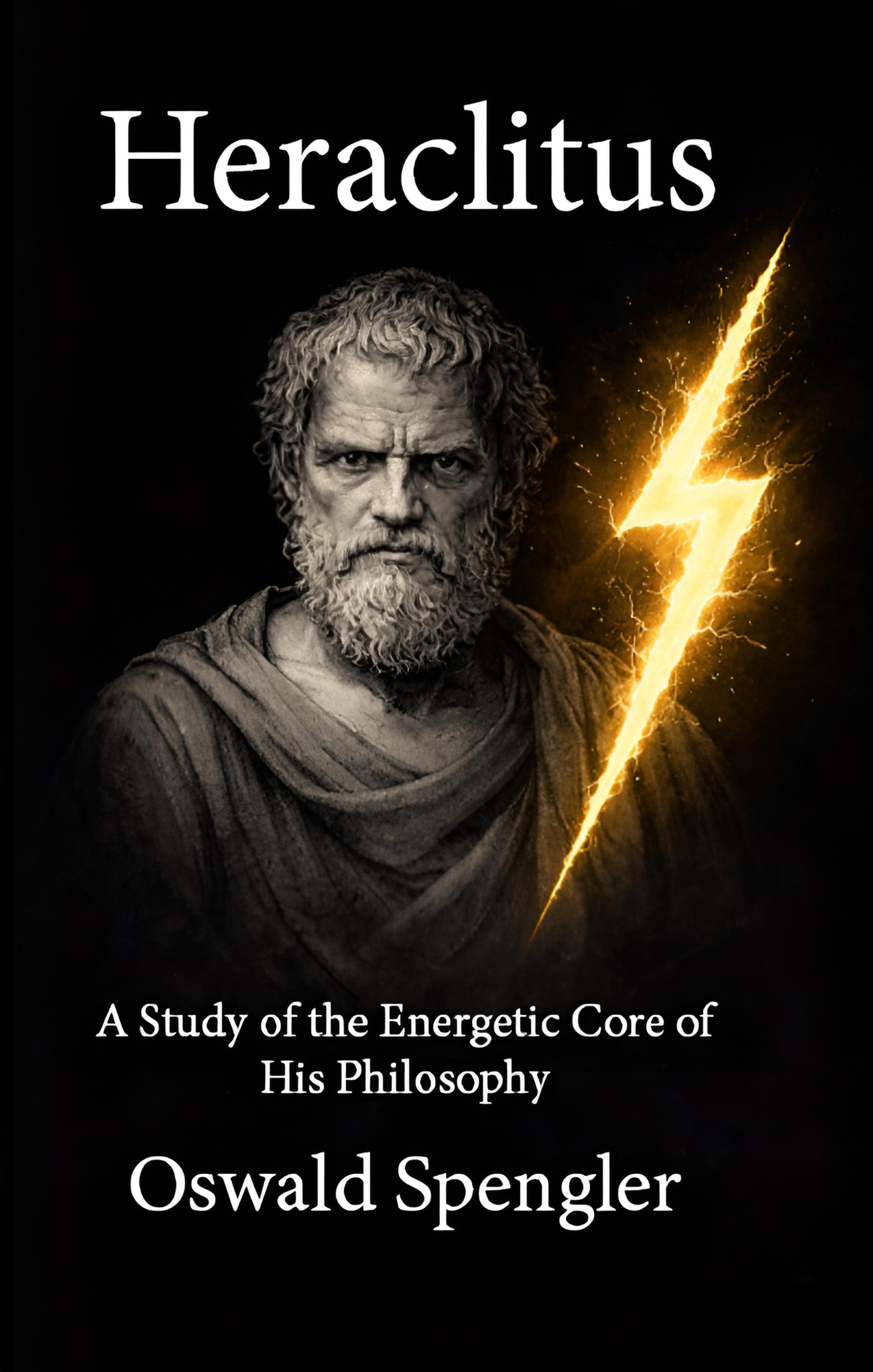
Order Heraclitus here.
This edition presents a new English translation with scholarly annotations, along with a foreword by Astral.
Agree that societal manifestations are fluid and only predictable as immutable nevertheless this knowledge is of little value to the individual who is subject to these circumstances. Societies are the measure of their constituencies and our only hope is to be all we can be and the Tao Te Ching is useful in that regard.