Habermas: The Re-Educator
The architect of confusion
Karl Richter on Jürgen Habermas and the intellectual ruin of postwar Germany.
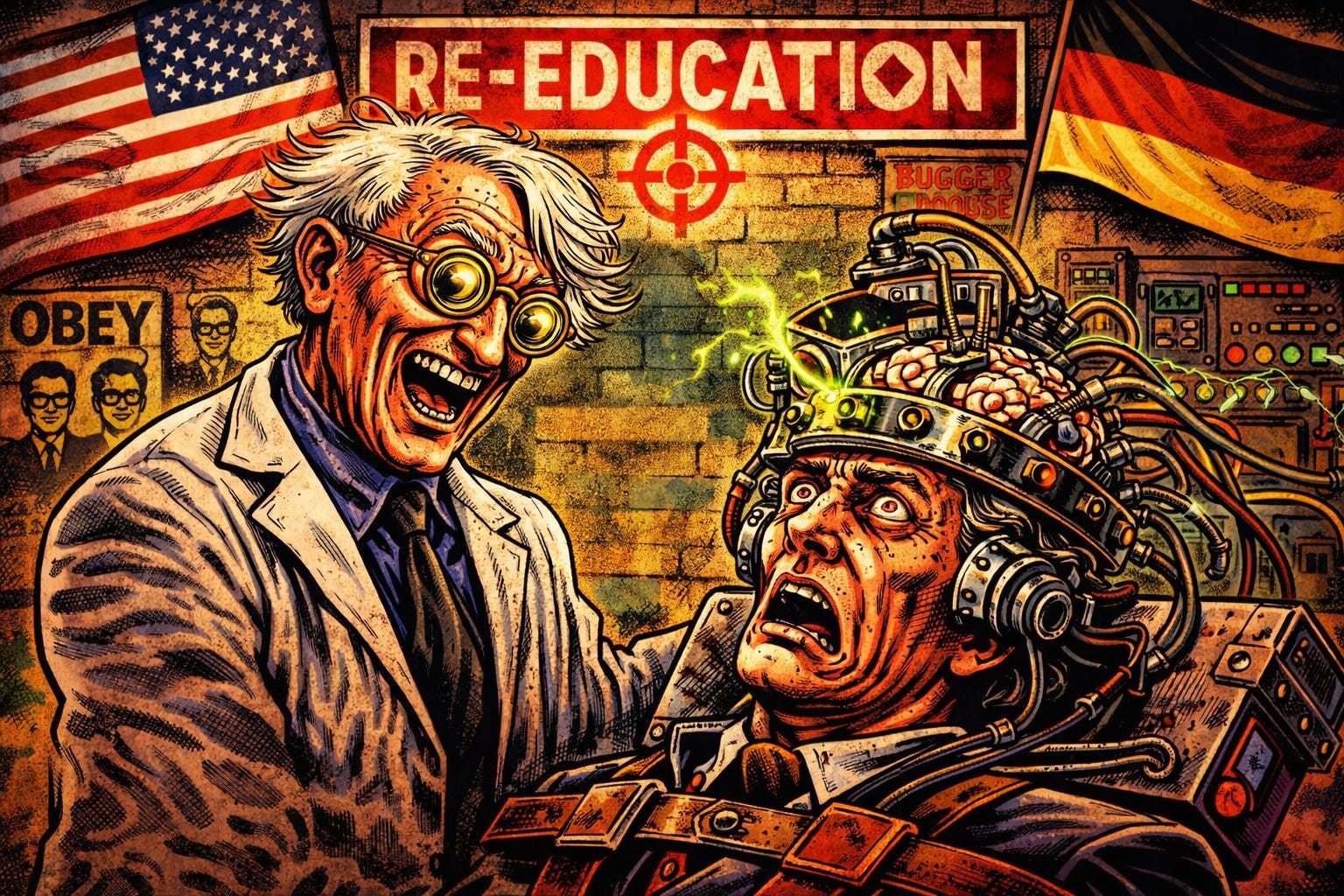
De mortuis nihil nisi bene—one should speak only well of the dead. In the case of Jürgen Habermas, who died on Saturday at the age of 96 in Starnberg, an exception may be warranted. Habermas was one of the principal architects of Germany’s post-1945 alignment with the West. He achieved this by infecting the political Left with a modernized Marxism enriched with American and Jewish intellectual currents, thereby steering it decisively onto a pro-Western course. In this role, he became one of the most influential propagators of postwar “re-education.”
Born in Düsseldorf, Habermas—who during the war served as a Jungvolk leader in the Hitler Youth—soon became a product of that very re-education himself and rose to prominence as the moral schoolmaster of the young Federal Republic. Few intellectuals shaped the political self-understanding of West Germany’s postwar society as profoundly as he did. Habermas taught Germans to repudiate their own traditions and to seek redemption in the language of “Western values.” In 1999, during the NATO attack on Yugoslavia, he openly applauded the intervention, presenting it as little more than “emergency assistance legitimized under international law.” At the same time, he indulged in the grand speculation that the world was moving “from the classical international law of sovereign states towards the cosmopolitan law of a world-citizen society.” Where such thinking leads is now evident. When Germany reunified in 1989, Habermas responded with lamentation, warning that German national unity might collide with “the universalistic rules governing the coexistence of equal forms of life.” Even then, however, it was mainly Habermas’s own theoretical constructions that collided with reality.
After completing his doctorate in 1954 under the former NS activist Erich Rothacker and publishing an early critique of Martin Heidegger, Habermas was brought to the Frankfurt Institute for Social Research by the central figure of what later became known as the Frankfurt School, Theodor W. Adorno. There he reshaped the so-called “Critical Theory” into an elaborate doctrine of communication—and in doing so played a decisive role in restoring Marxism’s intellectual respectability in Western Europe for a new generation of academics and left-wing thinkers.
His major work, the two-volume Theory of Communicative Action (1981), promises emancipation through discourse—an allegedly “domination-free discourse.” In practice, however, Habermasian discourse functions as a mechanism of domination itself. Anyone who refuses to accept its rules is excluded from participation. It is a theory of exclusion that large parts of the Left have since internalized to the point of complete detachment from reality. One sees this most clearly in the quasi-religious ostracism directed against the AfD (Alternative for Germany). At the same time, discourse becomes a substitute for action: endless discussion replaces concrete deeds. An entire generation shaped by the student movement absorbed this mentality and went on to populate schools, universities, party bureaucracies, and trade-union offices as insufferable and largely unproductive functionaries. Allowing this type of person to dominate the transformation of West German society for decades has brought the country to where it stands today: intellectually, it resembles a demolition site.
Habermas’s supposed philosophy is a purely cerebral construction. His language—labyrinthine, convoluted, and often bordering on the incomprehensible—is an endless juggling of abstract terms. In truth, it offers neither knowledge nor moral insight. It advances no one’s understanding. That this body of work displaced the philosophical tradition from Plato to Heidegger at German universities amounted, for the land of poets and thinkers, to a form of intellectual brain death.
In this context, one is reminded of the timeless words of Confucius:
If names are not correct, language will not correspond to reality.
If language does not correspond to reality, affairs cannot succeed.
If affairs cannot succeed, morality and art cannot flourish.
If morality and art do not flourish, punishments will fail to strike the mark.
If punishments fail to strike the mark, the people will not know where to place hand or foot.
Therefore the noble man ensures that his concepts can always be expressed in words and that his words can always be realized in deeds. That is what everything depends on.
In this sense, Habermas occupies a clear place in intellectual history: as a destroyer of thought, a confuser of minds and souls.
For decades, he was treated as the moral and intellectual authority of the Federal Republic. During the historians’ dispute of the 1980s, he arrogated to himself the power to determine what should remain “sayable” in Germany. Any attempt to view German history through a lens other than that of collective guilt he dismissed as “apologetic.” He coined the concept of “constitutional patriotism,” which soon became a favorite slogan among left-wing advocates of dissolving Germany itself. Yet the choice is simple: either patriotism or the constitution. Constitutional patriots have already lost.
The overall consequences of Habermas’s influence have been devastating. He trained generations of academics to transform real social conflicts into abstract discourse while simultaneously clouding clear thinking. Even the student movement—which originally sought concrete change—degenerated under his influence into a sect devoted entirely to communication. Thanks to the cultural dominance of the Left in media and institutions, this mentality has shaped public life for decades. In the end, Habermas was one thing above all: the most successful confuser of the German mind since 1945. There is little reason to mourn him.
(Translated from the German)


A fitting send off; doubt it could have been done better.