

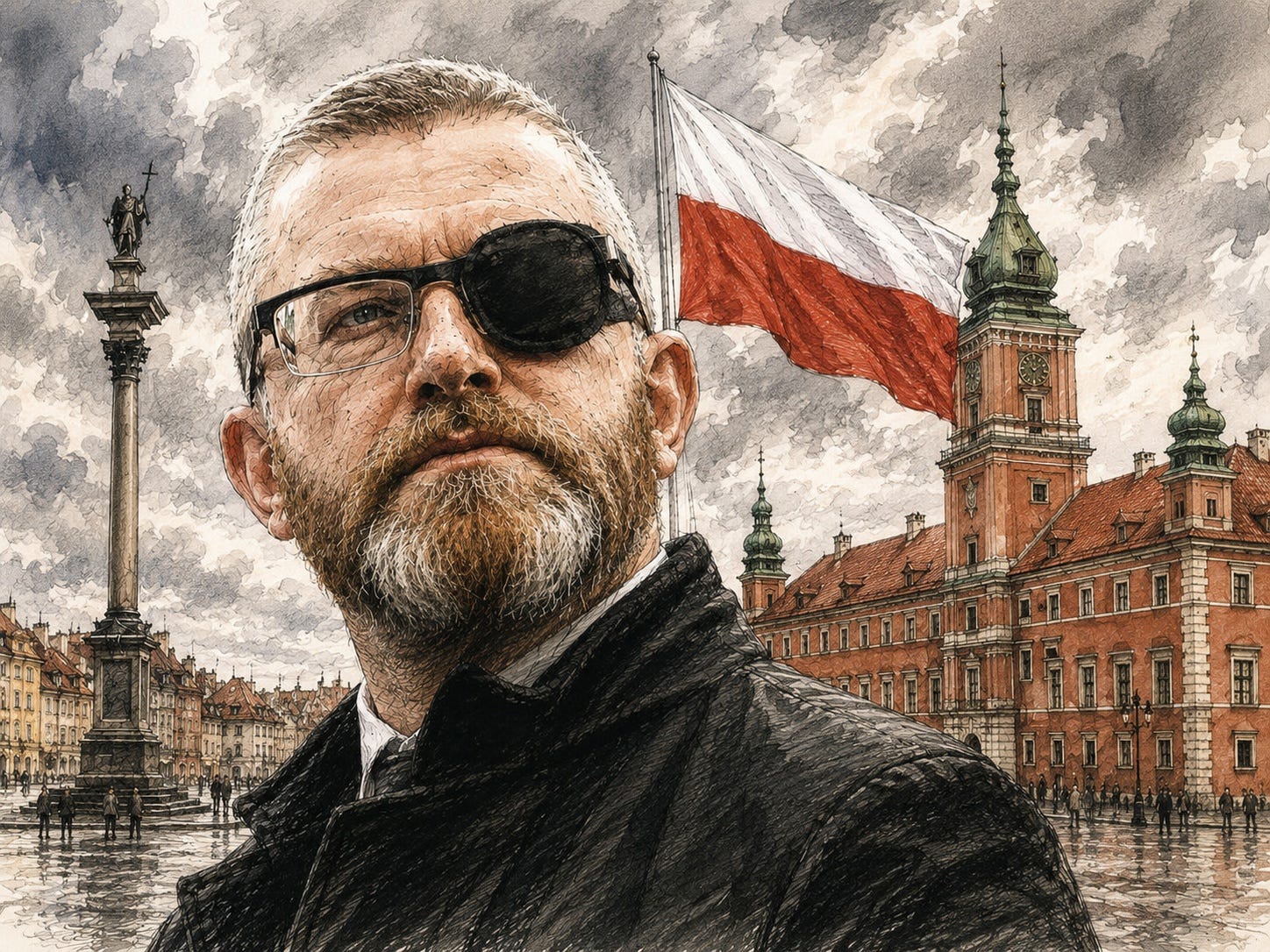
Constantin von Hoffmeister explains why Grzegorz Braun’s five-point program has become one of the most uncompromising challenges to Poland’s policy towards Ukraine.
Grzegorz Braun is a Polish MEP (Member of the European Parliament), filmmaker, and public intellectual who has emerged as one of the most defiant defenders of national sovereignty in contemporary Europe. As leader of Konfederacja Korony Polskiej—the Confederation of the Polish Crown, a monarchist, Catholic, and staunchly nationalist political formation that seeks to restore traditional Polish values, limit foreign influence, and uphold the independence of the Polish state against globalist pressures—Braun has built a reputation for theatrical yet principled resistance. He is known for bold public stunts, most famously using a fire extinguisher in the Polish parliament to put out a Jewish Hanukkah menorah during its ceremonial lighting, an act he framed as a protest against what he perceives as the erosion of Poland’s Christian identity and the undue influence of external symbols and agendas in national institutions. In an age of calculated conformity, Braun speaks with the directness of a man who refuses to participate in the great forgetting imposed by those in power.
On 27 June 2026, at a solemn ceremony in Kędzierzyn-Koźle honouring the victims of the genocide committed against Poles in the Borderlands—the historic Kresy, those vast eastern territories that once formed the cultural and geographic heart of Poland, stretching across what is now western Ukraine—Braun delivered a speech that served both as a memorial to the slaughtered and a warning against repeating the mistakes of the past. The Kresy, long a frontier of Polish civilization, were the site of horrific massacres during and after World War II, when Ukrainian nationalist forces, particularly the Organization of Ukrainian Nationalists (OUN) and its military wing, the Ukrainian Insurgent Army (UPA), carried out systematic ethnic cleansing against Polish civilians. Tens of thousands of Poles—men, women, and children—were murdered in brutal fashion in places like Volhynia and Eastern Galicia in 1943–1944. Whole villages were razed, inhabitants butchered with axes and pitchforks, and the atrocities often accompanied by torture and mutilation. Organized by the Association of Kresowiacy, the ceremony was a necessary act of remembrance against the forces of historical denial that seek to sanitize these crimes in the name of present-day alliances.
