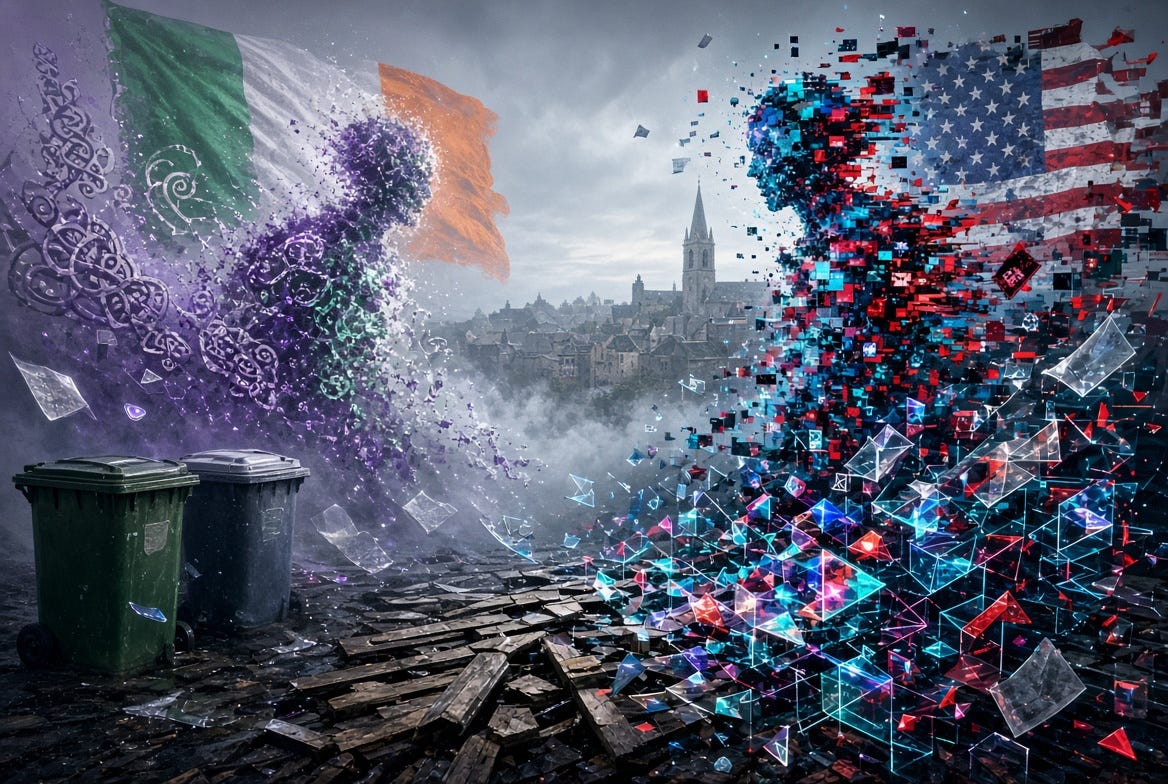
Cas Corach draws on Jean Baudrillard to trace a path from a false rumor that divided an Irish town to the empty spectacle of MAGA, revealing how the liberal order replaces material reality with rival simulations and why multipolarity must recover the real.
In May 2023, the normally quiet town of Corofin in Ireland’s County Clare was rocked by protest. This protest was small, parochial and uninteresting to any outsider, attracting only angry locals who were divided on a central question: should a property in the town be used to house asylum seekers? The debate was not held in a town hall or in the offices of political representatives, but rather on the streets and roads of that otherwise peaceful area. This culminated in the construction of a makeshift blockade of wooden pallets and large plastic bins across the entrance to the property. People shouted on either side of this physical divide, which was the real manifestation of a cultural divide in the town. One old man was even assaulted, leading to an arrest.
This story, on the face of it, is not unusual in modern Europe, as the housing of asylum seekers is a burning issue across the continent. Yet there was something unusual about the Corofin incident: there never were any plans to house asylum seekers or any immigrant group in that town. The blockade was, in truth, for nothing. The premise of the debate was false, and the assault and screaming matches were needless and tragic. Yet the anger itself was real. What had happened?
The rumour of housing foreigners had spread over social media when someone had illegally entered a newly constructed building, claiming it was being built to bring nameless ‘invaders’ to the town. That was enough to ignite the explosion in Corofin on that fateful day. The social media video was a simulacrum: it had no corresponding reality, yet it acquired a political meaning of its own and motivated people to act. A digital representation of an event that had never happened had produced very real consequences.
The incident at Corofin may, in the grand scheme of things, be unimportant and soon forgotten. Yet it represents a microcosm of a growing problem in the West: the use of spectacle to engender conflict, and the emergence of a political reality increasingly detached from the reality it claims to represent.
One influential theorist immediately comes to mind in relation to this question: Jean Baudrillard and his theory of the simulacrum. His writing is dense and complicated, but to explain it succinctly, Baudrillard argues that the words, symbols and signs we use to describe reality and communicate with one another are becoming increasingly detached from reality itself. What we say and believe no longer necessarily corresponds to anything concrete, but instead endlessly refers back to other signs:
….the era of simulation is inaugurated by a liquidation of all referentials—worse: with their artificial resurrection in the systems of signs, a material more malleable than meaning, in that it lends itself to all systems of equivalences, to all binary oppositions, to all combinatory algebra. It is no longer a question of imitation, nor duplication, nor even parody. It is a question of substituting the signs of the real for the real, that is to say of an operation of deterring every real process via its operational double, a programmatic, metastable, perfectly descriptive machine that offers all the signs of the real and short-circuits all its vicissitudes. Never again will the real have the chance to produce itself. (Baudrillard, Simulacra and Simulation)
For Baudrillard, this represents the transition into an era of simulation in which the distinction between the real and its representation becomes increasingly difficult to maintain. His argument extends beyond politics, affecting everything from family life and social relations to history itself. Yet for the purposes of this essay, our focus will be narrower: the political sphere, and the extent to which contemporary political discourse is becoming detached from the material reality it supposedly represents. Corofin provides a particularly simple example of this process. The building was real, the video was real, and the people involved were real; what did not exist was the political reality constructed around them. A representation of an imagined event became sufficiently powerful to produce a real political confrontation. The sign had effectively preceded the reality.
Following this, it is our contention that much of the current unipolar and liberal world order is a mere simulation of reality. Perhaps the clearest example is the death of George Floyd in 2020 and the extraordinary circulation of the footage surrounding his arrest. Whatever one’s interpretation of the precise circumstances of Floyd’s death, the footage rapidly ceased to function merely as a tragic individual police encounter and became a political symbol representing much broader arguments about American society; in short, the image became more important than the event it claimed to represent.
The name ‘George Floyd’ was associated with a whole collection of political symbols: racial injustice, police brutality, white supremacy and the condition of black people in America. The video was reproduced endlessly across television, social media and political demonstrations, while the individual circumstances of Floyd’s death became increasingly distinct from the larger political narrative constructed around the image. A real event had become a simulacrum, and one that had acquired a political life of its own.
This is important because it demonstrates that simulation does not necessarily mean that an event is entirely imaginary. The underlying situation may be completely real; rather, what changes is the relationship between the event and its representation. The representation becomes dislodged from the complexity of the real and becomes a symbol through which other political questions are understood. The image no longer simply tells us what happened; in fact, people from different political perspectives cannot even agree on what truly happened to George Floyd. The image simply references other symbols: Black Lives Matter, ‘support the blue’, rioting in the streets, ‘take our country back’, and so on. At no point was anything resolved or truly learned from the event. At no point was the real ever even under consideration.
Yet the backlash against this process has not liberated politics from simulation; it has merely produced a competing set of signs which are more ridiculous, if anything. The Right has correctly identified the artificiality of many of the political signs produced by the left wing of the liberal order, but it has failed to escape the system which produces them. MAGA, in particular, may represent the ultimate political simulacrum: a sign which appears to stand for a coherent political programme while increasingly becoming a vessel into which almost any political meaning can be poured; in short, a non-entity or void in the core of the US liberal empire.
MAGA has the uncanny ability to represent everything and nothing. It is for the working class yet funded and increasingly represented by billionaire elites; it is anti-war yet bombs schoolchildren in Iran; it promises economic rejuvenation while embracing policies that contribute to inflationary pressures. Most strikingly, it claims to be populist while becoming increasingly unpopular with the very population in whose name it claims to speak. These contradictions would seem fatal to any coherent political programme, yet they barely damage the sign itself. MAGA simply absorbs them.
This is what makes MAGA a simulacrum of a political movement. It does not need to correspond to one stable political reality because it can continually refer to other signs: America, greatness, the silent majority, the deep state, globalism, the wall, the establishment, the golden age. Each sign points towards another, and together they create the impression of a coherence which need not actually exist. The movement means everything and nothing precisely because the sign has become detached from any stable referent.
The speed with which these contradictions disappear is itself revealing. Who remembers Trump effectively threatening to end Iranian civilisation? The threat appears, dominates the political spectacle for a moment, is interpreted through the existing signs of strength and American power (or conversely American wickedness), and then disappears beneath the next controversy. The event does not have to produce a lasting material consequence because its primary function is symbolic. Even the supposed leader of the free world increasingly operates within this same hyperreality: the office, the rhetoric, the threats and the spectacle all possess the appearance of power, while the powerlessness of the US becomes more apparent against the rising tide of global opposition.
These issues are not limited to the US but stretch across the broader West. We have already mentioned Ireland and again we look to the dissident Right who crop up in response to liberal hegemony on the island. Phrases such as ‘remigration’ have become mere slogans of activists without any real power to achieve their goals, all the while the demographic situation worsens. The real is unknown, avoided and lost in the simulation. For much of the population, ‘remigration’ is an obscurity, and even among those who use it, its precise meaning and material implications are often unclear. The word therefore acquires a power independent of any clearly defined referent: it signifies a solution without ever having to confront the practical question of what that solution would actually entail.
Dissident organisations increasingly engage in a fantasy of political action which exists more fully online than it does in the material world. A video, a protest, a viral post or an impressive-looking march can create the appearance of political momentum without producing any corresponding increase in political power. Restore in Britain appears to suffer from a similar problem: considerable simulated support online, but little transfer of that support into the material institutions where political power is actually exercised. These movements can generate signs of political importance without necessarily acquiring the institutional power required to alter the political order.
The question remains: why all this? Where did this simulation come from? Baudrillard makes the point clear:
…..in the end, throughout its history it was capital that first fed on the destructuration of every referential, of every human objective, that shattered every ideal distinction between true and false, good and evil, in order to establish a radical law of equivalence and exchange, the iron law of its power. Capital was the first to play at deterrence, abstraction, disconnection, deterritorialization, etc., and if it is the one that fostered reality, the reality principle, it was also the first to liquidate it by exterminating all use value, all real equivalence of production and wealth, in the very sense we have of the unreality of the stakes and the omnipotence of manipulation. (Baudrillard, Simulacra and Simulation)
Baudrillard’s argument here is particularly important; capital itself has historically been one of the great forces of abstraction. It takes things which once possessed a particular use, meaning or place and reduces them to their exchange value. The local becomes the market; the worker becomes labour; the object becomes a commodity; and eventually even political ideas can become signs to be bought, sold and exchanged.
In this sense, the contemporary political spectacle is not simply an invention of the liberal left or its dissident enemies. It emerges from a much deeper process in which liberal capitalism has progressively dissolved the distinctions between the real and its representation. The irony is therefore that much of the contemporary dissident Right seeks to oppose the liberal order while leaving largely untouched the economic system which Baudrillard identifies as one of the original forces behind this destruction of the referential.
So what is the solution? We have written quite pessimistically but all is far from lost. From our own experience in Ireland, we can say that there are political movements that engage with real people and solve real problems. A new popular movement like Independent Ireland comes to mind, precisely because its appeal is rooted less in an online ideological identity than in practical questions of representation, local development and the material concerns of its constituents.
While of course nothing is immune from the simulation in its entirety, we now see more individuals who recognize the system for what it is and make genuine efforts to step over the signs and symbols and engage with real people. It is not glamorous or sexy, but a local representative fixing roads, funding schools or halting the development of an asylum centre in the town hall rather than in violent protest is a sign of real change in ways of thinking, small as it may be.
More of us are seeing the benefit of turning off our screens, rejecting ideology in favour of human interaction, and avoiding the language of simulation wherever possible. It is about building real community, not movements. Genuine interactions, not market relations. It means judging politics by what it actually produces rather than by the strength of its online presence, its slogans or the number of people who can be mobilised around a symbol. The answer to a politics increasingly detached from reality is therefore not to construct a more convincing simulation, but to recover the habit of dealing with things as they actually are: people, places, communities, institutions and material conditions.
This represents a step away from liberalism and towards multipolarity. Not the multipolarity of online edits or ideology, but rather the true recognition of people and place in the real. A politics of multipolarity, properly understood, is not simply about replacing one ideological centre with several competing ideological centres. It is about recovering the importance of locality, particularity and actual material circumstance against a political order which increasingly reduces everything to abstract signs. The future of politics may therefore depend less on who wins the next rhetorical battle and more on whether we can once again build things that truly last.
The lesson of Corofin, then, is perhaps a straightforward one: the blockade was real, the anger was real, and the people were real, but the political reality which brought them together was not. The task before us is to reverse that relationship: to build a politics in which the signs once again follow the real, rather than the real being forced to follow the signs.


