From Eden to the Monroe Doctrine
A logos for the New World
Momcilo Nevesky journeys from Adam and Eve to Carl Schmitt, uncovering a forgotten theological key to America’s role in the world.
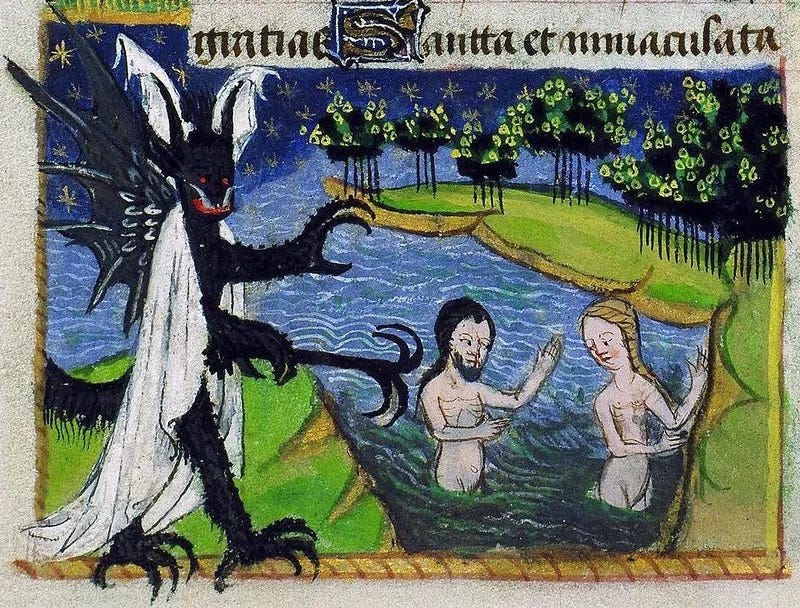
In Perelandra, the second book in C. S. Lewis’ sci-fi trilogy, the main character, Elwin Ransom, is sent to a pre-lapsarian Venus where his goal is to prevent the Green Lady (Venus’ Eve) from being tempted by the Un-man (Venus’ serpent) trying to convince her to break the commandment that God gave in order to preserve Venus’ Edenic state. Ransom tries to warn the Green Lady about what happened with Earth’s first humans who disobeyed, but the Un-man twists this argument and frames this act of disobedience positively, saying that Earth’s fall led to the incarnation. In the moment, the frustrated Ransom is unable to respond, believing that the Un-man is right and recalls the latin line “Felix peccatum Adae” (“happy sin of Adam”). This is a reference to the Exsultet, the start of the Catholic Easter service, which says:
O truly necessary sin of Adam,
destroyed completely by the Death of Christ!
O happy fault
that earned so great, so glorious a Redeemer!
In Perelandra, we later see a refutation of this idea and get a sketch of what might have happened if the fall had not taken place. In Orthodox theology, the thinking around this issue is developed quite differently from how it has in the West. There’s a distinction between tropos (the way a thing occurs) and logos (the end goal). The sin of Adam and Eve was not a happy fall, but it only caused the tropos of God’s divine plan to change but not the logos. The incarnation would have occurred regardless. As Saint Dumitru Staniloae explains (translation provided by Fr. Bodgan Bucur in footnote 53 of this article):
Without sin, there would have been an Incarnation, a Cross, and a mystical Resurrection, in the sense that created existence as such, even if it had reached apatheia, would have had to receive God in itself in a more perfect way (Incarnation), to rest from its natural movements and necessities (death), and to be resurrected for an exclusively divine activity (deification). The Logos in his humanity would have been our forerunner on this path. Therefore, Christ’s mystery was established from eternity... but sin has modeled its execution in a new way.
Having explained the tropos-logos distinction, I will now use Carl Schmitt’s political theology method (see my explanation elsewhere), wherein juridical concepts are analogical to theological concepts, to explain how we can affirm a unique logos to America situated in the Western Hemisphere, the New World, without forcing a unipolar tropos of this logos.
Schmitt’s views on the Monroe Doctrine can be found in several articles and speeches that he gave (see here, here and here) and are expressed at length in his book The Nomos of the Earth (especially Part IV, chapter 5), which was written during the final years of World War II. His general outline is that the Monroe Doctrine, first elaborated on by President James Monroe in a 1823 speech, originally fit quite well into classical European international law. It drew a line of separation between the Western Hemisphere and the rest of the world and barred European land appropriations in the New World. It was a line of self-isolation from the old world. However, at the end of the 19th century, with the closing of America’s western frontier, the United States showed that the Monroe Doctrine was no longer a line of self-isolation. In its war with Spain, the US took not only Spain’s West Indies holdings, such as Cuba and Puerto Rico, but also stretched its hand to take territories deep into the Pacific. Simultaneously, America was converting its rapidly growing industry into a weapon of foreign policy that demanded an “open door” in Asia for American industry, combined with a belligerent “dollar diplomacy.”
The US, despite its imperialist turn, still did not give up on the logos of the Monroe Doctrine, but radically altered its application, its tropos, by imposing the logic of the great space of the Western Hemisphere across the world, most notably through its unique understanding of state recognition. As early as the Civil War, the United States protested against the recognition of the Confederacy by France and England on the grounds that they did not consult the “legal government.” France and England were abiding by the norms of European international law, wherein recognition is not a moral as much as a factual claim that an entity has effective occupation over land and functions as a state with taxation, borders, and the ability to engage in organized combat. This made sense in the paradigm of the old European nomos because just war had been abolished and neutrality was the default position for states not engaged in conflict.
The United States would establish their interpretation of recognition as a moral act, and hence having interventionist qualities. This would be later affirmed with the Tobar Doctrine (1907) and reiterated in 1923 with the General Treaty of Peace and Amity among American states that denied recognition to governments brought about by revolution or a coup, i.e., non-democratic regimes. However, this logic of the great space of the Western Hemisphere was extended beyond the lines of the Western Hemisphere to the entire globe when the US established the Stimson Doctrine in the early 1930s, in response to the Japanese invasion of Manchuria, which refused to recognize territorial changes made by force. Ironically, this opened up space for the US to forcefully correct such actions taken by force.
America had given itself a claim to intervene anywhere in the world, but denied this same right to any other nation or great space on the grounds of the special status of the Western Hemisphere under the Monroe Doctrine (despite America’s absence, the League of Nations still formally acknowledged the Monroe Doctrine and did not try to intervene in the Western Hemisphere). Schmitt quite accurately predicted the way in which America would “abolish” war, a legal notion that is subject to the norms of international law, in favor of policing the world against what would later be called “rogue states.” The United States would not engage with these states as was typical in the now defunct system of European international law, where war was seen as a regulated feud between two legally equal sovereign states limited to organized conflict between two uniformed armies. Rather, by bringing in good and evil into the friend-enemy distinction, this new type of conflict would reduce the opponent to an unequal immoral criminal, justifying the most atrocious violence by claiming to be on the side of humanity combined. This issue is made extremely prescient with the advent of industrialized warfare and nuclear arsenals.
From 1890 to 1939, the old and the new interpretations of the Monroe Doctrine fought against each other. The treaty to annex Spain’s Pacific territories passed the Senate after intense debate by just one vote. Much to President Wilson’s chagrin, the US did not ratify the Treaty of Versailles, nor did it join the League of Nations. Wilson even had to promise that he would keep the United States out of World War I during his re-election campaign. Even before he rug-pulled his voters by intervening, his bellicose attitude towards Germany caused his secretary of state, the twice nominated Democratic presidential candidate William Jennings Bryant, to resign his post in protest. Likewise, before America’s intervention in World War II, there were large, and rather popular, pressure groups trying to keep America out of the war, such as the America First Committee. No one disagreed upon the logos of the Monroe Doctrine, that the United States and the Western Hemisphere had special territorial status as a great space, but there was a difference at the level of tropos of whether there were to be multiple great spaces in a multipolar international order or if the United States was to take the leap into unipolarity.
It is easy to be an American and simply decry the actions that America takes on the world stage. It is much harder to offer an alternative. However, using the structure of theology (not theology per se), as Schmitt does when looking at jurisprudence, we can easily see, although implementation is a different story, how America can still affirm its logos as a unique civilization in the world with only a change at the level of tropos. I am not saying this is easy. We cannot simply turn back the clock in a reactionary way, in the same way Adam and Eve could not simply go back into the garden and rebuke the serpent. Time has passed and we have to deal with the consequences of history. In the Life of Adam and Eve, a pre-Christian Jewish text widely accepted and preserved in Christian monasteries, our first parents began to correct their mistakes through great acts of repentance in the hostile world they were thrust into after their expulsion. I am unsure what the equivalent of repentance will be. However, as Schmitt says in Nomos: “As long as world history remains open and fluid, as long as human beings and peoples have not only a past but a future, a new nomos will arise in the perpetually new manifestations of world-historical events.”


