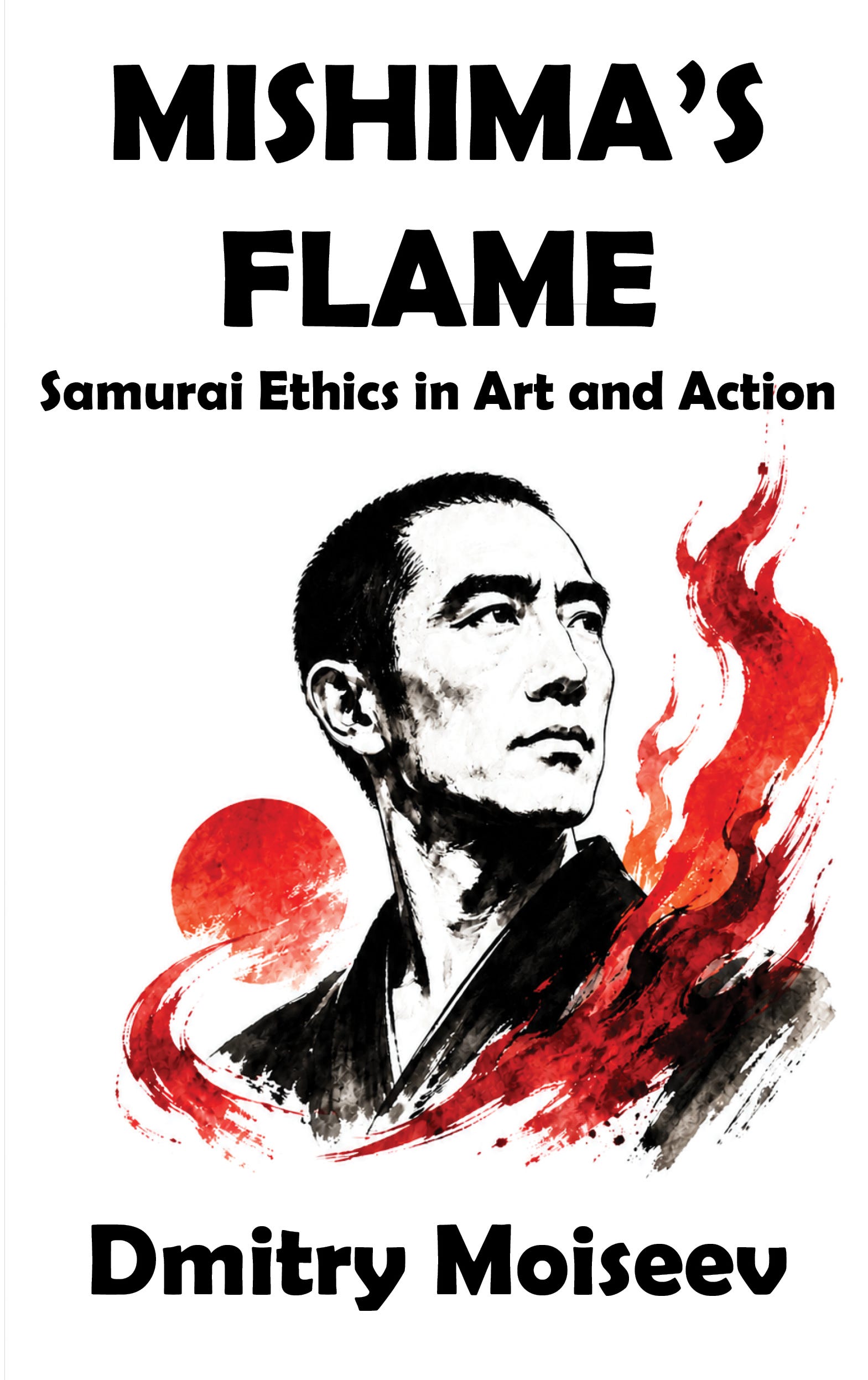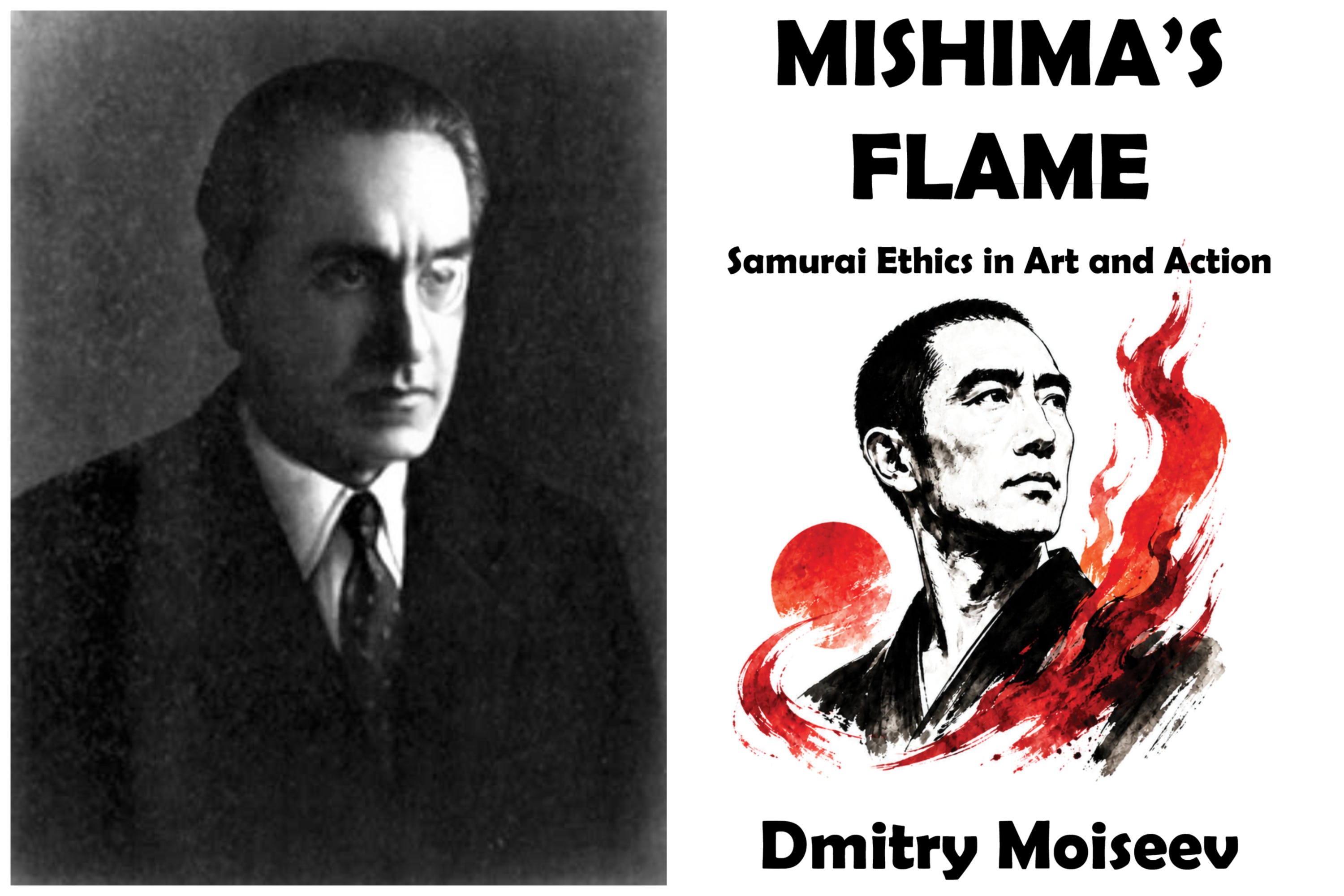
Dmitry Moiseev explores Yukio Mishima’s relentless pursuit of unity between art and action, tracing his spiritual kinship with Julius Evola in a world where thought demands risk and conviction requires courage.
This is an excerpt from Dmitry Moiseev’s MISHIMA’S FLAME: Samurai Ethics in Art and Action.
For Mishima, art and life were never separate domains but concentric circles of a single design. He rejected the assumption that literature may flourish in aesthetic brilliance while the author’s existence drifts in compromise. To create beautifully yet live timidly seemed to him a form of inner betrayal. The page demanded corroboration in flesh. His writing, his sculpted body, his carefully orchestrated public persona, even his controversial politics were not disparate enterprises but movements within one overarching composition. If a novel constructed a vision of beauty and resolve, then life itself must supply its proof.
This aspiration toward coherence places Mishima within a venerable lineage of thinkers and writers who refused to separate word from deed. In antiquity, Cicero did not purely theorize about republican virtue; he stood in the Senate and risked exile and death defending it. His speeches were not academic exercises but interventions in the fate of Rome. In Renaissance Florence, Niccolò Machiavelli wrote The Prince (1532) and the Discourses on Livy (1531) after years of service in diplomacy and foreign affairs, distilling hard-won political experience into theory. In the nineteenth century, Vincenzo Gioberti moved from philosophical reflection on national regeneration to the practical responsibilities of statesmanship as Prime Minister of Sardinia. Even in the twentieth century, Julius Evola, before composing his works on Tradition and abstract form, had immersed himself in avant-garde painting of the Dada movement, testing through artistic experiment the metaphysical ideas he would later articulate. In each of these cases, thought was not divorced from lived risk. The authority of their words derived in part from their entanglement with action. Mishima admired such coherence. He perceived in it a dignity absent from the detached intellectualism of his own time. To him, literature severed from existential commitment risked becoming decorative.
From Mishima’s earliest stories to his final completed manuscript, he pursued what might be called aesthetic totality. In The Sea of Fertility, culminating in The Decay of the Angel, he traced the arc of purity descending into corrosion across successive reincarnations. Action yields to contemplation; idealism dissolves into sterile rationality. Through the character of Honda, he examined the paralysis of a world that observes but does not dare. The tetralogy, which we will discuss in detail, became Mishima’s meditation on what transpires when a civilization loses the willingness to stake life on belief.
Mishima frequently invoked the maxim from the Hagakure that the way of the samurai is found in death. For him, this was not a morbid fixation but an ontological claim. Only the man who has accepted death as a possibility is liberated from calculation. Death, understood in this sense, is not annihilation but a criterion. It tests the authenticity of conviction. In The Temple of the Golden Pavilion, arson becomes a perverse attempt to arrest beauty at its peak; in “Patriotism,” ritual suicide is rendered as consummation—the sealing of love and loyalty in irrevocable form. These fictional acts are rehearsals in symbolic space or the deeper question: can existence itself attain the unity that art demands?
Get MISHIMA’S FLAME here.