

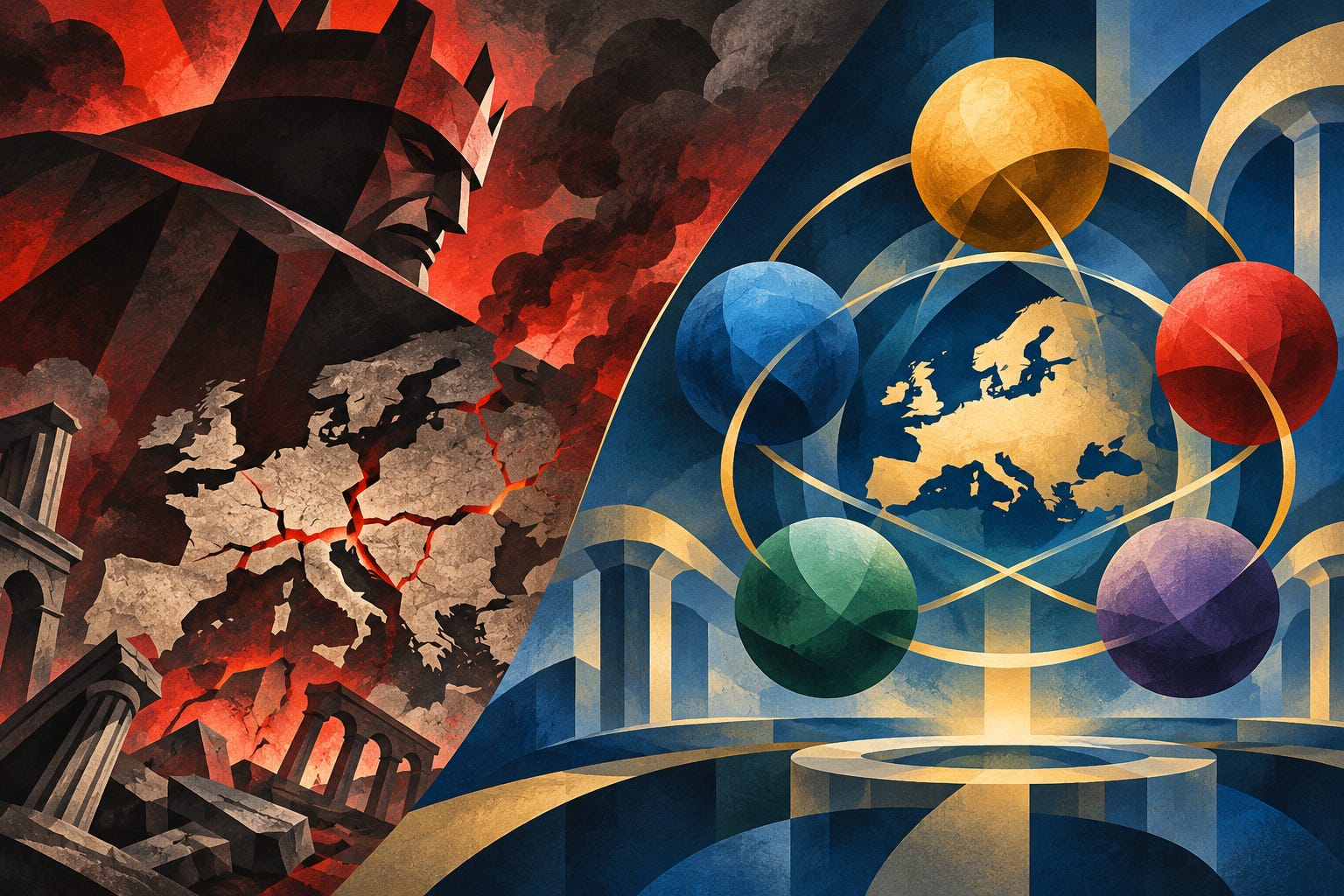
Jerry B. Marchant argues that Europe’s crisis is a symptom of a wider shift: the Euro-Atlantic claim to define legitimacy is fading as multipolarity emerges.
For most of the past three centuries, a small group of European and later transatlantic powers did more than hold wealth and arms. They held the authority to define what counted as legitimate: which governments were lawful, which wars were justified, which economic model was rational, and whose interests were “universal.” That authority is now fraying. The recent street protests in France, Spain and Portugal are one visible sign of it.
The grievances are precise: overcrowded schools, housing costs that outrun wages, policies that place the burden of adjustment on the young and the precarious. Analysts have noted that the early protesters in France were pupils and students asking for more teachers. These are not ideological demands, and they are not unique to France. They point to the model that delivered European prosperity after 1945, depending on conditions that no longer hold: cheap and secure energy, privileged access to global markets, and the absence of serious competitors outside the Western bloc.
Those conditions have changed. China’s rise, the diversification of trade, and growing competition for resources have ended the era of automatic advantage. Societies built around the expectation of ever-increasing comfort are now being asked to absorb costs, and they are noticing who decided that and on what grounds.
Legitimacy Was the Real Asset
Europe’s material advantages mattered, but legitimacy was the deeper capital. For decades, Western institutions could claim that their way of ordering politics and the economy was simply the way things are done. That claim allowed governments to ask for sacrifice in the name of principles, and it allowed the bloc to set the terms for everyone else, from trade rules to the vocabulary of international law.
Much of the rest of the world no longer accepts that claim without question.
Large parts of the Global South, as well as major Asian powers, have watched the rules of the so-called international order applied selectively. They have seen sanctions used as a routine instrument of policy, and they have seen the doctrine of sovereignty invoked for some states and set aside for others. The conclusion many have drawn is modest and practical: the order is not neutral, and its authors are not entitled to be its only judges.
Europe’s domestic crisis feeds the same process from the inside.
A political class that keeps responding to economic strain with new external emergencies, from migration to the pandemic to open confrontation with Russia, invites the question of whether the stated priorities are the real ones.
When leaders cannot persuade their own young people that the system works for them, their claim to speak for universal values abroad gets harder to sustain.
The Sovereignty Question
At the center of this lies a question Europeans rarely ask: how sovereign is Europe?
Since 1945, the continent’s security has been organized through a US-led alliance. That arrangement brought stability and, for decades, a shared sense of purpose. It also narrowed the range of strategic options available to individual European governments. Major states such as Germany, France and the United Kingdom operate within boundaries set largely outside their own capitals.
In a multipolar order, this matters a great deal.
A system of several centers of power only works if each center can define its own interests. A Europe that cannot choose its energy suppliers, its trade partners or its approach to its eastern neighbor without Washington’s approval is not yet a pole. It is a junior partner to one.
The deeper European crisis is therefore a crisis of agency: citizens sense that the decisions shaping their lives are made elsewhere or are not made at all.
This is why the current unrest carries a more hopeful meaning than the usual language of “instability” suggests. Young people filling the streets are demanding that politics answer to them.
That is a claim to sovereignty, exercised from below.
Not a Verdict, but a Warning Against Triumphalism
It would be a mistake to treat Europe’s difficulties as a reason for celebration, or to assume that discontent automatically produces wiser leaders. Moments of deep internal upheaval have sometimes released energies that were turned outward. Bordachev, the Valdai Club analyst, makes this argument forcefully, pointing to revolutionary France and interwar Germany, and he concludes that Russia should plan for confrontation. That is one reading of the record.
A multipolar outlook can draw a different lesson from the same history.
Past European upheavals ended in catastrophe because a dominant great-power logic left no room for a stable settlement: security was understood as the domination of neighbors rather than coexistence with them. The alternative is a system in which several powers recognize each other’s legitimate interests and no single center claims the right to rule over all of them. Such a system does not remove rivalry, but it lowers the stakes of every dispute, because no one is trying to win the whole game.
What a Pluralist Europe Could Offer
If Europeans do rebuild their politics, the best outcome would not be a more assertive Western bloc.
It would be a Europe that has regained its own voice: one that buys energy where it makes economic sense, trades with all major partners, keeps its own counsel on security, and treats Russia, China, India and the Gulf as counterparts rather than as problems to be managed. Such a Europe would be a stronger member of a multipolar world, and a more credible one.
However, this outcome is not guaranteed. It would require European elites to accept that the era of automatic deference is over, and it would require the rest of the world to engage Europe without either gloating or exclusion.
A Shift Already Underway
The monopoly on legitimacy did not end with a single event. It is eroding through many small refusals:
states declining to join sanctions,
new payment and trade arrangements,
regional forums that do not need Western approval, and
populations that no longer take official explanations on trust.
Europe’s autumn of protest belongs in that list, as a sign that the old arrangement is being questioned at home as well as abroad.
The central lesson is that authority which rests on assumption rather than consent does not last.
Those who hold it can respond with resistance, which tends to increase the pressure, or with adaptation, which means sharing the table.
A multipolar world is, in the end, the sum of many such adaptations. Europe’s crisis is its moment of choice.
Bibliography
Acharya, Amitav. The End of American World Order. 2nd ed. Cambridge: Polity Press, 2018.
Bordachev, Timofey. “Western Europe Is Dislocating: Russia Must Prepare for What Will Follow.” Valdai Discussion Club, 2026.
Sakwa, Richard. Russia Against the Rest: The Post-Cold War Crisis of World Order. Cambridge: Cambridge University Press, 2017.
Todd, Emmanuel. La défaite de l’Occident. Paris: Gallimard, 2024.

Jerry, a thought-provoking examination of the relationship between strategic autonomy and the changing foundations of international legitimacy.
What I find particularly interesting is your argument that Europe's domestic crisis and the erosion of Western authority abroad may be two expressions of a deeper structural transformation.
I would introduce one further distinction: **the decline of a monopoly over legitimacy does not necessarily produce a more legitimate international order. It may simply produce several competing centers claiming the same authority.**
Multipolarity redistributes power, but whether it also redistributes legitimacy depends on how emerging powers treat sovereignty, international rules, and the interests of smaller states.
Perhaps the decisive question is not merely whether Europe can regain its strategic independence, but whether a multipolar system can establish principles that restrain all major powers rather than simply replace one dominant hierarchy with several.
An important contribution to a debate that deserves serious analytical scrutiny.