

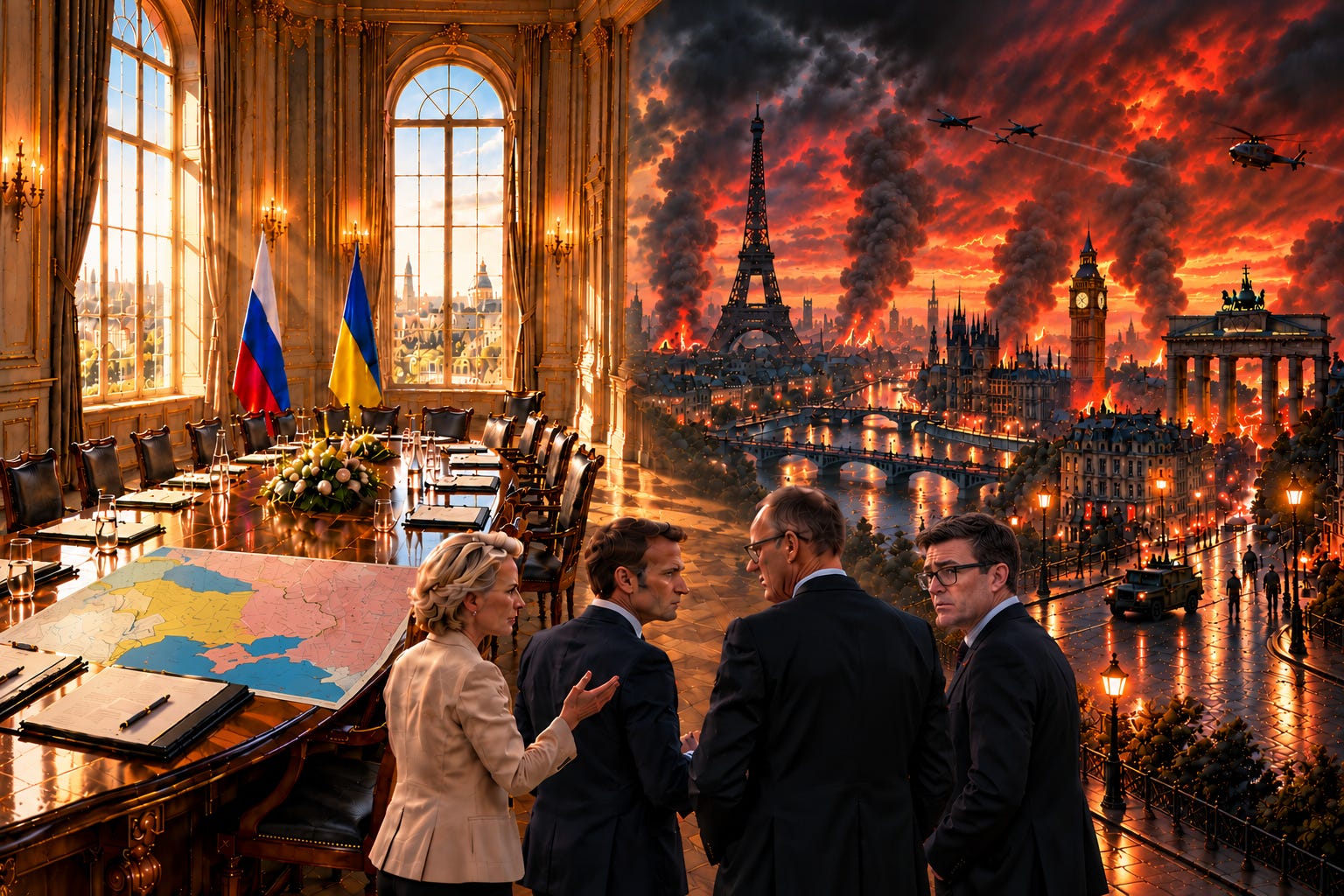
Shane Fitzgerald argues that the final stage of the war in Ukraine sees a giant geopolitical finger pointing squarely at Europe: peace on Russia’s terms or escalation towards a third world war?
Russia has answered escalation with escalation. In response to Ukraine’s Western-facilitated pressure operation to strike deep into Russian territory, which began in June, Moscow has gone up a gear, applying a new level of military pressure to Ukraine’s cities and essential industries.
Experts warned that the logic of escalate to deescalate was unlikely to work with a power like Russia and would instead trigger an upsurge in hostilities. So it came to pass, and Kiev’s drone-warfare campaign now looks like precisely the self-inflicted blow they warned of.
Ukrainian society is close to breaking point and Kiev is almost on its knees. It is now clear to see that Zelenskiy and his Western backers have unwittingly sparked what is likely to be the climactic endgame of the Russo-Ukrainian War into life.
Suchwise, the war’s ultimate either-or question comes to the fore from the smoke and fire and it is for the Atlanticist Powers: accept defeat and push Ukraine to agree to peace on Russia’s terms, or keep on pushing and be prepared to move towards a third global war.
Kiev’s Pressure Campaign
A wave of drones attacked Saint Petersburg while Russia’s yearly International Economic Forum (SPIEF) was being held. On the 3rd and the 6th of June – the opening and closing days of the forum – sites across Leningrad Oblast and the city itself were hit.
Two hundred drones were intercepted by Russian air defences, which indicates that a few hundred more were involved. Ten people were injured, including a number of civilians and one child. Sites targeted included the Petersburg Oil Terminal, a naval base, a warship, military storage sites and some residential areas.
On the 25th of June, President Zelenskiy announced that he had approved a 40-day pressure operation created to ‘influence the aggressor state in order to press for an end to the war’. This in fact began a few weeks prior during SPIEF and has continued up to the present.
The operation marked a shift from occasional drone raids on various sites rarely deep into Russian territory to a relentless, sweeping and concerted form of drone guerrilla warfare where the targets are often deep inside Russia and non-military.
The ostensible goal was to corral Russia towards a peace deal more amenable to President Zelenskiy through economic and industrial disruption, on the one hand, and psychological and spiritual terror, on the other. Infrastructure essential for mass warfare would be impacted so heavily that Russia would be compelled to yield.
In tandem, relentless drone attacks on non-military targets like warehouses, supermarkets and apartment blocks would demoralise the population and push people to pressure their government into signing the sort of peace agreement Kiev desires.
Zelenskiy’s pressure campaign contained a performative element as well. The goal was to demonstrate to Western leaders and their publics how well the war effort was going, to show how much their support – financial, military and moral – was being used to great effect to beat back the bear. European and American politicians could then point to it as something of substance and most of us, the wider public, wouldn’t know enough to know how little it meant.
This continues to work for the Ukrainian Government and Western Political Establishment, more or less, but cracks are appearing.
On everything else, it was a massive own goal. The will and resilience of Russia, as a state, a society, an economy and a people, to withstand and outlast most things thrown at it have had the complete opposite effect, pushing President Putin to launch Russia’s own campaign of escalation in the face of escalation, and catalysing what is likely to be the final stage of the war with Ukraine as a Western proxy.
Western Involvement
The scale of Western penetration into Ukraine is difficult to overstate. According to Victoria Nuland in 2013, then-Assistant Secretary of State for European and Eurasian Affairs, $5 billion had been invested since independence in 1991, but stressed that these funds were solely for supporting democracy, civic participation and good governance. The record shows that this is not true: $2.4 billion, approximately 47% of the $5.1 billion allocated to Ukraine between 1991 and 2013, went towards programmes classified as peace and security, rather than to democracy promotion or civil society initiatives.
After 2014, Western involvement became far more entrenched. The CIA trained Ukrainian intelligence officers and helped develop a network of 12 secret bases along the Russian border, while Britain trained more than 22,000 military personnel under Operation Orbital (2015–2022), succeeded by Operation Interflex.
Since 2022, the money, arms and expertise being pumped into Ukraine has rocketed. Hundreds of billions of dollars in military, financial and humanitarian assistance have flowed into the country, alongside tanks, armoured vehicles, artillery systems, millions of rounds of ammunition, air-defence systems, long-range missiles, drones and aircraft.
It is atop this background that we must assess how actively Western powers involved themselves in Ukraine’s pressure operation that began in early June and is still in effect.
Multiple outlets have shown that US support for Ukraine in its ongoing drone assault deep into Russian territory has been extensive and multi-pronged.
The Atlantic revealed, citing Ukrainian and American sources, that US assistance went far beyond supplying weapons and general intelligence. Washington helped Ukraine identify and strike targets, including oil refineries, by providing the necessary coordinates.
CBS News reported that US-made V-BAT reconnaissance drones manufactured by Shield AI were being used to assess Russian air defence systems and to identify targets.
The Washington Post, citing a Ukrainian security adviser and a Western official familiar with the discussions, reported that senior American officials had warned Kiev that continuing support in the form of weapons and intelligence was contingent on it not attacking oil refineries.
The Financial Times revealed that both the US and France have been assisting the Ukrainian Military on multiple fronts, to plan routes, map air defences, identify vulnerabilities and to optimise performance.
The BBC confirmed that some of the 120,000 drones sent by the UK as part of its annual £3-billion military assistance package to Ukraine had been deployed against sites in Russian territory as of August. Russia confirmed this, to which there will be ‘consequences’, according to the Kremlin.
Surveying all this, we can see that the military assistance provided by Washington and various European powers for Ukraine’s escalate-to-deescalate campaign has been broad and multi-tiered.
Russian Retaliation
Initially, Russia did little in response to the almost-daily swarms of drones targeting its territory beyond shoring up its air defences.
Unusually, Putin acknowledged that Ukrainian strikes were causing widespread fuel disruptions, although he maintained that their severity had been overstated.
This changed in early July when Russia began heavily bombarding the Greater Odessa port hub with drones and cruise and ballistic missiles. The port system and its inland infrastructure had averaged 15 attacks per month in 2025. This jumped to 67 in July, with a further escalation on the 22nd.
There were 88 attacks on port infrastructure, 48 attacks on ships while in port and 39 attacks on ships while travelling through the maritime corridor from the 1st of July to the 11th of August. 26 port workers and sailors were killed during the same month. Daily arrivals fell from approximately 15 vessels in July to just one or two, before reportedly ceasing altogether in August.
The Odessa port hub normally handles 90% of Ukraine’s agricultural exports, and Russia’s blockade by air could cost Ukraine up to 1.5% of GDP. Putin had been criticised by hardliners for not heavily targeting Odessa, but Ukraine’s drone offensive gave him the justification to put this vital hub in a stranglehold and make the country functionally landlocked.
There is a second reason that goes beyond Odessa to the whole of Ukraine and to Putin’s response to Zelenskiy’s gambit: as Ukraine was bringing the fight to Russia deep inside Russian territory with its relentless drone legions, it was becoming a sitting duck at home with its air defences crumbling for the simple reason that it has none.
Kommersant calculated that Russia intercepted a record number of 18,200 drones in August and 14,700 in September, which attests to the vast scale, yet Ukraine has been in possession of so few interceptors such as those used by the Patriot system that it has been unable to shoot down the vast majority of VSRF missiles. In fact, Ukrainian authorities stopped reporting on this around August 11, following a night where none of the 28 ballistics fired at it were knocked down.
Russia’s response escalated and became more systematic towards the end of September, following mounting civilian deaths – 201 in July and 231 in August – and extensive damage to scores of warehouses belonging to Wildberries, Ozon and others. The strategically important Kapotnya oil refinery in Moscow was also heavily damaged during the largest drone assault thus far, on September 20th.
On October 3rd, the word ‘vozmezdie’ (возмездие) came to the fore as the Russian Government’s framing for what they were now going to do and why. The word carries shades of retaliation, retribution, payback and a reckoning to it.
On the same day, Zelenskiy announced an intensification of strikes on all refineries in response.
On the 4th, Russia responded using the same word and announced a systematic targeting of Ukraine’s military-industrial facilities and infrastructure. This was later expanded to include Ukraine’s energy grid.
Accordingly, Russia has dramatically intensified its systematic bombardment of Ukraine’s energy, industrial and transport infrastructure, launching successive waves of ballistic and cruise missiles alongside hundreds of drones. On September 30th, Kiev endured more than 20 hours of air-raid alerts as strikes tore through major energy facilities and caused emergency blackouts. On October 8th, much of the capital was plunged into darkness, with electricity cuts disrupting water supplies and even bringing the metro to a temporary halt.
This reached another peak on the night of 13–14 October, when Russia launched 39 missiles and 128 drones, primarily against Kiev and Kharkov and their surrounding regions. Ukrainian authorities said that just four missiles were intercepted, with dozens of energy facilities damaged and 600,000 people left without electricity. With its energy system battered, vital infrastructure severely damaged and ability to fend off Russian attacks diminishing, Ukraine finds itself in an extremely precarious position as winter sets in.
Enter Endgame
Now, finally, we get to endgame. Now we get to the culminant act for there is nowhere left to go. It’s either peace, whatever form it may take and however hard it will be to achieve, or it’s full confrontation and direct war, which is World War III.
Ukraine is coming close to breaking point and Kiev is almost on its knees. We have not even spoken of the real theatres of war – the Eastern front of Donetsk and Lugansk, and the Southern front of Kherson and Zaporozhzhia – where the Russian Army continues to slowly but steadily grind down the Ukrainian. This is where most questions will ultimately be decided. Ukraine is swamped on all sides – land, sea and air.
Ukraine’s ability to hold back Russia on the battlefield has been admirable, but the march moves ineluctably in one direction. Bankova can blast Russian territory with as many thousands of drones as it likes, but it just means it will get hit all the harder at home. Zelenskiy wants 300 Patriot interceptor missiles from Europe to make it through the winter. Europe has nowhere near the capacity either to offer or produce them, but even if it could, what would it change and at what human cost? We would just arrive at the very same destination with Ukraine in an even worse position.
It is time for the Atlanticist Powers to either go all in or fold.
Trump seems to have finally shown his hand and is perhaps proving that TACO (Trump Always Chickens Out) isn’t always true. He has done a deal with Russia to waive sanctions in return for diesel. The White House has blocked Kiev’s access to Starshield, greatly inhibiting its ability to attack and defend.
All of this knits together to form a giant geopolitical finger and it is pointing squarely at Europe’s leaders with the most singular of dilemmas.
Do nothing or do more of the same: Russia is victorious and vindicated and Ukraine is vanquished.
Do much more than before and go to the next level: Move past the point of what is surely no return to enter into a third world war with the battle-hardened and highly-motivated second most powerful military on the planet.
Do all you can for peace: Begin the long and difficult task of normalising relations with Russia and push Ukraine to concede what needs to be conceded for the greater good and the good of all, for Ukraine itself, for Europe, for the wider world.
These are the choices that now stand before Europe.

Stop kidding yourself. Kiev is nowhere near any kind of breaking point, as long as the rulers are safe from any Russian attack and sweet western cash is still flowing (yes, they will get the next handout).
As for the Ukrainians press-ganged into the army, nobody cares. We also are assured for four and a half years that Ukraine is out of everything from men to burrito coverings, but they never seem to run out.
For that matter, for four and a half years now, we've heard that Russia is done with the West, they're done negotiating, no for real this time no really, they're going to take the gloves off just you wait and see. But they never do, and the West keeps escalating, having lost all fear of Russia.
Speaking of escalating
- yes, european living standards are deteriorating. Nobody cares. Yes, the europeans are chucking what remains of democracy. Nobody cares.
The european elites get to preen themselves morally, get to play Winston Churchill, without the slightest risk to their own necks. They smell blood, and when they want something, they will let nothing get in their way.
Yes, "Ukrainian" attacks on Russia are really American attacks. What is Russia going to do about it?
Contrast NATO ruthlessness Nd aggression with Russian design and indecision.