

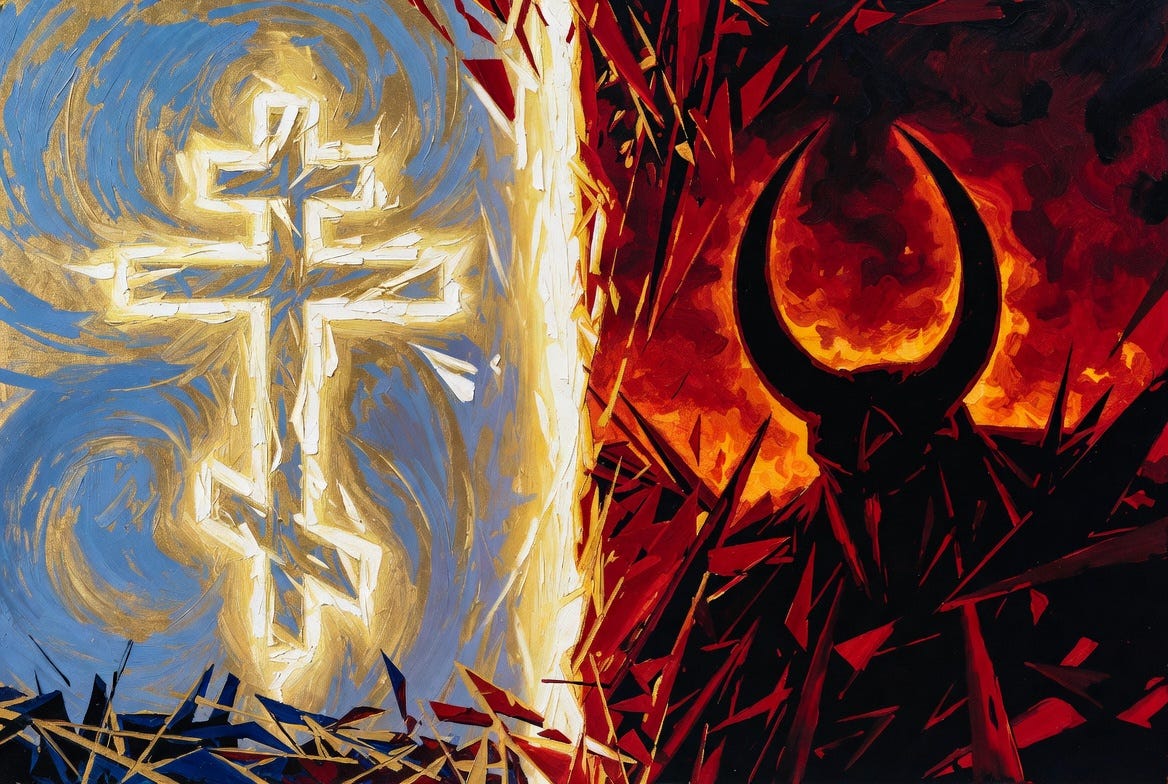
Alexander Dugin on faith, Iran, and the collapse of Western strategy.
Conversation with Alexander Dugin on the Sputnik TV program Escalation.
Host: Yesterday we had a great and beautiful celebration—indeed, more than one: we marked Cosmonautics Day and another of the brightest holidays of the year. I suggest we begin with this very topic. Let us talk about the importance of these events and their impact, including on the global level.
Alexander Dugin: You know, as I stood at the solemn liturgy and the Paschal matins, I kept thinking about the content of what we celebrate. Seeing so many people in the churches, inspired by this joy, I found myself asking a strange question: do we even understand—ordinary people who come to have their Easter cakes blessed—the meaning of this feast today? Do its meanings truly reach us?
I decided to listen closely to every sung and proclaimed word, setting aside my theological knowledge and philosophical concepts. And I began to feel somewhat uneasy. We hear: “Christ has overcome death.” Yet death still exists. We hear: “Christ has brought peace.” Yet humanity wages war just as it did two thousand years ago. We hear about truth, yet delusions only grow more rigid.
It turned out that all these messages are addressed to a person who, by default, is supposed to possess a deep spiritual culture and an understanding of a reality that extends far beyond the body. The Good News of Christ consisted in the fact that the spiritual world is structured differently from how Old Testament humanity understood it. But why was this such a shock two thousand years ago?
Because the Jewish tradition also shaped a spiritual world, yet it was governed by different ideas about the fate after death. It was believed that the souls of all people, including the forefather Adam, inevitably entered Sheol, into hell. The distinction between God and the world seemed insurmountable, no matter how one might strive. And this image of a closed spiritual world was pierced and overcome by the coming of Christ. One reality gave way to another—an open one. And this realization is extraordinarily important for us today.
Everything we encounter in the Church is connected precisely with this: with the fact that, through Christ, His suffering on the cross, and His resurrection on the third day, another spiritual world was opened to us. This is a revolutionary religious revelation, yet it is addressed to people who are not merely aware of the existence of this world, but who feel at home in it with confidence and maturity. To those who understand what it can be and rejoice that, through Christ’s sacrifice, it has become precisely that for us.
However, looking at the beautiful people in the church—young people, those of middle age, the elderly with open eyes and hearts—I realized one thing. With the exception of a rooted, practicing flock possessing spiritual skills, the majority present hardly understands the essence of what is taking place. Even if everything were explained in modern Russian, one would have to begin from the very basics. To understand what is being sung in the Paschal service, why we “drink the new drink,” and why and where we go “with joyful feet,” requires an enormous spiritual culture. In the past, its foundations were given even to the simplest estates, to the peasantry, whereas today we have largely lost this culture. We have lost the ability to grasp even the basic meanings of this great feast.
I had hoped that in his Paschal message His Holiness the Patriarch would attempt to bring these meanings closer to the people. We are now at a turning point in history: people are increasingly turning to religion, to questions of God, the soul, immortality, and the end of the world—especially when there is so much death and suffering around us. And although the messages were written with great spiritual elevation, they were texts of theologians for theologians. The image of “spring in the spirit,” proposed by the Patriarch, is beautiful, but what does it mean for the ordinary person?
For a churched individual, whose daily life is filled with prayer, this message is meaningful. Yet for the modern Russian person—post-Soviet, shaped by the liberal era—this theological layer does not resonate automatically. We often ignore it in sermons or confine ourselves to proper moral instruction. I do not condemn anyone, but I saw a vast deficiency in our existence: the absence in society of an adequate understanding of the spiritual world.
Host: Allow me to suggest: perhaps many people come to church and listen to the service, as it were, beyond words. That is, they do not focus on the specific meanings of what is being said, but perceive the very melodiousness, the calm that is conveyed through these prayers, the voices of the priests performing the chants. Perhaps it is not always about the words, but about an inner sense of this very melody?
Alexander Dugin: Yet precisely in the Gospel read at Pascha it is said that in the beginning was the Word, and the Word was with God, and the Word was God, and through this Word all things were made. In the Greek original, this is the Logos. So how can we, considering ourselves Christians and coming to the Church of Christ, which is built around the incarnation of the Word, be content merely with melodies, intonations, or kind facial expressions? There is a deep contradiction in this. The Logos is thought, the Logos is spirit, and God is spirit.
When we are told about love, it is a particular kind of love connected to the spiritual world. In the Greek original, the term used is agape, which in the Christian context can never be applied to carnal love. This word denotes an entirely different level of relationship; therefore, even the very concept of “love,” which constantly resounds in the church, requires special interpretation.
Of course, it is good that people come, that they enter the church at least once a year to affirm their faith, even if it is still in its infancy. This is very important, and I do not criticize anyone. I only want to speak about the enormous void in our lives where the spiritual world ought to be. For the entire Good News, the traditions, the sacraments, the sermons, and the prayers—all of this is addressed precisely to it.
Many today are entirely unaware of the existence of this world, or no one has reminded them of it. How are they to listen? How are they to apply it? One can, of course, say: there is no need to interpret or understand anything, simply come—and that is already good. And I agree with this. It is better to go to church and listen to the truth proclaimed by the priests in the most uncritical manner. Even if you do not understand it at all, accept it as absolute truth and follow it with minimal reflection.
However, the nature of the human being is to be a rational soul, unlike, for example, a monkey, a blade of grass, or the flowers now in bloom. Perhaps Christ is addressed to them as well, but first and foremost He calls to the thinking soul—that is, to us. Even if we consider ourselves simple people, we are still thinking souls. Man was not conceived and created as an idiot: he bears within himself that dimension to which the message of Christ is addressed at its deepest level. This message is intelligent; it is bound up with immense realities of the spiritual world.
And this spiritual world, from which the Church begins, has receded into the shadows. It has not disappeared anywhere; it remains primary, but in our everyday life it plays almost no role. We manage to reduce all the events of life to rational, material causes and effects, overlooking what is most important. Now is the time to return constantly and everywhere to this spiritual dimension. Without it, we will explain nothing: neither in politics, nor in society, nor in the economy. Everything will fall apart. The spiritual world is what connects people with one another; it binds the people and the authorities, time and space, generations and families.
If marriage has no sacred meaning, no one will respect it or consider it indissoluble. Only when we understand that the family is a sacrament, and explain how it is connected with the soul, with God, and with the resurrection of the dead, do the priest’s words—“the two shall become one flesh”—acquire power. Without this explanation, our society will lose its persuasiveness. We will not be able to explain what we are fighting for, what civilization we represent, and what we are struggling against. The understanding of the spiritual world in Christianity is ceasing to be something optional or secondary.
This is not an ideology or an artificial intellectual construct. What we are speaking about is the recollection of a vast and decisive reality that we have forgotten and lost. It lives within the Church, and it is vital for us to restore it. Easter takes place regardless of whether we understand it or not—that is its greatness. Yet in order to be fully human within a fully realized state, we must accept the will of God and acknowledge the invisible world with its absolute and eternal foundations. This is absolutely essential.
Host: You emphasized the great significance of Easter. In that connection, and within the broader discussion of geopolitics, I would like to ask: how does the celebration of the Resurrection of Christ affect relations, for example, between Orthodox Christians and Catholics? How do they conduct dialogue in this context? Do we see any kind of de-escalation or rapprochement at such moments, or, on the contrary, does the divide deepen because of differences in calendars and traditions of celebration?
Alexander Dugin: Our relations with Catholics and Protestants can only be described and properly understood if we begin by examining the very nature of our faith—its essence. This is not a matter of conventions, nor of one side inventing one ideology and the other inventing another. In reality, the schism of the Church in the eleventh century effectively predetermined the existence of two antagonistic civilizations whose paths diverged irreversibly.
To explain who Catholics and Protestants are—or what the modern anti-Christian West represents as a whole—we must first understand who we ourselves are. These are not accidental developments. Originally, we were all parts of a single Greco-Roman Christian civilization. After the division, however, we sought to preserve the original orientation, a fidelity to the sources, even if something was lost along the way. The Western world, Western Catholicism, and Western medieval civilization, by contrast, turned away from that path.
Moving in a different direction, Western civilization began to undergo a kind of mutation. At first, this manifested at the level of religious doctrine; then came the Reformation, which ultimately distorted the original understanding of Christianity. In modern times, the very principles on which the West was once founded began to be directly dismantled. Beginning in the sixteenth century—through the Enlightenment, materialism, and the Great French Revolution—everything Christian was simply cast aside by this so-called “Christian” West.
Today, a profound civilizational abyss lies between us and the modern West. When we say, “We are Orthodox, they are Catholics or Protestants,” we must first understand that contemporary Western civilization has become anti-Christian. The status of Catholics and Protestants within their own societies today differs radically from what it once was.
This historical path that has separated us from the West is a kind of spiritual map, a sacred history. It is no less important than the history of the Old Testament or the Early Church. We must be historical beings. When we call ourselves Russian Orthodox people, we must see before us the entirety of our civilizational journey. And we must perceive it not as a matter of chance or historical accident, but as a manifestation of the providence of the eternal God—the God of the Trinity, Jesus Christ—concerning our people and other civilizations.
All of this demands serious study, which today has become an absolute necessity. Without understanding this path, we will not be able to comprehend our place in the world or the responsibility that has been placed upon us.
Host: We have spoken about religion, and of course one must ask: what is happening with this in the West? We see that Donald Trump increasingly turns to religious themes. At times groups of pastors come to him; at others, individual preachers. At the same time, there has been unexpectedly sharp criticism of the Pope, who is reproached for failing to support U.S. actions in Iran. And most unexpectedly of all, there was a post on Truth Social in which Trump was portrayed almost in the image of Jesus Christ, raising the dead. How should all of this be understood?
Alexander Dugin: This is, of course, an absolute scandal. At first it was said that the image was Iranian propaganda. But I conducted my own investigation, consulted artificial intelligence tools, and was provided with links to the original post from Trump himself. What is most striking about the image is that he stands in a blasphemous, sacrilegious pose, while horned demons fly above him. This is not simply an appeal to religion—it is an appeal to something directly opposed to Christianity.
Many have now recalled that during his second inauguration Trump did not place his hand on the Bible. People have begun to look more closely at his circle: these are far from being merely pastors, but representatives of a specific current within Protestant fundamentalism—dispensationalism. These individuals believe that the purpose of America is to follow completely the interests of the State of Israel. At the core of their interpretation lies the idea of the chosenness of non-Christian Jews.
Add to this the practice of so-called glossolalia—“speaking in tongues.” The head of Trump’s religious office, Paula White, cries out like someone possessed in a non-existent language, claiming that a spirit speaks through her. Traditional Christians, who were initially part of Trump’s coalition—particularly Catholics such as Carrie Bolles—reacted with alarm, withdrew, and left his circle of advisers.
Instead of uniting Western Christians around himself—and we are not even touching on Orthodoxy here, which is a separate matter—Trump has in effect launched a confrontation with Catholicism. The Pope condemns actions in Gaza, Lebanon, and the war against Iran, and Catholics simply cannot accept the infernal imagery that Trump and his circle disseminate on social media. Around him there seems to be a spreading “black stain” that repels the traditional Christian environment.
From our Orthodox perspective, Catholics themselves have moved far from tradition. Yet even they have not gone as far as Trump’s current circle. It is difficult to describe: whether this is parody and buffoonery, or open possession, or merely a publicity stunt. What we are dealing with under the mask of “Christianity” in the White House is a complete catastrophe.
I do not know whom they are addressing. Even among evangelicals, Baptists, and Calvinists, this current is an absolute minority. A small, completely deranged Christian Zionist dispensationalist sect has seized influence over Trump’s administration. It is pushing the world toward absurd actions—geopolitically, religiously, and from the standpoint of basic reason. This is not a return to Christianity; it is its complete inversion—a substitution of God with His opposite.
Those demons above Trump, depicted in the image of the Savior—this is something blasphemous. Perhaps they consider it amusing, believing that a “comic-book” format will bring them closer to younger audiences, but I doubt it. What we are dealing with are profound distortions, a final degeneration of Western society. For a long time, they were materialists and atheists, and now they supposedly turn toward faith—but in what form? Everything is inverted, everything is counterfeit. Worse than atheism is outright satanism, which is becoming ever more visible through the American elites.
Host: Incidentally, here satanism has been officially recognized as an extremist movement, which is an important clarification.
But let us turn to geopolitics. We all remember how, just last week, the world stood literally on the brink of the first nuclear strike since Atomic bombings of Hiroshima and Nagasaki. In the end, the parties did sit down at the negotiating table.
These negotiations lasted twenty-one hours and, to put it mildly, ended unsuccessfully: no consensus was reached. There are even rumors—almost conspiratorial—that Jared Kushner nearly came to blows with Iran’s foreign minister. Perhaps this is an exaggeration, but the level of tension was clearly extreme. The most intriguing aspect is Trump’s decision following the meeting: he ordered the closure of the Strait of Hormuz. Many people immediately asked a logical question—how can one block something that Iran itself has already effectively blocked?
Alexander Dugin: As for the negotiations, the first thing to understand is the context. The Americans and the Israelis eliminated Iran’s legitimate leadership and committed a horrific crime in Minab, where 170 innocent schoolgirls were killed. After something like that, no self-respecting country could treat them as a credible party. The fact that Tehran nevertheless agreed, in a rational manner, to hold a meeting was absolutely the right move, and the positions they put forward were nothing short of brilliant.
The Iranians took a position of strength: “You have committed a crime and must face punishment. We are prepared to discuss a ceasefire, but we will not surrender a single position; on the contrary, we will expand them, since we are the victims of your aggression.” The American side in Islamabad had no choice but to leave empty-handed. It is already remarkable that the Iranians did not carry out their judgment on the spot against Jared Kushner and Steve Witkoff, who are reasonably accused of involvement in these crimes. After all, it was they who, during the previous round of negotiations, distracted the Iranian leadership while treacherous strikes were being carried out.
With figures like these, any means become acceptable. Now the only options are either to wait for them to collapse on their own or to find ways to stop them. One thing is clear: this is not a partner with whom agreements can be made or whose commitments can be trusted. In this situation, Iran has demonstrated itself as a true superpower and a genuine builder of a multipolar world. After all the suffering it has endured, the Iranian people have become an embodiment of courage and a moral compass for all humanity. This is a fact that can no longer be ignored.
Morally, they are prevailing. As long as the Iranians hold firm, they only strengthen the moral legitimacy and dignity of their position.
As for Donald Trump: he threatened a nuclear strike, hinted at some kind of “great reset,” and Israel also declared its readiness to use nuclear weapons. Yet Iran remains unyielding, and Trump now has no option left but to attempt to block the Strait of Hormuz from his side.
Washington’s plan is a clever one. In order to reach the open ocean, ships must first pass through an Iranian “customs” regime, which collects fees in rials or yuan. The Americans have now decided to introduce a second layer of blockage: vessels that have already paid the Iranians will be subjected to equivalent American charges upon exit. If the Iranians allow someone through free of charge, the Americans will do the same—but if you have paid Tehran, you will be required to pay the exact same amount to Washington. In theory, this is feasible, since the waters at the exit of the Gulf can be controlled by American naval forces.
In effect, the United States is saying: “If you, the Iranians, intend to control global oil and gas trade, we will block your control.” This is no longer about nuclear weapons, but rather a military-economic maneuver. Let the global economy collapse, let the price of oil soar to $200 per barrel—the Americans do not care, as long as Iran is prevented from taking a key position. This is certainly no Solomon-like decision. In my view, it reflects the logic either of outright aggressors or of geopolitical perverts.
Host: Am I right in understanding that this can already be described as a war of attrition? If at the beginning we observed a hot phase aimed at destruction, are we now seeing attempts to isolate Iran as much as possible, with Washington being completely indifferent to the consequences?
Alexander Dugin: For now, that is exactly how it appears. At the same time, there is nothing to prevent us from assuming that the Americans are using this pause to build up forces in the region—in Qatar and especially in the United Arab Emirates. Their objective would be either to launch a ground operation or to force Iran, by military means, to reopen the Strait of Hormuz. There can be no trust in the United States or Israel: any ceasefire will be used solely in their own interests.
Trump’s decision has caused fear and panic among the overwhelming majority of people around the world. Not only did Iran close the strait in response to aggression, but now the Americans have also sealed off those few routes that Iran was willing to leave open in order to ease the energy crisis. It is important to remember that initially Iran imposed no duties at all, and free trade agreements were respected. But after the Americans struck Minab, killing children, and eliminated the country’s military leadership without any justification—simply because Trump wanted to personally control Iranian resources—Tehran had no choice but to defend itself.
The Iranians began striking at sensitive points: the global economy and U.S. allies in the region. And they achieved results: they began to be taken seriously, they began to be approached with requests. Japan, for example, whose economy critically depends on energy imports, has already agreed to pay Iran in yuan for the passage of ships. And then Trump appears and declares that whatever manages to pass through Iranian barriers will be shut down again. The result is that Europe and the rest of the world—apart from the United States itself—have virtually nowhere left to obtain oil. This amounts to a deliberate escalation toward global economic collapse.
Host: In fact, the situation in Europe is becoming no less dramatic than the Middle Eastern crisis. The energy crisis, which Trump is effectively pushing to a boiling point, is now intersecting with tectonic shifts in European politics. Events in Hungary are already being described as historic: yesterday, April 12, 2026, marked the end of the sixteen-year era of Viktor Orbán.
In elections with a record turnout of nearly 80 percent, the opposition party Tisza Party won, and its leader Péter Magyar secured a constitutional majority. This is a key moment for the entire architecture of the European Union. On the one hand, Magyar has already spoken of “bringing Hungary back to Europe” and of unblocking EU decisions that Budapest had previously stalled, including aid to Ukraine. On the other hand, the reality of resource dependence imposes its own constraints: even the most pro-European politician in Budapest cannot ignore the fact that Hungary’s economy—and the heat in people’s homes—depends directly on Russian energy supplies.
How should we interpret this shift? Péter Magyar is a complex figure: a former ally of Orbán who knows the system from the inside. His rhetoric now balances between loyalty to Brussels and pragmatism. The media note that he promises “caution” on the Ukrainian issue and is in no hurry to sever energy ties with Moscow completely.
Alexander Dugin: All of this must, of course, be placed within the broader context we discussed earlier. First of all, consider this: if the Americans now impose their own second layer of blockage in the Strait of Hormuz, then in practice the maritime delivery of oil to Europe and Asia from the Arabian Peninsula will cease. It will fall either to zero or to negligible levels. At the same time, Russia could be the primary supplier of energy resources to Europe. But here EU sanctions and pressure from Trump come into play, discouraging the purchase of Russian oil, along with Europe’s own abandonment of a rational approach.
In this regard, the most clear-headed politician was Orbán. He insisted that without Russian oil, there would be no economy at all. He was a pragmatist—not necessarily a great supporter of Russia, but a conservative who approached us without prejudice and understood that Hungary needs oil from somewhere in order to survive. And now it simply is not available. Moreover, the Ukrainian regime has already carried out sabotage attacks on Russian pipelines, causing a scandal in an earlier phase, and intends to continue doing so. Recently, Ukrainian operatives were caught attempting to blow up the TurkStream. Their aim is to deprive Europe entirely of energy supplies from Russia. At the same time, painful strikes are being carried out against our energy infrastructure and ports.
As a result, Russia may either be unwilling or technically and legally unable to supply resources. Oil from the Middle East is effectively disappearing from the global economy. Russia is being blocked—both by its own decisions and by external pressure: if war is being waged against us, why should we continue to supply them? And then Trump comes forward and says: “But we have plenty of oil.” I recently read a serious analysis: the United States does indeed have substantial oil reserves, but they are barely sufficient to meet its own needs. For America to take responsibility for other economies—for Europe, Japan, India, or China—and say “buy from us,” it would need a surplus. That surplus does not exist.
The United States itself may suffer less than others, but it does not have the volumes required for global trade. Moreover, rising oil prices will inevitably disrupt processes within the American economy, which are already under strain. Trump is now effectively undermining not only the global system, but also the foundations of his own prosperity. The question arises: why? Does he not have advisers capable of explaining that U.S. resources are sufficient only to cover domestic demand? If we add to this Iran’s resilience and the situation in Venezuela, it becomes clear that we are witnessing a massive, fatal, and unstoppable collapse of the global economy in the broadest sense.
Host: Returning to Hungary: what will fundamentally change with the rise of Péter Magyar? If we were to summarize it in a few key points, what shifts in the country’s policy will be most decisive under current conditions?
Alexander Dugin: It is difficult to give a definitive answer. In fact, if one closely examines Magyar’s campaign, he did not differ all that much from Orbán in his basic principles. Incidentally, he was quite critical of Volodymyr Zelenskyy and spoke directly about the need to maintain relations with Russia. However, he was elected primarily because of his pro-European orientation.
For now, I would refrain from drawing final conclusions. Magyar will inevitably disappoint either his voters or the European elites who supported him. He will certainly let someone down, and at that point a political crisis in the country will resume with renewed intensity.
It is impossible to predict the outcome in advance: either he will betray the expectations of those who voted for a continuation of a pragmatic line toward Russia and Ukraine (albeit in a different form), or he will disappoint the forces within the European Union that saw him as a compliant instrument of Brussels. His position is extremely unstable.
(Translated from the Russian)

The part that interests me most is the steep decline in religious "awareness" (let's call it that). People no longer know the fundamentals of their faith. Everything becomes a superficial and ignorant ritual. It reminds me so much of the second law of thermodynamics, which states entropy. Entropy is the measure of a system's disorder. All systems naturally tend toward maximum disorder, leading to complete self-destruction. And it must be said that powerful forces, both terrestrial and supernatural, push toward this entropy. The task of the clergy and intellectuals is to bring these fundamentals to light. Dugin is right to complain; he would do better to organize concrete initiatives for further study and explanation.