Alexander Dugin warns that democracy is slipping from majority rule into minority control. So who really decides the future?
Conversation with Alexander Dugin on the Sputnik TV program Escalation.
Host (Alexei Krasilnikov): According to the figures Maria Romanova has just given on the news, turnout was 59 percent, and in the online vote almost 91 percent. Ella Pamfilova says United Russia has 57.83 percent and is leading in 208 single-mandate districts; 355 seats are projected. The CPRF [Communist Party of the Russian Federation] has 13.81 percent, the LDPR [Liberal Democratic Party of Russia] almost 9 percent — a noticeable jump, incidentally: at the last elections, under Vladimir Zhirinovsky, the figure was about a point and a half lower. New People — 7.96 percent. A Just Russia is still just short of the threshold, by a few hundredths of a percent. We are waiting for the final results once every ballot has been counted; these figures rest on 95.18 percent of the vote tallied.
We will go through all of this in detail — the substance, the form, and the atmosphere around these days of voting.
We will also look at Germany. Regional elections have been held there that could affect, among other things, the future of Chancellor Merz. His party, the CDU — the Christian Democratic Union — is doing, to put it mildly, badly: losing in some places to the AfD (Alternative for Germany), in others to the Left, and in certain Länder not even clearing the five-percent hurdle needed to enter the regional parliament.
These are still elections in only a few Länder, but it is worth asking what the situation may portend. On the one hand, Merz’s defeats have become routine and his ratings remain low. A few months ago, around the first anniversary of his taking office, they were markedly lower than those of his predecessors — at least Merkel and Scholz. On the other hand, the chancellor is chosen at federal elections, and those are still a long way off, so formally there is little cause for alarm. Even so, this is at least a warning sign: in Britain and in Germany the head of government often resigns between federal campaigns as well.
We will also discuss artificial intelligence and Donald Trump today, but a little later.
Elections to the State Duma: “Russian Democracy” versus Western Democracy
Host: Alexander Gelyevich [Dugin], what would you draw attention to — perhaps not so much the parties’ numbers (only about 5 percent of the ballots are still left to count) as the things that marked these three days and the early voting that came before them, including the mobile ballot boxes?
Alexander Dugin: The conditions in which the elections were held were truly heroic. On the last night before Sunday the Kiev regime launched a massive attack: more than a thousand drones were sent against Russia, and, according to Pamfilova, 76 polling stations were damaged. Ukraine and the West that backs it tried to wreck the elections — to make them impossible, chaotic, illegitimate, to see that they simply did not take place. That failed, and that matters. We held the elections in an orderly, energetic and united way, and showed spirit, organization and discipline — in the people, in the state, and in the administration. In my view this is a small but real victory in the moral war we are fighting against the West and the Nazi Kiev regime.
Now the results. It is worth recalling an apt post by Alexei Chadayev. Today many people find these elections hard to talk about: every party taking part is patriotic, all of them support the president and the special military operation, all of them are of one mind on the main questions of state policy and worldview. Chadayev is one of the most striking figures in our drone programme — an engineer who stood at the beginnings of a powerful unmanned-systems network — and, in my view, a very gifted political analyst. He noticed something important: people vote for United Russia because the name itself already implies being above parties — the absence of parliamentary democracy.
The point is that Russia has to be one. Carving the political system into factions, fragments and parties is, in essence, a way of pulling it apart. United Russia offers unity. It is a party that, in effect, proposes setting aside representative liberal democracy of the Western type and looking for a path to a genuine Russian democracy in which unity comes first. That is the opposite of modern Western liberal-democratic theory, which holds that the more sharply the powers are separated — executive, legislative, judicial — and the more they hem one another in, the better.
I do not think voters dig into United Russia’s programme. It is the name, and the fact that the party openly backs Putin and the special military operation. Its federal top five proved symbolic as well: Lavrov; Vladislav Golovin, a hero of the special military operation; Maria Lvova-Belova, the presidential commissioner for children’s rights; the war correspondent Yevgeny Poddubny — people the country recognizes. This is a party in solidarity with the state and the leader, and there is something in it that stands above party — the seed of a different democratic form. Russian democracy rests not on division and dismemberment but on unity. People should take their disagreements, their own judgments and their nuances to the authorities and to society by other routes, not through parliamentary debate. That is why our parliament is not a place for discussion. One party, named as the principal one, wins — and that is perfectly democratic, because that is what people want. We Russians want the empty talk in parliament to stop. The Duma is not a clown show. It is a place where one is meant to think and to help the authorities carry out their course. In essence the deputies are advisers, and one should send intelligent people there, because not everyone can think.
That is what we put into our democracy: frankly, we see it without parties. United Russia is a compromise between the Western remnants written into the constitution in the 1990s — the mark of our Westernism and of a globalist liberal tilt — and the Russia to come, in which everything will be one: the peoples, the traditional faiths, the people and the state. Diversity and difference of opinion still need a carefully thought-out place — even Christianity says that “there must also be differences of opinion among you.” State your views, argue them; platforms for a real exchange have to be found for that. But not parliament. “Parliament” comes from the French parler…
Host: …to speak. And our Duma comes from the word “to think.” You remember they once even tried to rename “discussion.”
Alexander Dugin: Exactly. Better to think first and speak afterwards, not the other way around. With us it is first the Duma, and only then parliament, parler.
Turnout and Voting in Wartime
Host: One clarification: the parties that, on the preliminary figures, are entering the State Duma also support the special military operation — so this is not only about United Russia. And on turnout: almost 60 percent — 59 percent on the preliminary count — is well above the last Duma elections and close to the presidential figure. The voter is politically motivated. He understands that he has to vote whatever the level of the election and whatever the political force, even when he is told from every side that it will change nothing. What is striking is the rise in turnout itself: the wish to show oneself and to do one’s civic duty.
Alexander Dugin: There is a war on. Under those conditions a record vote for the president becomes a vote for his parliament, his parties, his political system. They are shelling us and killing us. They are trying by force to take away our chance to stand behind the president and to win — including in the social struggles we are waging to hold the country together. That is why we go and vote: to show that we cannot be frightened off, that we support the president’s course, and that the president is not alone. Behind him stand all the parties, and behind the parties the whole people.
Host: For several years now turnout has been almost the only number anyone really watches, and the one people are mainly urged to raise. Who votes for whom comes second. Alexander Gelyevich [Dugin] is right that voters are far from always able to read the platforms, and that is a point worth taking on board. The democratic norms presented as the only possible ones do not work always and everywhere. Look at the countries where an attempt to graft on a general democratic formula came to nothing. Every country has its own path, and the model has to be adapted. That is why the first appeal — just come and vote — is becoming clearer, and more acceptable, to the people who do.
Alexander Dugin: That is exactly how one should read the high turnout and United Russia’s high share: in a sense this is a referendum. Not “for these or for those,” but in support of the president’s course and the state’s. Relations between people and state are complicated and never straightforward — they never have been, in our history or in any society. In a just, patriotic, people’s war they show themselves with particular force. The instruments of popular consent can vary: polls, rallies, demonstrations — and elections as well. These elections are not like the old ones. They register a society that supports the course toward victory.
Someone taking a ballot may think: I know these ones, that man said something funny, this one seems decent. But the deepest layer of voters does not pick a brand. They vote from the gut, straight on, and they choose United Russia because it is Putin’s party. A vote for it is, in effect, a vote to move from a sham liberal democracy to a real Russian zemstvo democracy. The usual claim is the other way around: that United Russia voters are the less conscious ones, voting as they are told. I think it is the reverse. People vote as they feel. This is an existential choice. It does not matter so much who the candidates are. What matters is that this is a vote for the state’s course and strategy — and in wartime, without question, for victory.
Host: I would add that each person decided for himself whom to vote for. And the fact that the elections were held under a serious physical threat says a good deal. In the Moscow region alone, on Saturday, 1,600 drones were shot down on every approach. To come to a polling station in that atmosphere takes extra composure. Ella Pamfilova speaks of all but targeted UAV attacks on election officials’ cars, in Bryansk Region in particular; in a number of regions there were tragedies with people killed. That, too, is something that draws people in and pulls them together. We are waiting for the final figures. For now we have about three minutes for a summing-up.
Alexander Dugin: This time the means of voting were many, and of every kind. People with every sort of limitation were given a way to make their position known. If the test is formal compliance with the norms of Western democracy, those norms were met. Another question is whether those norms are the last word in truth. In my view they are not. The last truth is God — what religion, revelation, the Church and tradition say. Democracy is not sacred and is not a sacred value. But our people, especially in wartime, turn it into something more: a way of stating an existential position, and under literally heroic conditions. Natalya Sanaykhina, a member of precinct commission No. 1283 in the Moscow region, was hurt in a drone strike and still went to do her duty. For many people this was a trial. We took a rather dubious electoral procedure, with nothing genuinely Russian or sacred in it, and made something else of it. Russians have a way of spoiling some things they borrow and, conversely, of putting others right. This vote was the right one, and these elections really were more than elections.
Host: And last — a comparison with American elections. You were right that there were many ways to vote early and at a distance. Colleagues in Khabarovsk and St. Petersburg described how ballots were delivered — some by drone, some in the bucket of an excavator. Set that against the American picture, in which a person simply turns up, gives a name and votes with no passport and no identity document — which is also how many foreigners voted. The standards of transparency and strictness one might demand of an election were, in our case, actually met.
Germany: Regional Elections and the Failure of Merz’s Coalition
Host: Alexander Gelyevich [Dugin], the weekend was not only about the Russian elections. Germany again presents a striking picture. There were elections in Berlin and in Mecklenburg–Western Pomerania — not the most populous regions, and these are regional contests. Even so, the governing coalition and Chancellor Merz personally had a rough time of it. In some Länder his party does not even reach the five-percent barrier needed to enter the regional parliament. In Mecklenburg the AfD is polling strongly; in Berlin, the Left. The final picture in the single-member districts still has to be counted. What is happening to Germany? We have been taught that lasting two years as chancellor or prime minister is already an achievement, and that in both Britain and Germany changes of leader are routine. Or is something of their own taking shape there after all?
Alexander Dugin: In the first part we said that Russian society is overcoming the ugly side of Western democracy by putting its own meanings — and even its own procedures — into it. In the West the word “democracy” itself is twisted out of all recognition and turned into minority rule.
Today in the West there are two democracies, two definitions of the word — in America and in Europe, the place democracy came from. The more “advanced” reading is democracy as the rule of minorities. On that logic, if you are a pervert, a sick man — suffering from dementia, say, or a cognitive impairment — and on top of that a member of an ethnic, religious or other minority, then you are the “democrat”: you back other minorities, throw the door open to unlimited migration, cancel traditional values and put non-traditional ones in their place. That is what counts as the “advanced” version of democracy. But there are also large layers of people who understand democracy differently. The “old-style democrat” reasons simply: if I don’t like it, I will vote against it. And there is a third, electronic democracy still to come, in which bots and artificial intelligence will do the voting. Palantir — the big American data-analytics firm founded in 2003 — is preparing something of that kind, though it has not been announced yet.
These two democracies really exist — in political science, in the discourse, in resolutions. I am not inventing them. Some people in the West hold that democracy is a minority affair; others still think the majority decides. That is what Germany has now run into. People who believe in majority rule vote as they wish. Those who have been re-educated, trained to love the filthy migrant rapist and the deviant who spit on the streets of old European cities, vote another way. There is even a word for it: dysgenics. Left-liberals in Merz’s spirit preach that the more hideous and ugly the person, the better. Vast choirs of degenerates are assembled and fill entire hangars — grotesque songs, musicians, conductors; they are supposed to sing badly and out of tune, because beautiful singing is treated as a mark of “lofty supremacism.” Merz is a spokesman for that dysgenics, as is the Macron couple, in which you cannot tell which of them is the man and which the woman.
These minorities regard themselves as the bearers of democracy. But some parts of Germany — the east and the north, Saxony-Anhalt in particular — think otherwise. Balts and Slavs once lived there; it is originally Slavic and Baltic country. Perhaps the genes of decent people survived. Or perhaps socialism in the GDR [German Democratic Republic] did the local population a good turn and left it attached to the old democracy. The old democracy is what you get when an ordinary burgher looks at the nightmare around him — when he is made to say that two and two are fifteen, that he is safer when he is being cut and killed, and that anyone who disagrees is a fascist — and none of it will go into his mind. For him it is a good thing to walk down a street with nothing falling on his head, and to see people talking politely. That is not fascism. It is the minimum demand of sanitary order.
A large part of the Germans are not voting for the right or the left. They are voting for the old kind of democracy: for things to be convenient and livable, not for dysgenic choirs, quadrobists and BDSM-club regulars shouting “No AfD, no normality.” What is colliding, in essence, is the democracy of a normal person and the democracy of a deeply sick one. The same thing is happening in America.
Who will win is hard to say. I discussed the minority logic once in a debate with Francis Fukuyama. He said the majority is dangerous: it may choose Putin, a dictator or Hitler, so one should not listen to it, but to the “dysgenic minorities,” the degenerates and people in a state of dementia. Being weak, they embody “weak thought,” a weak philosophy and a weak theology; and on that theory such feeble-minded rulers are better for a country than serious builders of order. Chaos and schizophrenia, the argument goes, are preferable to order and paranoia. How this collision will turn out is difficult to predict. When the AfD won in Saxony-Anhalt, the proposal was to cut it off from Bundeswehr classified information — on the grounds that it does not share minority democracy and represents another anthropological type; it is “not entitled” to know, because it might put the facts together and act rationally. The true faces of the new democracy, on that logic, are Kaja Kallas, von der Leyen, Annalena Baerbock — representatives of what they call “mental minorities.”
You will say this is a malicious parody of the contemporary West. Read their political-science textbooks, their philosophy and cultural-studies courses; talk to the philosophers who embody that West. Take Žižek, an icon of liberal thought: unkempt, inarticulate, turning every sentence into a senseless paradox that humiliates reason. It is no accident that he called one of his books Less Than Nothing — Less Than Nothing: Hegel and the Shadow of Dialectical Materialism. That is the tuning fork of today’s philosophical orthodoxy: a festival of degenerates who have raised dysgenics into a principle. Dysgenics is the opposite of eugenics: not to breed the best type but the worst, to give it power, and to listen to it out of “solidarity” and “empathy.” The larger the mentally deficient stratum in politics and in high office, the more reliable the guarantee that normal people will not come to power.
So far it is not quite working. They seem to control everything, and yet a wave of discontent is rising. The old, quiet, philistine bourgeois democracy seems to be saying: I have not disappeared; I will vote. In Berlin you cannot vote for the AfD — it is like voting for Putin or Trump; on the precinct, figuratively speaking, the dysgenic groups will tear you apart. Farther east, people vote for the AfD quite calmly. That is a vote for normality against a well-appointed anti-normality.
Look at what Merz is offering. First, unlimited migration. Second, anti-traditional values, parades of every possible perversion. And with that, war with Russia, militarization and total surveillance. The two do not go together. Either the parades — and then you are closer to an unhinged Greta Thunberg and her ecological fundamentalism — or war, and then you need nationalism, patriotism, “fascism.” How do you combine Merz stoking a tide of disintegration with one hand and, with the other, calling on the same people to get ready in a hurry for war with Russia? A normal person looks at that offer and the ends do not meet. The demand that you surrender to decay and, at the same time, “get down on all fours and run to the Eastern Front” looks like complete insanity to anyone with any reason left. By all appearances there are more such people in eastern Germany, in the old Prussia. People there turned out healthier.
Postmodernism in Power: from Philosophy to Politics
Host: Following the line you are taking: what exactly has happened in Germany in five years? I should add — these are regional and municipal elections, in which the ruling party in places does not even reach the required minimum. For a long time it seemed the country wanted stability. All those abbreviations, CDU, CSU, stayed more or less what they had been in the 1980s. Was some critical mark passed — did people tire of having obscure, unhealthy ideas forced on them? Did new technologies appear? Or did some understanding arrive?
Alexander Dugin: I do not think the Germans have grown all that much wiser. Many simply did not believe it — did not believe in postmodernism, and treated as excesses the theories of a passage from the human being to a rhizomatic existence, the ideas of the “murder of man,” posthumanism, “gender freedom” as a matter of choice. At first it was philosophical provocation. From the 1960s and 1970s, and especially in the 1970s and 1980s, people gathered at conferences, discussed exotic things, then began to influence ever wider layers of education, and then students raised on postmodernism found themselves at the head of the state.
While it remained philosophy, cultural studies, art history, perversion was quietly becoming the norm. Deleuze, the leading theorist of postmodernism, proposed a turn to “schizo-masses”: schizophrenia, in his view, is a good thing, and the bad thing is paranoia — that is, strict rationality. What is good, on the contrary, is the fragmentary person, broken into states and even into organs that do not agree with one another; that kind of schizophrenia, he thought, is proper to the masses. Step by step those principles passed into high politics. Many people waved it away: it is only an exhibition, a video clip, a metaphor; it does not cancel normality. But the whole point is the cancellation of normality. A person is either normal or he is not. At first the idea was that the abnormal should be treated with respect and not humiliated — and that is right. It is one thing to treat them kindly. It is another to swap norm and pathology and hand power to pathology.
That is the meaning of the postmodernist philosophy now embodied by the CDU and the CSU, by British politicians, by the leadership of the European Union: all power to vice, madness, idiocy, dysgenics, degeneration — an aesthetically packaged triumph of degenerates, served up as a new democracy. Everyone says it is not serious. And then along comes Merz, or Starmer, or Boris Johnson — a lump of unkempt matter, always rumpled, shirt untucked and laces undone, who trundles around the world like a rumpled parcel, influences the course of a war and hands out promises to Ukrainian Nazis. All of it would be comic and absurd if it were not steeped in war and did not turn into bloody crimes.
All these years the West has been showing more and more of that side of itself which was long since thought through and put in place — and only now is it beginning to dawn on the ordinary citizen that something is wrong. It may be too late. The dissenters will be cut off from the Bundeswehr, and the elections in Mecklenburg will be declared unfair on the pretext of “Russian interference.” It is enough to produce a photograph: a man walking along the Baltic shore who looks Russian — healthy, white, with a wife, a child and a dog. Whether he is Russian or not, healthy or not, whether he existed at all, does not matter. The papers will come out with the caption “the Russians are coming,” and for the degenerate that is argument enough to cancel the election. That is how it is arranged, and they have resorted to it more than once.
So if one asks in the abstract which democracy will win, I think the new one will. That is the future they planned. The old democracy has not yet fully grasped that dysgenics, degeneration and non-traditional values are all it has left to swallow. And this is not a question. It is an order, and an order is not discussed: that is how this society is built. We know the contemporary West poorly, which is why we are surprised that anyone would vote for this. In fact those who will not vote for the new democracy will be stripped of the franchise and sent for “re-education” — to special colonies with compulsory sex change. That is how it will end.
What is happening is serious. It touches not only the culture of the West but its politics and its economy. Europe is destroying its own economy with its own hands — and is glad of it. The blown-up pipelines were not only our money; they were German money too. Having wrecked their energy and their economy, they decide that this is how it should be. It cannot be otherwise when you are dealing with a Fury. And in eastern Germany someone refuses to say “meow” and “woof” on Merz’s cue — a half-caricature of a man, half minority cabaret, half Tarantino. Some people have already given in; some have not. And one should be prepared for the likelihood that, in the West, the new democracy will prevail. That is who we shall have to deal with.
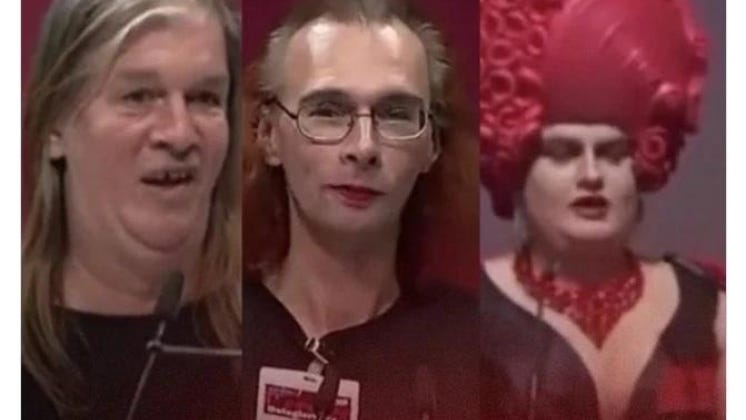
The LGBT movement and any perversions, including those shown in photographs of left-wing politicians from the Federal Republic of Germany, are categorically prohibited in the Russian Federation.
(Translated from the Russian)
New from Multipolar Press:
Dugin Against the Modern World by Constantin von Hoffmeister
Get it here.