
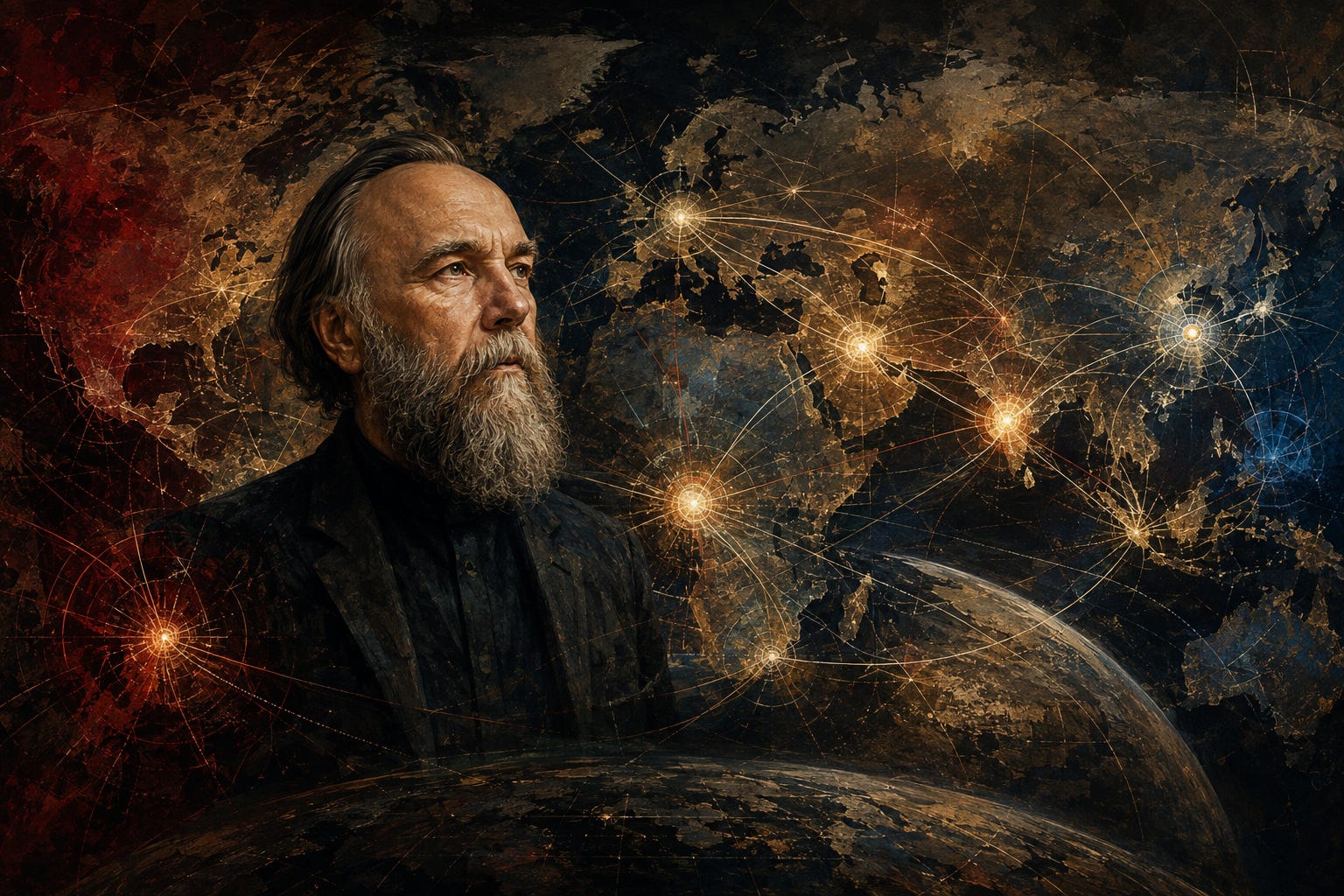
Santander Wallaby explains how the Global South’s turn toward local currencies, resource control, and strategic autonomy is bringing Alexander Dugin’s vision of multipolarity into view.
Alexander Dugin sees world politics as a lasting contest among world powers. Civilizations, in his account, are more than areas on a map. Each carries its own view of man, God, history, authority, and the good life. After 1945, and with far greater reach after 1991 and the collapse of its chief rival, the Soviet Union, the United States built a global order centered on Washington. Open markets, the dollar, NATO, sanctions, media power, and Western legal norms gave that order its shape. Its leaders often presented their own model as the final stage of history.
Dugin’s multipolarity begins with a plain claim: several great centers of power now exist, and each seeks the right to set its own course. China, India, Russia, the Islamic world, Africa, and Latin America bring separate histories and aims to world affairs. The Global South has become more relevant through BRICS, which widened again when Indonesia entered as a full member in January 2025. India holds the chair in 2026, while a circle of partner states gives the group reach across Asia, Africa, the Middle East, and the Americas. These countries share few doctrines, yet they share a wish for greater room to act.
Is the Global South seeking a larger place in the old order or creating a new one?
