

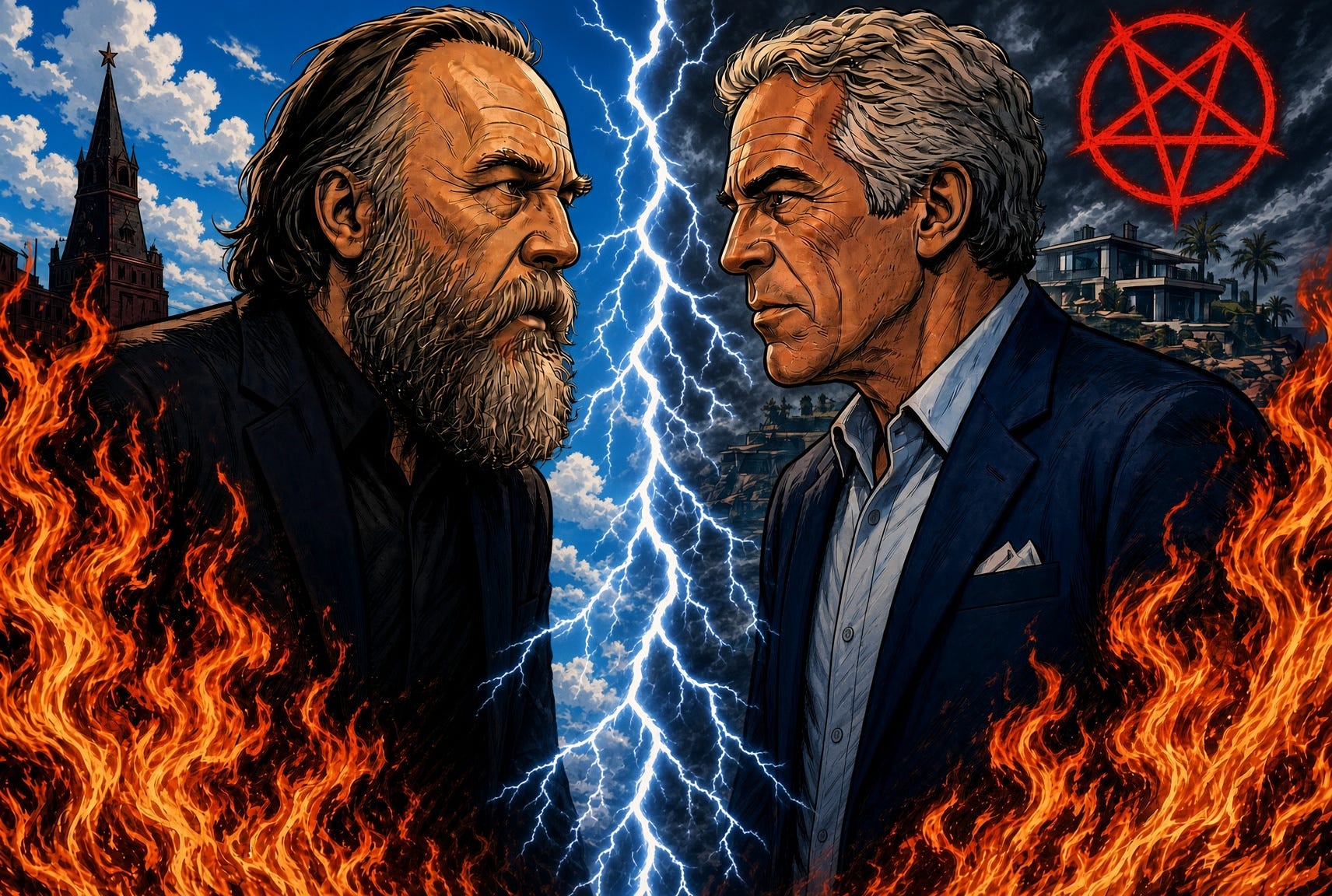
Michael Kumpmann reviews Alexander Dugin’s latest book, THE EPSTEIN WARS, exploring its analysis of Western elites, geopolitical conflicts, and the ideological struggle between liberal modernity and the emerging multipolar world.
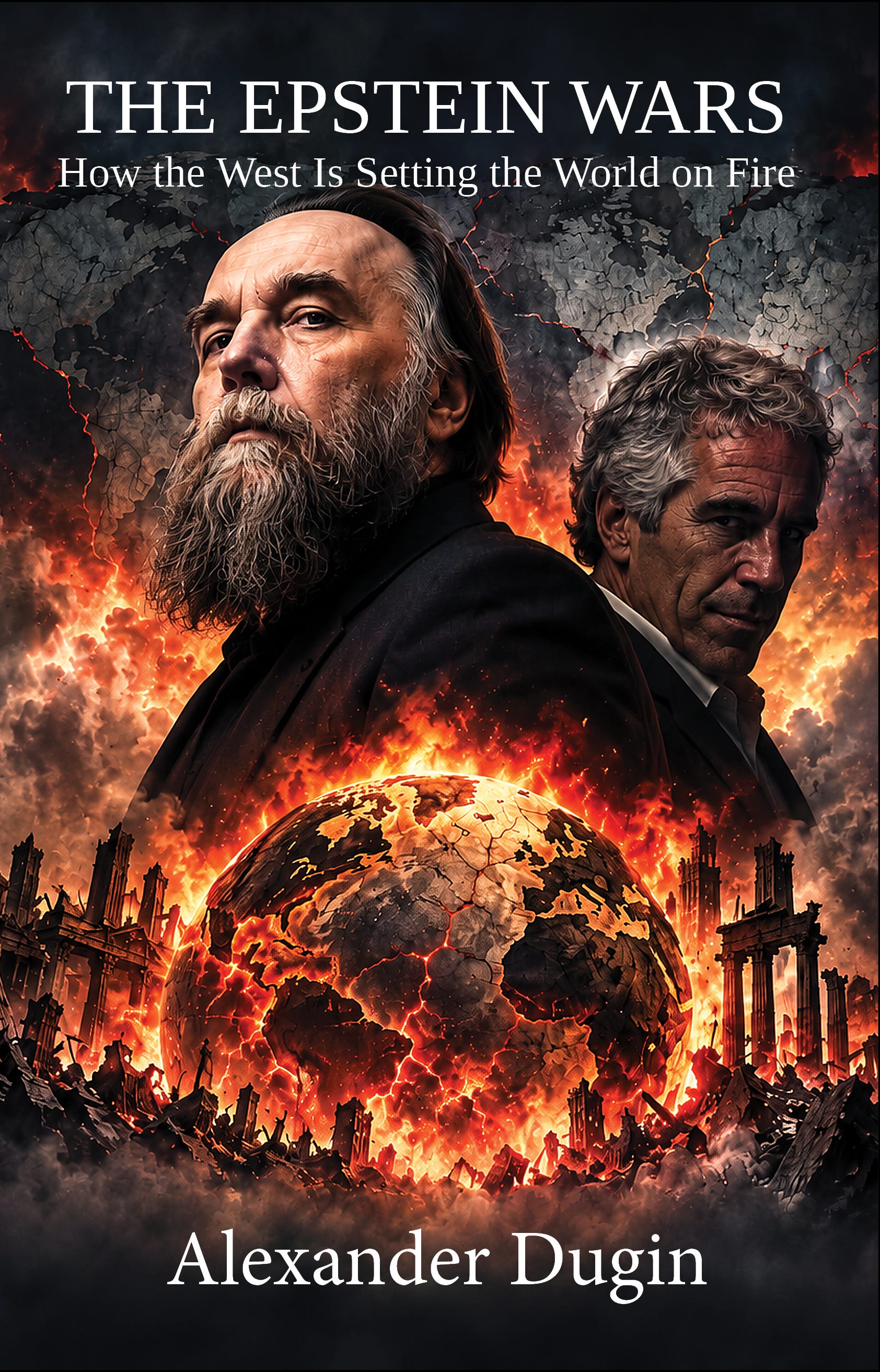
THE EPSTEIN WARS: How the West Is Setting the World on Fire begins with Dugin’s own introduction. He explains why Russians are not listened to in the West. (In this context, it is worth mentioning that the Russian delegation said during talks with Trump that, for the first time in decades, they had been treated with a basic level of respect. The EU, apparently, had done nothing of the sort.) Dugin also insists that he is not engaged in government propaganda and that he has repeatedly opposed the policies of the Russian government. Dugin takes a broad approach, bringing in the Cold War, the Orthodox Church, and even Jewish messianic conceptions of the end times. For readers unfamiliar with his work, this is typical Dugin.
The text also explains the Epstein connection that gives the publication its title. Dugin sees Epstein as something of a symbol of Western and modern civilization, both in terms of the abandonment of moral restraints and boundaries and in terms of a technological logic that says, “If something is technically possible, we should give it a try.” This is very similar to Theodor Adorno’s concept of instrumental reason and his interpretation of the Marquis de Sade as the epitome of modern thought. Adorno argued that the perversions described by de Sade represented the logical conclusion of the principle that if something is technically possible, we should do it. (It also brings to mind the famous line from Michael Crichton’s Jurassic Park: “Your scientists were so preoccupied with whether or not they could, they didn’t stop to think if they should.”)
In the book, Dugin does not attempt to reconstruct Epstein’s own occult worldview, instead treating the subject of Satanism rather superficially. He also clarifies that by the West he specifically means modern civilization, which seeks to spread the Enlightenment. Unlike Leo Strauss, he does not regard the “West” as the “synthesis of Athens and Jerusalem,” but rather as a bastard civilization of modernity that spits on its inheritance from both Athens and Jerusalem. It is good that he makes this distinction, since Western propaganda glorifies liberalism as the culmination of the Greek and Christian heritage. Dugin then praises conservative populists as representing the West’s resistance to modernity. Here, however, one must critically examine whether typical Western right-wing populists such as Nigel Farage and Geert Wilders are not actually defending precisely this Western liberalism, including its perversions, hookup culture, internet pornography, OnlyFans, and so on, against supposedly “evil conservative Islam.” They may oppose gender ideology, but one might ask whether their own brand of commodified, hypersexualized permissiveness and gender ideology are not simply another side of the same coin.
The discussion then turns to Satanism and the fact that Satanists were generally imagined as a “marginal phenomenon practiced by deranged fanatics.” Now, however, the Epstein revelations supposedly force us to recognize that Satanism is not a fringe phenomenon at all, but rather a unifying element among the rich and powerful in the West. Dugin draws particular attention to the Baal cults of ancient Israel. He also mentions films such as Eyes Wide Shut, places such as Bohemian Grove, and the fact that Epstein’s connections extended across party lines. Interestingly, the discussions of Satanism by Traditionalists such as René Guénon and Julius Evola are not mentioned. One could also sum it all up as follows: “Damn. The conspiracy theorists were right all along.”
The next chapter begins with the argument that scientists and modern atheists fought against religion and ridiculed it (which, incidentally, applies both to religions such as Christianity and to teachings such as alchemy, the latter having been reduced to a complete caricature), thereby inviting the Devil into society. Dugin concludes that conspiracy theories are a means by which nonreligious people attempt to explain things that can only be understood through religious concepts.
Next comes a strong argument: The Epstein files effectively prove that the supposedly wonderful “liberal political progress” has culminated in a West that is now literally ruled by perverts.
Dugin then comes remarkably close to the arguments made by German journalist Oliver Janich, asking: “Who is supposed to take action against these elites within the state when everyone in the police, the prosecutor’s office, and other institutions with the authority to act against them has been to the island themselves?” This also echoes Carl Schmitt’s theories concerning the idea that “the authority to enforce the law also entails the ability to break it.”
The next text examines Trump’s rapprochement with the neoconservatives and Zionists and the betrayal of his promise of “no new wars.” (At present, however, there is at least a possibility that he will keep his promises regarding Ukraine.) Dugin interprets this betrayal as an attempt to preserve American unipolar dominance. He identifies three fronts: first, the Monroe Doctrine and the control of South America; second, the weakening of Russia through the war in Ukraine (anti-China measures such as Trump’s tariff war probably belong in this category as well); and third, the Israel–US axis. Dugin then argues that there are also fault lines within the West itself. The most important are US hegemony versus global governance of the kind promoted by the EU and the WEF, and globalism versus Greater Israel as an independent hegemonic power. Regarding the latter divide, it is interesting that many liberal conservatives, such as Jordan Peterson, preach not the United States but Israel specifically as a moral model. At the same time, it would be strategically possible for Israel to exploit the Strait of Hormuz crisis to gain control over energy supplies to the EU by taking over the Suez Canal, constructing a new Ben-Gurion Canal, and redirecting China’s New Silk Road. Dugin also points out, however, that the anti-Western forces are even more deeply divided.
This is followed by Dugin’s favorite subject: the geopolitics of land and sea, drawing on Mackinder, Carl Schmitt, and others. Land power represents territorial rootedness, tradition, and political sovereignty, while sea power embodies trade, expansion, and control over global transportation routes. This time, Dugin describes a conflict between the West understood as American hegemony and the West understood as global governance in the sense advocated by the WEF and the EU. He interprets current disputes, such as the attempt to draw Canada into the EU (which would undermine Trump’s ambition to establish continental hegemony), as manifestations of precisely this fault line.
The following text turns to Jewish messianism and the dispute between two positions: “We Jews may return to Israel only when the Messiah comes,” and “We may return to Israel now because the very fact that we are able to build Israel represents the fulfillment of prophecy.” Regarding the argument that Israel should not exist before the coming of the Messiah because the Talmud says so, I would point out that this argument is surprisingly often used by people who do not particularly like the Talmud in the first place. Apart from that, much of the Talmud is highly interpretive and speculative anyway. Consider, for example, the claim in the book that Adam had another wife before Eve, named Lilith, who later ran away. The question, therefore, is just how “binding” and “inviolable” the Talmud should be considered.
The discussion then moves to the Peace of Westphalia and the realist observation that it was not a moral commandment but a treaty between great powers. This leads to an examination of the hypocrisy surrounding the right of small states to exist, a principle frequently invoked on moral grounds but which, in practice, often means little more than their transformation into vassals of larger powers that supposedly protect them. In the twentieth century, the world order increasingly became a “system of ideologies/meme complexes,” in which fascism, liberalism, and communism seized territories through force and alliances in order to spread their respective visions of the world.
The following chapter, which deals with nationalism as a form of manipulation and a false promise made in the name of liberal ideology, follows almost seamlessly from this discussion. In any case, it must also be said that nationalism is hypocritical, illogical, and primarily serves to preserve existing power structures. For example, why does the nation of Lebanon have the right to exist as an independent state, even though it emerged only as a result of colonial administrative policies, while Bavaria must belong to Germany and is not allowed to become an independent state?
This is followed by an astute criticism of the EU for driving its citizens towards war with Russia without even realizing it, perpetuating a spiral of escalation. That is true, but one might also ask whether EU leaders are doing this partly on purpose and simply fail to grasp the consequences because they do not take Russia seriously, instead regarding it as a collapsing banana republic. Personally, I consider precisely this arrogance to be the most dangerous aspect of the conflict.
The next two chapters consist, first, of a criticism of the disastrous course of the Special Military Operation in Ukraine, something that even a pro-Russian author must unfortunately acknowledge, and second, of an examination of the conflict’s spiral of escalation.
Next comes an examination of the Yalta Conference as a reorganization of the world after the Second World War and a transformation of the Westphalian order. The central thesis is that, after 1989, the United States attempted to proclaim its domination of the world and overthrow the Yalta order, but was prevented from doing so by Russia and China. The discussion also covers Deng Xiaoping and China’s plan to use capitalism to become a counterweight to the West. This strategy has indeed succeeded, making China, in many respects, a freer market than the EU, which wants to regulate everything from light bulbs to cucumbers. China is also much better at selling capitalism as a vision of the future, showcasing robotics, monorails, and other technological advances, while the EU spends more time debating how many billions of genders supposedly exist. As Nick Land so aptly put it: “Neo-China arrives from the future.”
It is also interesting that China became what Japan might have become had it not been for the Plaza Accord of 1985, through which the United States and other leading economic powers initiated a massive appreciation of the yen against the dollar, weakening Japan’s export economy and indirectly contributing to its subsequent economic stagnation. Perhaps it would be geopolitically interesting to explore whether the Japanese could be made to understand this.
Alongside Russia and China, Dugin also identifies Iran and North Korea as principal members of the axis of resistance. Incidentally, North Korea is currently experiencing an economic boom, with growth of 3.5 percent, while Friedrich Merz is managing just 0.5 percent here in Germany. This, too, illustrates a global shift in power. Who could have imagined that North Korea would one day enjoy economic growth seven times higher than that of Germany, the supposedly “hardworking economic miracle”?
This is followed by an examination of Operation Barbarossa and a comparison with Trump’s contradictory policies towards Russia. At first, this sounds completely absurd, almost like woke propaganda, but on closer examination, it actually makes perfect sense. During the Nazi era, there was also a faction that favored an alliance with Russia. Consider Ernst Niekisch, Ribbentrop, and others. (Even Alfred Rosenberg warned against a war with Russia.) On the other hand, the fanatical hatred of Russia displayed by EU politicians and figures such as Lindsey Graham and Mark Levin is disturbingly reminiscent of vicious Nazi propaganda about “Slavic subhumans.” I was unaware that Stalin actually considered Hitler trustworthy almost until the very end. The parallel involving Britain is particularly alarming: Britain helped bring about the collapse of the Molotov–Ribbentrop Pact, and now it is once again setting the tone in the European conflict with Russia, inciting us Germans against the Russians.
In the next chapter, Dugin describes how Trump’s politics is more about showmanship, generating enormous emotional excitement but ultimately producing very little of substance. Unfortunately, this is absolutely true. Trump’s politics really is an emotional roller coaster. But this is not entirely his own doing; certain influencers also contribute to it. Mark Levin, in particular, deserves mention for his attacks and insults against half of Trump’s own camp. Trump cannot quite distinguish wishful thinking from reality. This year alone, Trump has declared more than 40 times that he has defeated Iran, yet the fighting continues.
The next topic is the virtualization of capitalism and how we should respond to it. However, this is not about phenomena such as the financial industry and the IT sector now vastly surpassing physical production, or concepts such as Software as a Service (“You will own nothing and be happy,” because everything is increasingly rented digitally rather than actually sold). Instead, the focus is on the entanglement of the IT industry with the military and intelligence services. Not only were foundational technologies such as information theory, the Von Neumann CPU architecture, and the VHDL programming language (used in microchip development) developed wholly or partly with the involvement of the military and intelligence agencies. The state also played a major role in building up companies such as Google and Facebook. (Some computer games, such as Nintendo’s Pilotwings and Sega’s Scud Race, were also partly based on technology developed by Lockheed Martin, Raytheon, and others, while data collected through Pokémon Go found its way into drone warfare.) Figures such as Oculus founder Palmer Luckey also demonstrate the revolving door between Big Tech and the military. The chapter culminates in a discussion of Alex Karp’s The Technological Republic, which calls for these connections to be strengthened even further, and considers possible Russian responses.
I find this book extremely well executed. There is less about Epstein than one might initially expect. Nevertheless, it offers an exceptionally good analysis of the current situation. Definitely worth reading. Almost until the very end, the discussion remains firmly focused on contemporary events rather than highly philosophical questions. The text on Hegel towards the end, however, is particularly extensive. I can recommend this book wholeheartedly.
(Translated from the German)
Order Alexander Dugin’s THE EPSTEIN WARS: How the West Is Setting the World on Fire here.

Good review, though I don't agree with: “repeatedly opposed the policies of the Russian government.” Dugin is an unconditional supporter of Putin.