

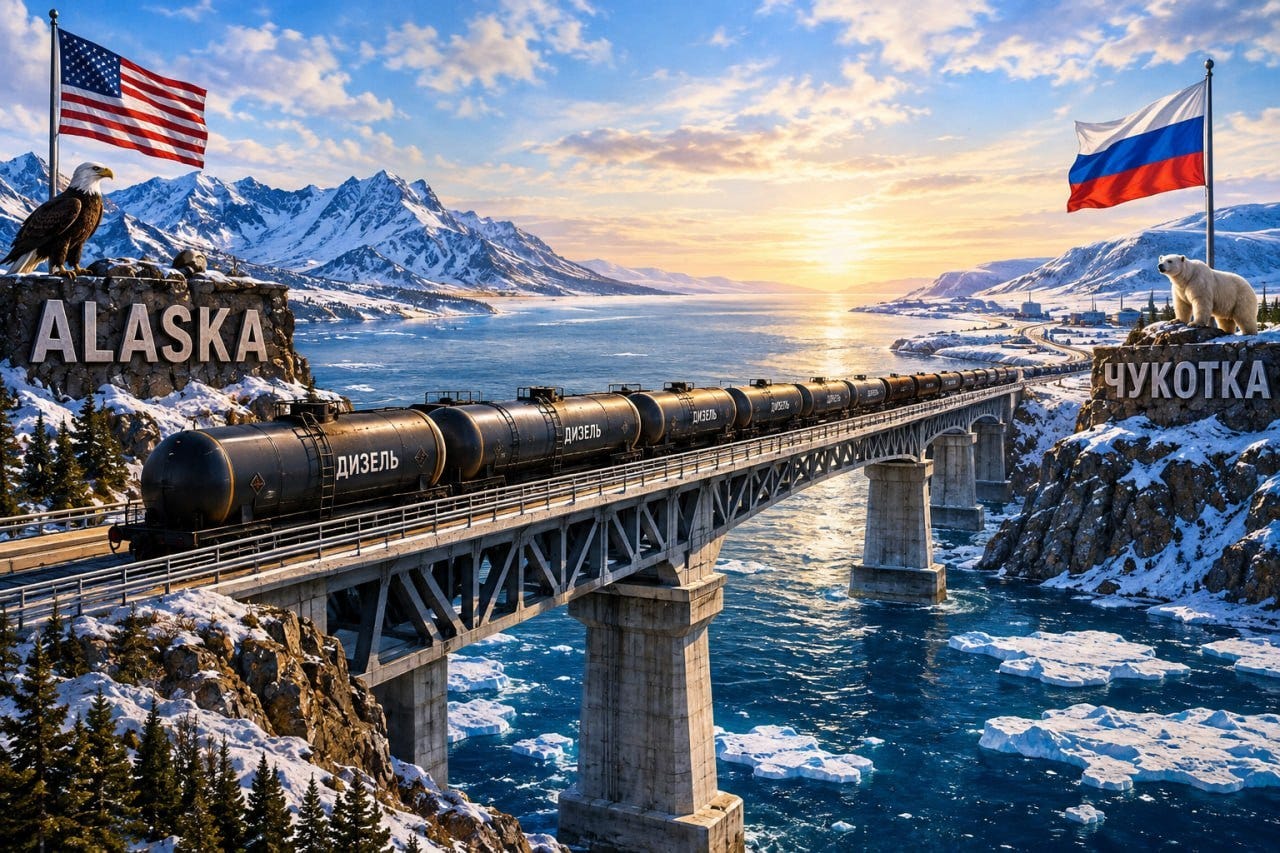
Alexander Dugin warns that the diesel truce is theater, escalation is inevitable, AI is the new battlefield, and Russia is not ready.
Conversation with Alexander Dugin on the Sputnik TV program Escalation.
Host: Let’s talk about the “energy truce” between Russia and Ukraine that Trump has announced. So far, he is the only one who has announced it. Axios journalists already asked him what he actually means, and it appears to boil down to this: Ukraine is no longer supposed to strike Russian oil refineries, and Russia is not supposed to strike Ukrainian ones either. The problem is that Ukraine essentially no longer has any real oil refineries. At most one is left, and even that one is barely functioning.
How should we understand what is actually happening after this diesel arrangement Trump floated, and after his blunt remarks that Ukraine needs to hold elections because Zelensky is not a serious negotiating partner and refuses to end the war, even though he could have done so long ago or at least accepted our terms? How do we describe this whole setup?
Alexander Dugin: We need to be clear why Trump has chosen this moment to push the issue. The midterm elections are approaching, and the Republicans are likely to lose the House and may even lose the Senate. If that happens, Trump becomes a classic lame duck, dependent on a Democratic majority that is hostile to him. The Democrats will not merely try to constrain him; they will seek to criminalize both his past actions and Trump himself.
The political situation for him is already bad. The sharp rise in diesel prices has become a major campaign issue. Most Americans are practical people and have little interest in the war with Iran; they are against it. Trump can claim he is supporting Israel and confronting Iran, but that does not resonate with ordinary voters. Meanwhile, the diesel price spike has handed his opponents, including critics inside the Republican Party, a powerful weapon. They are saying, in effect: “We warned you not to get involved with Iran. You followed Israel, diesel prices went up, and now you are losing the election.”
Trump, thinking like a businessman, sees that the numbers no longer add up. He is looking for any way to bring diesel prices down. Other options are blocked: Iran controls the Strait of Hormuz, the Houthis control the Bab el-Mandeb, and there is a real shortage of diesel on the market. So he offers a short-term fix: if Russia has diesel, let’s do a deal now and sort out the rest after the elections. This is reactive, situational management with no long-term strategy. If prices fall, he will claim credit; if Kiev complies, he will call it an “energy truce.” Almost no one still takes his peacemaking claims seriously. He is playing for the short term.
The main obstacle to any truce remains Kiev. After Anchorage, Trump never forced Zelensky to accept the terms because the rest of Europe and the American Democrats stood behind the latter. The part of the West that wants to continue the war and inflict a strategic defeat on Russia simply blocked Trump’s initiatives. They told Zelensky, in essence: “Don’t worry. Trump won’t be around much longer. After the midterms, we will tie his hands, so hold firm and don’t give in.” Trump could have pressed harder earlier if he had treated it as a priority, but he never did. He has preferred to freeze the conflict rather than resolve it on terms that would require sustained effort.
For Trump, Russia is not the main adversary—unlike for the European Union, the European leadership of NATO, and the American globalist Democrats. His primary target is Iran, because he has fully aligned with Israel’s foreign policy, and his main strategic opponent is China. He is also focused on consolidating control over the Western Hemisphere, something he is, unfortunately for Latin America, making progress on.
Because he does not regard Russia as enemy number one, he is largely indifferent. At the same time, he has no intention of fighting for Russian interests or for a settlement, and he readily backs down under pressure. In that sense, Trump is an unreliable partner for us—ideologically, politically, and tactically.
Still, when he proposed the diesel arrangement, it was correct for us to respond positively. Encouraging the friction between Trump and the rest of the West, and between Trump and Kiev, is a short-term advantage. We sell fuel in any case; selling it under these conditions is pragmatic.
We must keep two things in mind:
It will not last. Even if it works for Trump temporarily, he will drop the arrangement as soon as circumstances change.
Trump does not control Kiev. Zelensky is already dismissing him publicly, essentially saying that Trump is a temporary figure whose time is running out, and that after the elections everything will return to the Biden-era approach that Europe prefers.
Zelensky is stalling because he sees the divisions in the West and understands that Trump’s power is limited. We are right to describe him as illegitimate and untrustworthy, but he is not an independent actor; he is a function of the broader Western system. We are not fighting Zelensky personally; we are fighting the collective West, of which Trump is only one part.
Trump’s overall line differs only marginally from that of the other globalists. He is not a supporter of multipolarity or of peace. He has also targeted BRICS and seeks to undermine independent centers of power. His main focus is simply on China, and in the Middle East he follows Israel almost without reservation. Russia ranks low in his priorities, perhaps sixth or seventh. He might prefer that Russia did not exist, but that is not his immediate task. On a narrow time horizon, his short-term calculations can overlap with ours. But unless he takes genuinely radical steps during this period of tension with Kiev, such as cutting off intelligence sharing or a real move away from NATO, the situation will quickly revert to the previous pattern.
Host: A natural question follows: can personal factors override pragmatism? Zelensky has been openly dismissive of Trump’s initiatives, calling them weak and essentially defying the White House’s calls to stop strikes on Russian refineries. Many observers now say Trump is pushing for elections in Ukraine because Zelensky has personally offended him and bruised his ego. In the short run, Trump is clearly driven by electoral calculation. But could this personal irritation turn into something more systematic: sustained U.S. pressure on Kiev to remove Zelensky, hold elections, and reshape the Ukrainian leadership over the longer term?
Alexander Dugin: Probably not. For Trump, the war in Ukraine is a secondary issue. He would prefer to hand it off to Europe entirely. He does want a degree of deference, and in practical terms we are fighting the United States on Ukrainian territory, since NATO without the United States is not a serious force. Trump wants to be listened to. But whenever the rest of the Western establishment—the globalists, the EU, NATO leadership, Mark Rutte, the Democrats, and the neoconservatives in his own party—unites against him, they have repeatedly been able to override his preferences on Ukraine and restore the previous course. There is little reason to expect that this time he will suddenly cut Kiev off. It is theoretically possible, but it does not fit his broader strategy of consolidating American hegemony in the Western Hemisphere.
Trump is consistent in his own way: consistent in supporting Israel, and consistent in not treating Russia as a top-tier adversary. He is not, however, a genuine advocate of peace or multipolarity. The most that can be said is that he dislikes us somewhat less than the other globalists do. That does not mean he is on our side or that we rank high in his priorities.
He can be talked out of any irritation with Zelensky. He has criticized and threatened Zelensky before and then simply moved on. Past behavior suggests the same outcome is more likely now.
Narrow windows of opportunity should still be used when they appear. If Trump were, for example, to ask Elon Musk to shut down Starlink for a couple of days, those days would be the moment to act decisively—to press the front, take ground, and deliver strikes without hesitation, because the window would close quickly. Waiting for Trump to sustain a coherent policy towards Ukraine is not realistic. He is also likely to lose control of Congress in the midterms, diesel deal or not. There will be no automatic end to the war. And once the Democrats strengthen, pressure on us will increase again. Trump’s promises cannot be relied upon.
Anything can happen, and we should retain room for maneuver. So far, our approach has been correct. But we should not expect Jared Kushner and Steve Witkoff to return and suddenly produce a grand settlement or infrastructure projects linking Alaska and Chukotka. Trump cannot stop the war alone, and after the midterms his position will weaken further.
Reliance on Trump is illusory. Using the internal divisions within the West, however, is both possible and necessary, and we are doing so. At the same time, Russian society needs to prepare for escalation and for serious pressure, not for the comforting idea that the conflict is about to end neatly.
Host: You say we should encourage these divisions. How far? What would the ideal outcome look like: a direct clash between Europe and the United States, the collapse of NATO, or something else?
Alexander Dugin: Either would be desirable. Deep conflict inside the United States, open friction between Trump and Europe, tension between the United States and Israel, or between Britain and the EU—all of these are useful. The West today has several distinct centers: the United States, the globalists, the British, continental Europe, and Israel. They all ultimately work to preserve a unipolar order, but they do so with different methods and priorities. If they fell out with one another—over Greenland, over Canada, or on other issues—that would serve our interests.
Our ability to shape these dynamics is limited, but where a diplomatic opening exists, we should use it. The strategic goal remains the weakening and fragmentation of the West, and ultimately a strategic setback for it.
A direct military confrontation with the West risks rapid escalation to nuclear war, which would destroy the remaining restraints inherited from the Yalta order. Everything short of that threshold should be used. We should abandon the idea that any of these Western actors are “partners,” or that some are reliably better than others. They are all adversaries, but the degree of hostility varies. Israel is not currently directing major aggression at Russia, so our hierarchy of priorities should reflect that. The European Union, the British, and the American globalists are the most immediate and determined opponents. Trump and Israel are adversaries as well, but secondary ones.
We need to maneuver between these centers skillfully and, where possible, proactively.
Host: Even a limited agreement with the United States appears to create friction between Washington and Europe. Does that mean we should actively pursue further deals with Washington in order to pull it further away from Europe?
Alexander Dugin: Yes. The only caveat is that we should be discreet about the rationale when dealing with outside actors, not when explaining matters at home.
In practice, the opposite often happens. As soon as a diesel arrangement is discussed, part of the patriotic camp reacts with outrage, treating any fuel sales as equivalent to supplying an enemy in wartime. The historical and geopolitical situations are not comparable. At the same time, liberals seize on any contact as a sign that Russia should make major concessions and accept unfavorable terms.
Both reactions miss the point. Many details of foreign policy do not need to be debated in public in real time. The president is conducting the policy; constant public second-guessing from both sides makes the task harder. Patriots sometimes fail to see the tactical purpose of a maneuver, while liberals treat any negotiation as an invitation to capitulate.
It would be better if foreign-policy moves were left largely to those responsible for them, while society focused on domestic questions—the economy, education, social policy—where public involvement is essential. Foreign policy is not a subject on which the average citizen, lacking the full picture, is likely to reach the right conclusion. The president has been given the authority to handle it. Constant emotional and media pressure from different domestic camps does not help.
The president understands the situation and has the information. He should be allowed to pursue the course he judges necessary. Society does not need to be kept in a state of permanent anxiety over every diplomatic contact or trip. The goal remains a favorable outcome for the country; public commentary that interferes with the ability to pursue it is counterproductive.
Host: Alexander Gelyevich [Dugin], Zelensky has just made another statement. He is seriously asking why the United States does not sign a diesel supply agreement with Ukraine, claiming that “Kiev decides whether Russian oil refineries operate and whether the Russian tanker fleet can sail.” Is the man alright? What does this kind of statement indicate?
Alexander Dugin: He’s fine. There’s no point exaggerating his drug use. Zelensky is simply betting, consistently, on a force in the West that is not just equal to Trump but stronger than him. That force is the deep state. Trump declared war on it once and never beat it.
Western systems don’t work like ours. The personality of the leader decides far less than people assume—often almost nothing. Their presidents are performers. Ours actually holds power. They don’t have that.
So Zelensky’s behavior is logical. He’s telling Trump, in effect, to get lost: “Who do you think you are, old man? You’ve got a month or two left. We’ll manage. And if you try to cut the power or the link, dozens of generals, admirals, your own donors, and the big corporations will walk in and tell you to put the switch back and go build a ballroom in the White House. That’s all you’re good for.”
We’ve watched this repeatedly. On serious issues, Trump makes noise, posts defiant messages about renaming the world, then quietly does what he’s told.
Zelensky is therefore betting on continued escalation. We are betting on Western divisions and on using whatever internal contradictions appear. That is the right approach. But there is no realistic prospect of a lasting truce. Escalation is the direction of travel, and it will intensify.
Western voices are also saying more openly that a full-scale high-intensity war with Russia is necessary.
The categories are simple:
Low-intensity: the Donbass before 2022—localized clashes and shelling.
Medium-intensity: the war in Ukraine as it is now.
High-intensity: direct confrontation with the West, including limited nuclear use.
Western planners are already calculating how to inflict a strategic defeat on Russia under high-intensity conditions. That is the actual situation. The idea that Trump will shout and Zelensky will salute is a fantasy. The diesel arrangement is a sound tactical step. Expecting it to produce a strategic turning point is not realistic.
We have to prepare to defend the country and to impose a strategic defeat on the other side. Military people know conflicts have two phases: attrition and annihilation. What is happening now is still attrition. The West is being worn down too, but so are we. Their planners believe the process is still moving according to design and that, at some point, attrition will shift to annihilation once they judge we are weak enough. How they measure that is their problem. High-intensity war is precisely that shift.
If a war of annihilation against us is a realistic prospect—and NATO leaders are already discussing it—then we have to think in the same terms. We cannot rule out the possibility that a window opens for us to deliver a decisive blow. That option stays on the table.
We are entering a spiral of mutual escalation that both sides will try to manage. The West needs to be reminded that escalation is a two-player game. It is not chess in which one side moves for itself, flips the board, moves for the opponent, then moves again. That is how they have long preferred to treat us: as if the other player were not serious.
The player opposite them is serious. He understands that a moment may come when a large-scale operation to break the opponent becomes necessary, and that the response will be far heavier than anything we are seeing now.
We have to operate inside that recognition. Once the seriousness of the moment is accepted, behavior becomes more disciplined.
Yet some people still announce that they want to lead a “patriotic opposition” to the president’s course. In wartime, that is not a difference of opinion. It is mutiny. There is no room for it. The country—left and right, whatever disagreements exist on secondary questions—has to be united behind the leadership and the war effort.
We are already moving from medium-intensity to high-intensity war. A phase of annihilation is possible. Military professionals understand what that means. That assessment rules out any expectation of a pause or relaxation in the near term.
Host: The world is changing, in large part because of artificial intelligence. We are watching it closely, and we are not the only ones. Bill Gates has said again that AI may produce serious catastrophic outcomes later, but that the moment is still distant. His immediate prescription is regulation: the state should oversee the companies developing AI the way it oversees cars or drugs.
This brings us back to the basic question: accelerate AI, slow it, or ask whether the direction itself is sound? What is actually happening?
Alexander Dugin: Serious shifts are underway. But any serious discussion of AI first requires ordinary human intelligence, because the word that matters is “intelligence.” This is not a narrow technical question. It is a basic philosophical one: what a human being is, what natural intelligence is, what artificial intelligence actually is, and what the logic of technological development has been.
AI is the end point of humanity’s long bet on technical progress. That progress has already turned people from masters of technology into its servants. The next stage is dependence that amounts to slavery. The classic master–slave relation is reversing.
Technology began as a tool—the digging stick archaeologists now date to roughly 400,000 years ago. From that first instrument to artificial intelligence runs one continuous history of the human relationship with technology. Marx and Spengler both saw this.
We are approaching what futurists call the singularity. Technology, built as a means of mastering nature and fighting wars, is becoming the master. It has not finished the transition, but it is close.
This is where the philosophy of history concentrates. Was the Western turn to technical progress in the modern era a net good? Were other paths available? Are they still? For a long time, these questions were not asked because linear progress was treated as self-evident. We have reached the point at which the practical question is whether human beings are still required. Our functional role in the emergence of autonomous technology is nearly finished.
Outcomes will increasingly be decided less by what people choose to do with AI and more by what AI does with people. This is no longer speculative.
Russia fell behind in sovereign AI because of prolonged uncritical Westernism, liberal assumptions, and the habit of borrowing foreign models. Defense considerations alone required treating it as a priority. AI is a weapon, and in both attrition and annihilation wars the latest capabilities will be used at full intensity.
In our case, it was handed over for a time to Yandex, whose leadership was ideologically opposed to the Russian state. They controlled the relevant work for years and left with the source code when the Special Military Operation began. Closing the gap took time.
Who is working on it now? The military is involved, but still in secondary roles, even though this is a direct question of national security and of contemporary warfare. AI is a new domain of conflict.
The lag is severe:
Mentally: the scale of the threat is still not fully registered.
Strategically: the military potential of neural networks is badly underestimated.
Philosophically: basic questions about the nature and direction of AI are barely asked.
Technologically: a clear gap already exists.
This is dangerous unless the people who produced it are identified and held accountable. Every consequential decision has an author. Those decisions left Russia entering a major confrontation with the West at the same moment that technological singularity and the potential dominance of AI are arriving.
In the West, the argument is mainly about timing. The singularity is treated as imminent: a year, two, three at the latest. The question is no longer whether it will occur.
Russia needs to act as an independent participant, not as a spectator waiting to hear whether Bill Gates prefers to slow or accelerate development. Trump has called for maximum speed. In the United States, the issue is already politicized: Democrats favor regulation and restraint, partly out of concern about figures such as Musk and Thiel; Musk and Thiel urge acceleration. It is a geopolitical contest in which Russia’s voice is barely present. In earlier years, we even supplied talent that reinforced the Western lead.
Most current AI work inside Russia is still being done by people who are neither military nor strongly committed to sovereignty, and who are not philosophers. The practical results follow from that.
AI has to be treated as a first-order priority on four grounds at once: military, sovereign, technological, and philosophical. On all four, we have large conceptual gaps. Different people need to be in charge. Both Trump and our own president see the importance of the issue. At the working level, the familiar pattern appears: competition for budgets, limited originality, preference for lightly adapted Western code. The sharpest political and philosophical questions are often avoided. Essential problems get set aside along with inconvenient ones.
That is why Russia is not yet a serious player in AI, even though it needs to be. Nuclear weapons remain fundamental to sovereignty, but they are a twentieth-century marker. In this century, the decisive markers are leadership in high technology, artificial intelligence, and unmanned systems. A sovereign advance in these areas is necessary because they are the terrain on which future conflict will be decided.
A nuclear exchange, one hopes, will not occur. That deterrent still functions, but its remaining life is limited. AI, digital systems, and global networks are already moving towards effective control over large parts of human society.
Strikes against Russian technological infrastructure—Yandex, banking systems, and the like—are therefore especially costly. Ukraine’s side has in some respects been quicker to identify and exploit technical vulnerabilities. This is not because the Kiev authorities are unusually insightful. They are being directly advised by people linked to Western technical and intelligence capabilities, including Alex Karp of Palantir and Peter Thiel. Close integration gives them faster feedback on the technological side of the war.
Russia has to treat the problem with corresponding seriousness. Past nuclear deterrence and earlier military successes will not automatically solve the present technological challenge. If defense, technological, and civilizational thinking are not brought into line with current conditions, the future position will be weaker.
For a long period, it was treated as normal that the leading experts in science, culture, and technology were liberal Westernizers. Their models were internally coherent but incompatible with Russian sovereignty. A sovereign intellectual cadre was not formed in time. A part of the earlier liberal stratum left and became foreign agents or emigrants; another part remained and continued to obstruct. In some cases, as with the old Yandex leadership, people took knowledge and code with them. The intellectual class of the last three decades was largely formed inside a liberal-Western paradigm.
A patriotic, sovereignty-oriented intellectual class was not systematically developed. Millions of people who are patriotic by inclination therefore lack deep systematic training in the relevant fields. That is a structural failure, not a personal one.
What is required is the creation, essentially from scratch, of sovereign institutions:
institutes of philosophy and anthropology,
institutes of ontology and the philosophy of technology,
institutes of sovereign thought, culture, and education,
centers for civilizational research across the main domains.
These have to rest on Russia’s traditional values and civilizational identity.
The war is already underway. Earlier deadlines have passed. Work on sovereign intellectual capacity is still being done on a residual, half-awake basis. That is what the other side is counting on. Their aim is to keep Russia’s intellectual resources paralyzed or misdirected. Because the previous elite was liberal and oriented towards Western centers, effective control has not yet been fully transferred.
On the patriotic side, there are capable and sincere people, but many of them are not yet conceptually equipped for the scale of the challenge Russia now faces.
Host: How can such people be found or formed now? Can they really be prepared quickly when we are moving towards a high-intensity phase? Is there time?
Alexander Dugin: There is no comfortable margin. If the present pace continues, the outcome is unfavorable.
The alternative is immediate and thorough mobilization of the kind Russia has historically claimed for itself: harness slowly, then move fast. The Russian troika is the relevant image.1 Once the decision is made, the pace has to be fast.
What is required at once is a sharply accelerated model for education, culture, science, and the training of military, civilian, security, and intellectual specialists. That is the central task. The necessary cadres can still be formed quickly if the effort is treated as urgent.
Only a short period remains in which to impose emergency conditions and conduct a genuine special operation in science, philosophy, and education.
It is no longer useful to assume that in three or four years the problem will solve itself. A good deal is already being done, but much of it is still proceeding at a peacetime tempo, years behind the requirements that became clear in 2022.
Acceleration has to be treated as an immediate necessity. The window is still open, but it is closing. The work has to begin now.
(Translated from the Russian)
Translator’s note: A troika is a traditional three-horse carriage famous for its speed; here used as a metaphor for the idea that Russians are slow to start but can move very fast once mobilized.

"Kyiv remains the main obstacle to any truce".... I believe Kyiv is merely a puppet, a marionette being waved close to Russia's heart. Continuing to speak of Kyiv as a key player is just one of many ways to temper the narrative. Regarding the fuel: the contradictions within various Western power structures have certainly blown up, yet no one asks what Iran thinks about it. The only positive aspect is that, surely, the West will change its mind—or sink the ships en route—before there is even time to load them. As for AI: this is another challenge the Russian system must face. My impression is that the sanctions have actually done a tremendous amount of good. They have forced a lethargic nation (it’s cold, the women are beautiful, and vodka—like corruption—is everywhere) to rethink the fundamentals of a great nation. The disappearance of Western technology has had more impact than dozens upon dozens of development programs. If Russia becomes great, we can thank the sanctions. The same applies to AI. By navigating the maze of chips and patents, China achieved in a single year what the US took a decade to build. I believe Russia is perfectly capable of doing the same. Let us not forget that the Fatima prophecy points to Russia as a "correction" to Western arrogance.