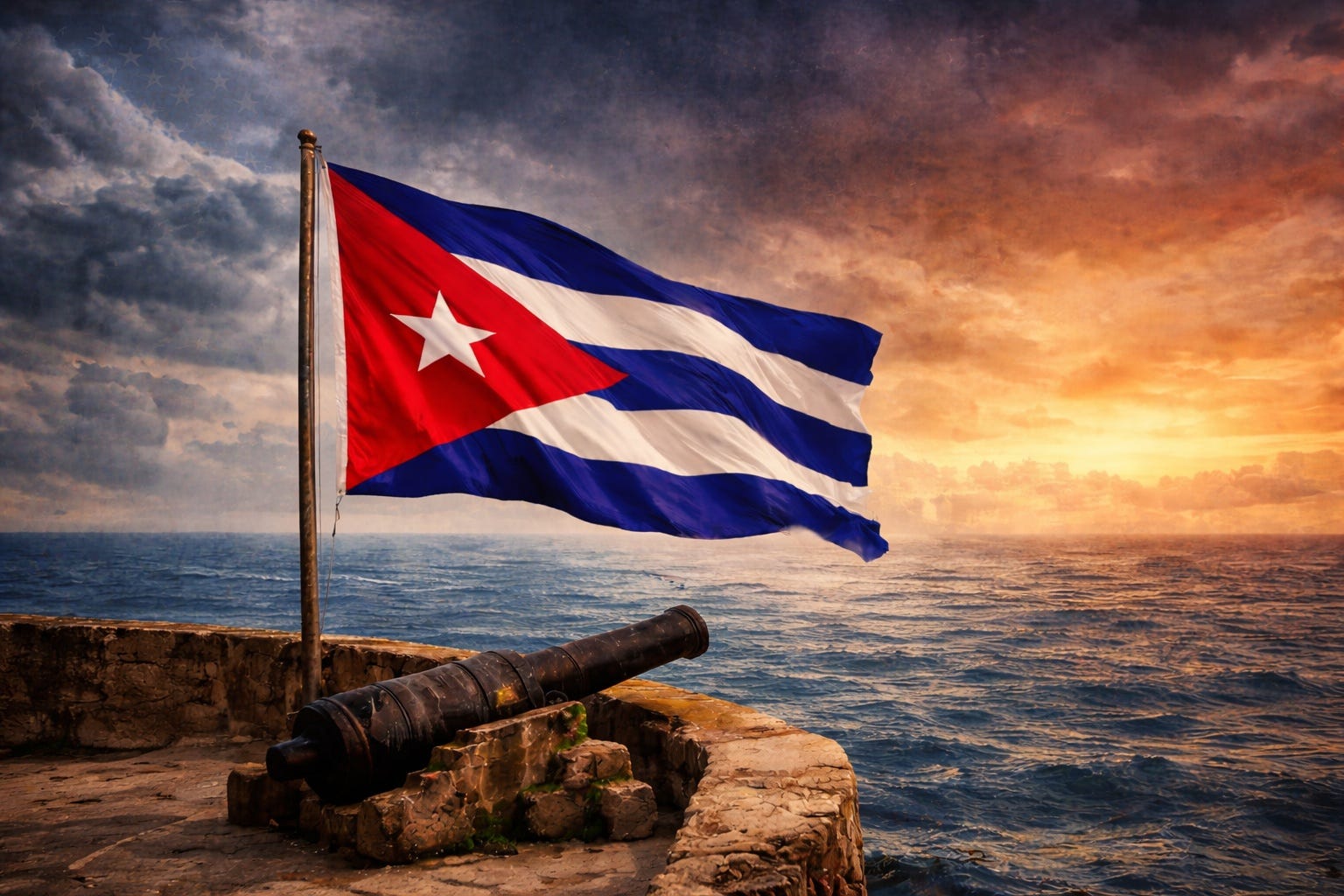
Cuba: A Test of Latin American Sovereignty
The island as a political barometer
Nuestra América on solidarity, autonomy, and the stakes for the hemisphere.
In the political imagination of Our America,1 Cuba is more than a country; it is a historical symbol of self-determination in the face of external pressure. For this reason, any threat or act of aggression against the island is perceived across broad sectors of the continent as a message that transcends the territorial: a reminder that Latin American sovereignty remains a contested terrain.
From this perspective, raising the alarm about the risks of escalation against Cuba does not imply a call to war, but rather underscores the need for a shared regional consciousness. History has shown that processes of isolation, sanctions, or pressure directed at a single country rarely stop at its borders. They function as precedents that later extend to other states pursuing autonomous political projects.
To speak of Cuba, therefore, is to speak of a broader principle: the right of peoples to decide their own destiny free from coercion. Defending this principle does not require weapons, but political unity, active diplomacy, and regional solidarity capable of deterring conflicts before they occur.
Our America today faces the challenge of building mechanisms of cooperation that can transform alarm into prevention and pressure into dialogue. Within this framework, Cuba becomes a political barometer for the region: what happens there will set the tone for hemispheric relations in the years ahead.
More than a slogan, this idea should be understood as an ethical warning: regional peace depends on ensuring that no country is treated as a territory of exception. In this sense, the defense of Cuba is the defense of the principle of sovereignty that underpins all of Latin America.
(Translated from the Spanish)
Follow Nuestra América on:
Translator’s note: Our America refers to Latin America as a shared civilizational and historical space, a concept articulated by the Cuban poet and revolutionary José Martí (1853-1895), emphasizing sovereignty, cultural identity, and independence from U.S. domination.


Thanks for your great work!
We've restacked and shared this link on 'The Stacks'
https://askeptic.substack.com/p/the-stacks