
Chevron vs. Iran
A Hidden Empire: Gaza to Venezuela

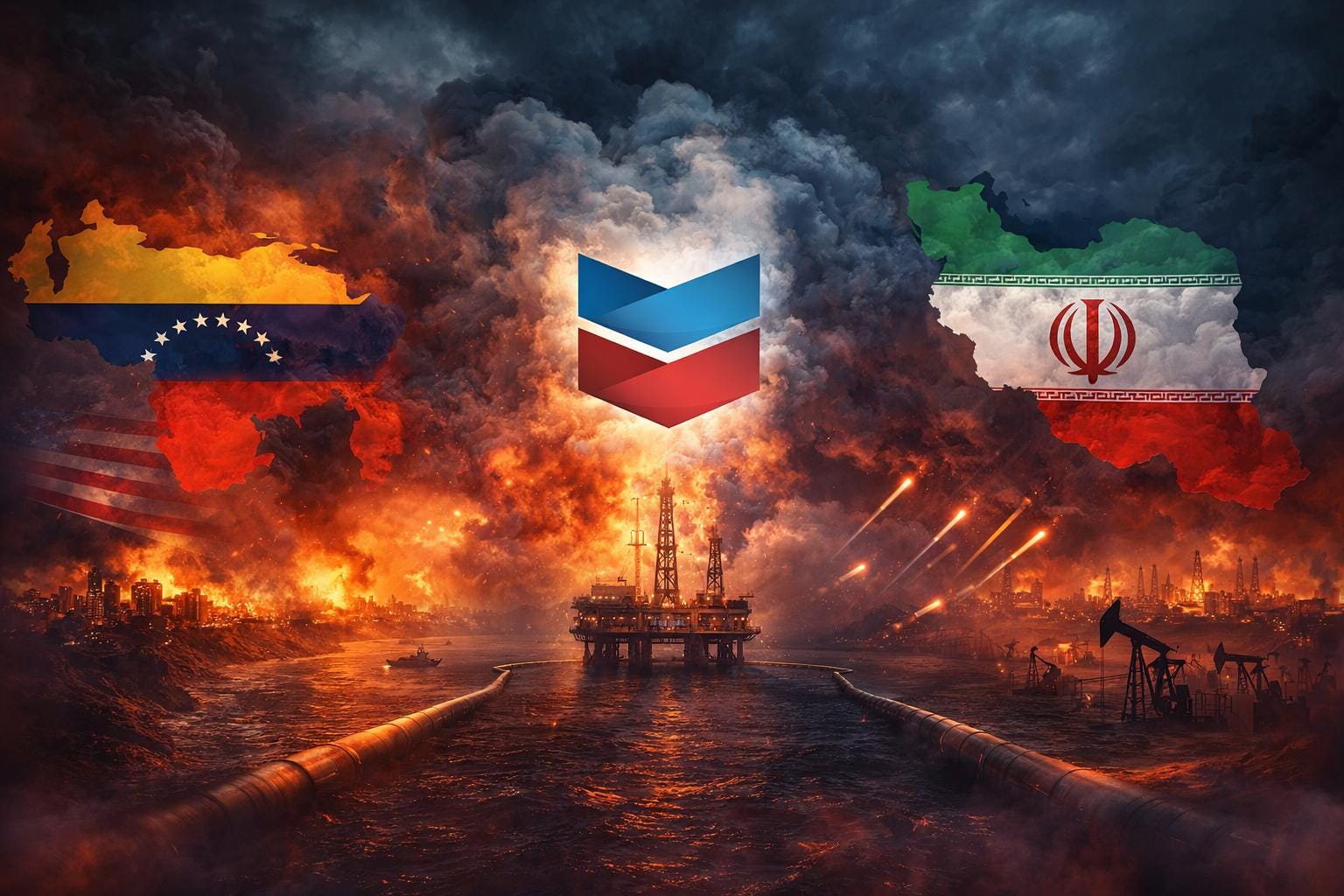
Kazuhiro Hayashida traces how Chevron’s energy empire stretches from Gaza to Venezuela, revealing a hidden structure of control, capital, and geopolitical confrontation shaping the emerging multipolar world.
Gas Fields Operated by Chevron off Gaza
Chevron operates two major gas fields offshore Israel.
The Tamar gas field is located 13 miles (21 km) off Gaza, near Ashkelon. Chevron holds a 25% stake and serves as the operator. Other partners include Delek and Avner. This gas field supplies 70% of Israel’s energy demand and also exports to Egypt and Jordan. Its reserves are approximately 10 trillion cubic feet. Following the Hamas attack on October 7, 2023, operations were temporarily suspended.
The Leviathan gas field is located 120 km off Haifa. Chevron holds a 39.66% stake and operates the field. Other partners are Delek (22.67%), Avner (22.67%), and Ratio (15%). It is the second-largest gas field in the Mediterranean, with reserves of approximately 22 trillion cubic feet. Its processing capacity is 1.2 BCF per day, with the potential to expand to 2.1–2.4 BCF per day. In August 2025, a $35-billion export contract with Egypt was signed.
Chevron’s economic interests consist of 25% revenue rights from Tamar and 39.66% from Leviathan, generating several billion dollars in annual profits in total. These gas fields were acquired through the 2020 acquisition of Noble Energy.
Venezuela: The Structure of Chevron’s Control
The 2007 Chávez Reforms and Corporate Responses
In 2007, Venezuelan President Hugo Chávez issued an ultimatum to all foreign oil companies: “All oil operations must be converted into joint ventures in which PDVSA (Venezuela’s state oil company) holds at least 60%.”
In response to this demand, ExxonMobil refused, had its assets expropriated, and withdrew from Venezuela. The company later filed for $12 billion in international arbitration. ConocoPhillips also refused, withdrew after asset seizures, and subsequently won its arbitration case.
Chevron alone accepted these terms and remained in Venezuela. As a result, Chevron is now the only U.S. oil company still operating in the country.
Chevron’s Four Joint Ventures
Chevron operates four joint ventures in Venezuela.
The first is Petroboscán, located in the Boscan oil field in the west, with ownership structured as PDVSA 60% and Chevron 40%.
The second is Petroindependiente, also located in the west, with the same ownership structure: PDVSA 60% and Chevron 40%.
The third is Petropiar, located in the Orinoco Belt in the east, with PDVSA holding 70% and Chevron 30%. This project includes facilities that upgrade extra-heavy crude into synthetic crude, enabling direct export.
The fourth is Petrocarabobo, located in the Carabobo 3 block of the Orinoco Belt. A Chevron-led consortium holds 40%, while PDVSA holds 60%. Chevron paid a $500-million signing bonus for this project.
Divergence between Nominal Structure and Reality
All four of these joint ventures share the same structural contradiction. Legally, PDVSA holds 60% to 70%, and the Venezuelan state is said to control the operations. However, the economic reality is entirely different. Since 2007, under the Chávez administration and its successor under Maduro, PDVSA has continuously diverted oil revenues into political projects. As a result, it has completely lost the ability to pay the operating costs of the joint ventures. Engineers were dismissed in large numbers for political reasons or left the country, and infrastructure collapsed. More than $11 billion disappeared due to corruption. Venezuela’s oil production capacity fell sharply from 3.5 million barrels per day in the 1990s to around 800,000 barrels per day in the 2020s.
Under these conditions, how did Chevron continue operations? The answer is simple. Chevron bore 100% of the investment in the joint ventures. It provided 100% of the technology and handled 100% of operations. It also advanced the unpaid operating costs that PDVSA was supposed to cover. Repayment was received in oil. The Venezuelan government received no cash income; everything was processed in the form of debt repayment.
In other words, while PDVSA nominally holds 60% to 70% and the Venezuelan state is said to be in control, in reality Chevron invests 100%, operates 100%, and effectively controls everything. Because PDVSA lacks funds, it cannot exercise veto power over Chevron’s decisions. This is the reason Chevron remained in Venezuela. Formally a minority, it is in practice the controlling power.
Production and Export Reality
In 2024, total production from these four joint ventures amounted to approximately 200,000 barrels per day. Of this, exports to the United States in the fourth quarter of 2024 were about 140,000 barrels per day. This corresponds to roughly 1% of Chevron’s global production. However, the crucial point is that the Venezuelan government receives no cash income from this production. All flows are processed as debt repayment to Chevron.
Donations to Trump and Returns
Understanding this structure clarifies the relationship between Chevron and the Trump administration. John Hess is the former CEO and heir of Hess Corporation. In 2024, Chevron acquired Hess Corp. for $53 billion, and John Hess became a director of Chevron. On December 12, 2025, John Hess and his wife Susan Hess each donated $1 million, for a total of $2 million, to Trump’s MAGA Inc. Two weeks later, at the end of December 2025, the U.S. military carried out an operation to capture Venezuelan President Maduro.
Chevron itself also donated $2 million to Trump’s 2025 inauguration committee, the largest contribution within the fossil fuel industry. In return, Trump authorized Chevron’s operations in Venezuela in July 2025, overturned a Federal Trade Commission (FTC) decision that had blocked Hess’s appointment to Chevron’s board, justified intervention in Venezuela, and granted $18 billion in tax advantages to the oil industry as a whole.
The Essence of the Structure
The essence of this structure lies in the paradox that the nationalization of assets proclaimed by the socialist revolution produced, in practice, the effective control of foreign capital. Chávez sought to establish national sovereignty by mandating that PDVSA hold 60%. However, the moment PDVSA lost its financial capacity, this legal form became hollow. By investing 100%, Chevron became, legally, a minority but economically the complete controlling power. To maintain this control, it donated to Trump, and Trump intervened in Venezuela. This constitutes the full structure of Chevron’s control in Venezuela.
The Competitive Structure between Iran and Chevron
Competition in Venezuela
While Chevron has established effective control in Venezuela, the country simultaneously receives strong support from Iran, Russia, and China. This structural contradiction has turned Venezuela into a frontline of the multipolar world.
Iran has provided Venezuela with oil-refining technology, petroleum products, financing, and political support. Particularly under U.S. sanctions, as Venezuela’s oil industry collapsed, Iran dispatched engineers and assisted in restoring refining facilities. Iranian tankers transported petroleum products to Venezuela, while Venezuelan tankers carried Iranian crude. The two countries formed a joint front to circumvent U.S. sanctions.
Thus, within the same Venezuelan oil sector, Chevron (U.S. capital) and Iran (an anti-U.S. state) coexist. Chevron continues production through its four joint ventures and exports to the United States. Meanwhile, Iran supports PDVSA’s refining sector and prevents the collapse of Venezuela’s oil industry. This coexistence produces a paradox: the more Trump intervenes in Venezuela to protect Chevron’s interests, the stronger the ties between Iran and Venezuela become.
Competition in Gaza
Chevron operates two offshore Israeli gas fields: Tamar (25%) and Leviathan (39.66%). These facilities lie 13 miles (21 km) from Gaza and supply 70% of Israel’s energy demand. Chevron secured a $35-billion export contract to Egypt from these gas fields in August 2025.
However, these gas fields are directly threatened by Iran-backed Hamas and Hezbollah. Following the Hamas attack on October 7, 2023, the Tamar gas field temporarily suspended operations. Hamas declared that it had targeted the facility. Hezbollah, backed by Iran, possesses the capability to strike the northern Leviathan gas field. When Iran launched missile attacks against Israel, both gas fields halted operations for several hours.
In other words, one of Chevron’s most important assets lies within the strike range of Iran’s proxy forces. The more Chevron aligns with U.S. policy and Israel’s Gaza operations, the more the widening Iran–Israel war draws energy infrastructure into direct conflict, sharply increasing the vulnerability of offshore gas fields.
The Structural Contradiction of Competition
Here lies the contradiction. Chevron is in direct competition with Iran in two of the most critical regions: Venezuela and Gaza. To protect Chevron’s interests, Trump intervenes in Venezuela and supports Israel’s operations in Gaza. Yet these actions strengthen ties between Iran and Venezuela, deepen coordination between Iran, Russia, and China, increase anti-American sentiment across the Middle East, and heighten the threat posed by Hamas and Hezbollah to the gas fields.
The more Chevron pursues short-term profit, the more its assets become unstable in the long term. The more it seeks to maintain control in Venezuela, the more Iran’s influence expands. The more it attempts to secure gas fields off Gaza, the greater the risk of attacks from Iranian proxy forces. Most importantly, this competition is accelerating the transition towards a multipolar world.
The rivalry between Iran and Chevron is not merely a bilateral conflict. It represents a structural confrontation between U.S. unipolar hegemony (represented by Chevron) and the multipolar world (represented by Iran). By faithfully serving its sponsor Chevron, Trump has, unintentionally, become one of the greatest accelerators of multipolarity.
The Structural Transformation of Capital Flows
The traditional structure of U.S. dominance consisted of bureaucratic networks—such as the State Department, the Pentagon, and the CIA: the so-called “deep state”—which determined policy, while corporations acted within that framework. Japan and European countries were integrated into this network, and corporations were subordinate to state policy.
However, this deep-state structure appears to no longer function.
The current structure is direct: corporations donate to Trump and receive policy in return.
The case in which Chevron donated $2 million to Trump, followed by Trump’s intervention in Venezuela and support for Gaza operations, illustrates this new structure. Corporations no longer need to operate through deep-state networks. Companies controlled by the Big Three (Vanguard, BlackRock, State Street) purchase policy directly through donations.
What does this change produce? The logic of capital—profit maximization—becomes the sole criterion of policy. There is no state strategy, no geopolitical consideration. There is only the pursuit of short-term profit. The deep state has collapsed and been replaced by the pure logic of capital. This is the United States today.
(Translated from the Japanese)
 | A guest post by
|
Watch the billionaire cliques and global power blocs war on each other for control of natural resources and power. Yes, we STILL aren't in their club... But "they" certainly would like us to back their plays, at least until they can get their humanoid robots and AIs all on line & encourage us plebian meat sacks to die off (and leave the billionaires with the whole world as their jackpot). Fuck 'em all.
"The more Chevron pursues short-term profit, the more its assets become unstable in the long term" pretty well sums up US financial capitalism.