

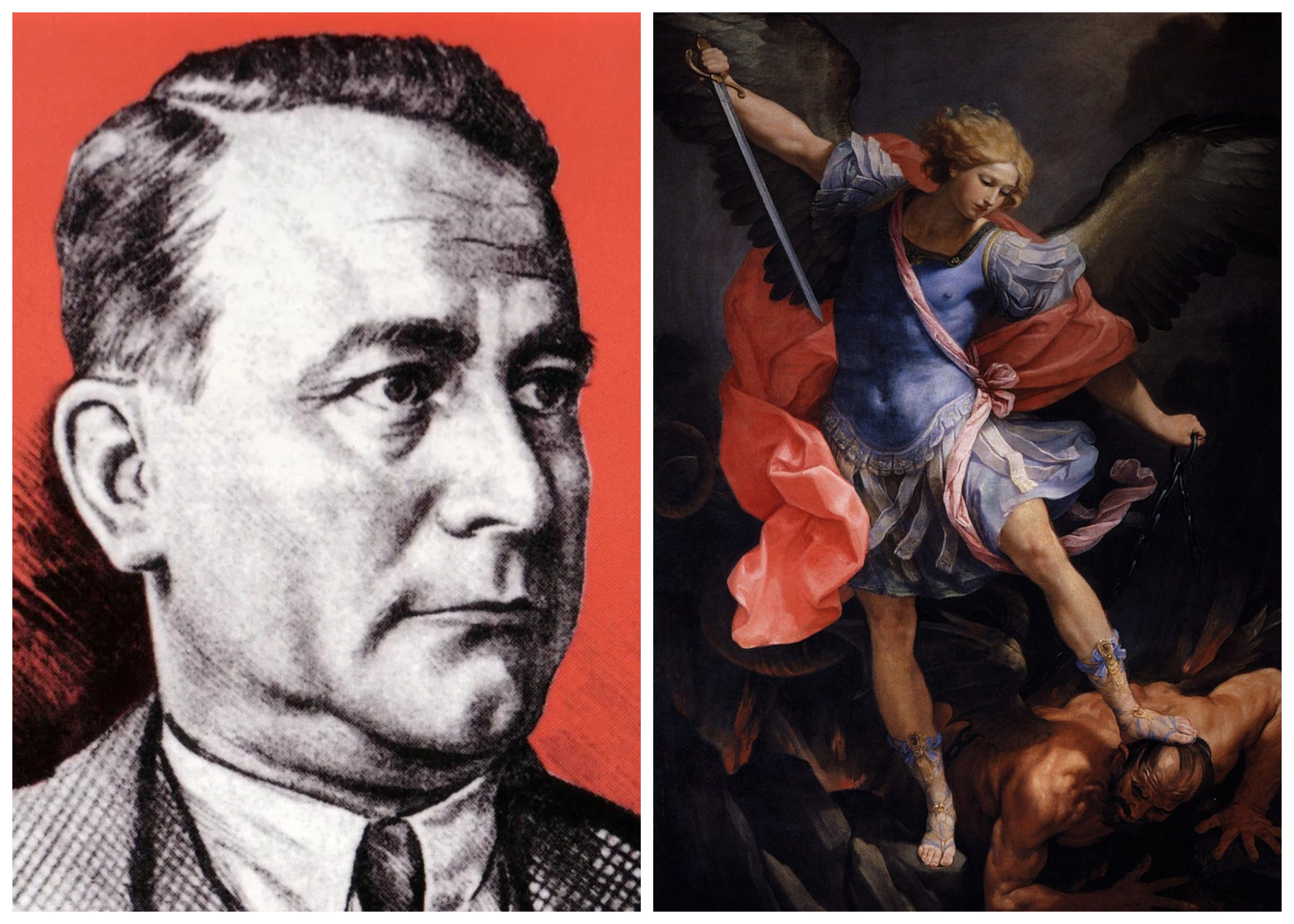
Alexander Dugin on the crisis of the friend–enemy distinction in a multipolar world.
I have always approached Carl Schmitt with enormous interest and attention. I translated his works. Certain things—for example, his treatment of Hobbes’s Leviathan, his interpretation of Shakespeare’s Hamlet, or his critique of Political Romanticism—provoked some resistance in me. Yet overall, I considered, and still consider, the majority of his ideas and concepts to be highly relevant.
His definition of the Political as the distinction between friend and enemy is an indisputably classic doctrine. The main point here is the realist and Machiavellian division between two ontologies: the moral and the political. Friend/enemy is by no means the same as good/bad. The sphere of morality is absolute: evil cannot become good, and vice versa. The sphere of the Political is relative. In politics, yesterday’s enemy may become today’s friend; everything depends on interests.
This is the foundation on which the whole political philosophy of Carl Schmitt is based. Applied to international politics, and under a realist interpretation of sovereignty—and Schmitt adhered precisely to such an approach—it is entirely adequate. On this basis, Schmitt, and after him Alain de Benoist, built the theory of the Pluriverse. Here, friend/enemy broadly works, and the implicit critique of liberalism proves fully effective.
But if we apply the friend/enemy principle to domestic politics, we effectively provide a basis for radical democracy and parliamentarism, both of which Schmitt himself hated. In internal politics, recognition of the friend/enemy principle splits and polarizes society. This means that Schmitt’s definition, when applied internally, divides society into opposing halves.
The ontology of friend/enemy in foreign policy also, upon closer examination, proves less convincing than it seems. It is perfectly suited to realism and to the Westphalian system. But with the transition to a multipolar world—to the state-civilization—the realist tendency to downplay ideology, even while recognizing civilizational sovereignty, no longer seems convincing. The civilization of the Katechon cannot relate to the civilization of the Antichrist in a neutral, purely formal way, as the ontology of the Political in the friend/enemy model formally requires.
The applicability of Schmitt’s general model is thus called into question, despite all its relevance and persuasiveness.
This deserves more thorough reflection.
(Translated from the Russian)

Professor Dugin, there is also the somewhat problematical claim that liberal parliamentary democracy neutralises conflict (by concealment or obfuscation, to be sure, not by negation/eradication). This, what I just wrote, is not an entirely accurate or just assessment of Schmitt's argument, which is more sophisticated than I suggest. However, I believe the opposite: that liberal parliamentary democracy institutionalises and fosters conflict. Chantal Mouffe is wrong, I suspect. It only neutralises it at an abstract level of an immanent possibility (The possibility of a consensus. Note, the possibility, not the achievement!) Przeworski's argument that conflict is tamed by its subjection to procedural rules (institutionalisation), that very English political ingenuity, also misses the point entirely. Conflict is not domesticated at all by procedural taming. Quite the opposite.
We are discovering, globally, together, that all along we had been promised that the underhandedness of evil was a sort of undesirable but necessary component of deal-making, especially politically and in business, where especially in a world without it being solely dominant, it was an excusable sort of moral luxury and like 'the way things really work' and so on -> people felt that they were gaining an insight to a more True and Higher Reality when coming in and encountering it from the bottom. It's like discovery of a club and the higher reality together, and also the Faustian bargain, in one.
That naive entry is self-conceived of people doing it, to start with, and from the outside; because what we are seeing on their experience on the inside, is that they experience it as a sign of sophistication and superiority to go out of ones way, to deliberately target any items of good faith, of agreement, that the scam or deceit has intrinsically more value for them, than a normal, now noble agreement.
It's more than that actually, because for the dominant actor there, to ritualistically break anything that has the essence of nobility, good faith, agreement and so on engaged in this ritual over enough time that it defines them -> that for them is the highest Truth and Reality. Not just the machiavellian act, but the domination of God as the cause of action and the self-justified end.
For Western post-enlightenment actors, call the entity, the Hell of, or the Nightmare of, the naive, Machiavelli and Faust.
So I think the leap of faith is in recognising, firstly Good and Evil, which I call the 'Teleological Vs Entropic', through which I also define 'Western' (Teleology v Entropy, where teleology Wins is essentially what 'Western' is -> and does not preclude 'Western' to Western Europe or USA for example (and are clearly pure Entropy in this moment)), but then to understand the ritualistic element of what has been going on as opposed to intellectual abstraction and arms-length analysis.
That for the individual, and within a system, that this becomes a recursive and self-initiating process. The ritual of participating in machiavellianism as an actor who now understands 'how things really work', is a sort of initiated acolyte actually, who has passively accepted a structure they suspected, but also really desired; and they have pursued it under an innocent naivete, but also really as quite an active participant -> far more than they would have admitted to.
They weren't willing to be 'left out' for some questionable promise of ideals, higher purpose, or even the animating cause of the enterprise they are engaged in at face value - the inability to fulfil the mandate of the position or organisation to begin with is irrelevant to them.
They are always extractive, zero-sum and introducing the prisoners dilemma in their subversion of Trust, and establishment of themselves as a node in which the spoken ideal is subverted to personal gain. But then at some point and threshold, the whole system is the node and it collapses (we are here).
---
But there is also something else going on here.
These events are pleas from the global system, of being unnecessary and unimportant.
Our context of materialism, in the super-familial (non-related) social organism, where a common entity (City-State, Nation-State) exists and competes with others, is defined in materialism, and whose performance (and originally survival) depends on the ability to extract economic power, and distribute that within the system.
This requires some co-ordination and planning, especially with centralised leadership; and you get a vertical, bureaucratic-administrative power structure. There are add-ons like culture, religion, science e.t.c., but all of these act as instruments to increase the capacity of the size, as sort of technologies with which the collective entity can expand, defined as extracting and distributing more economic power.
So for example, when it gets too large, and where the Leader claims God status, where some minority ends up either feeling politically isolated or exploited, or for whatever reason wishes to gain more power; they (So Jews in Egypt is the story) conceptualise a God outside of the Divine Mandate of the Man, which, after demonstrating the impotence of the Man-God to predict nature and weather, gains a dominating position; and this artefact is then mediated through more powerful religious instruments (institutions as political containers for the artefact (Monotheism)) that allow far larger collective social sizes.
So then we can see that
1. The collective entity is primarily about Economics and Politics (how to extract and distribute resources).
2. Vertical hierarchies develop vulnerabilities that require imagination and cultural development that act as civilisational technologies to overcome threats and maximise strength.
3. The legitimacy of the authoritative hierarchy, as well as each layer of its vertical structure, depends on their ability to manage economics and politics, and to either ensure technologies are NOT developed to collapse the structure, or that the technologies that are, are integrated.
So then in the Industrial Revolution, we have a very direct assault on the cause of the entity (collect and distribute material/economic power) - with the machine, we have a distribution of Power again, away from the King/Monarch/Aristocrat or Noble vertical hierarchy. The economic power structure, and cause to exist, becomes more horizontal, while the social, political, religious, cultural structure retains its verticality.
The Industrial Machine starts doing, or perhaps inherently as essence is providing, the Kings job, while the King still desires his positions and privilege, introducing irresolvable structural conflict in the entity.
As a system of distribution of economic value, the old system was to distribute that new value from the machine to the King/Aristocracy and so on -> but at the same time they were no longer necessary and provided no value, over the machines, that distributed economic power horizontally. In fact the luddites were on the Kings side, as it were.
But the old system - they don't know, or experience that the old system has become the old system.
They experience more power than ever, more wealth than ever, more luxury and frivolity than ever.
They start acting like it too. They have massive palaces and extravagant parties, and titles, and become absurd and caricature like.
They abandon their positions, as if these were not positions at all, just inherited privilege.
While abandoning the positions, and while the social order crumbles under them, they believe, they have all the evidence in the world, that they are more in power than ever.
In fact they are loudly shouting, that they are no longer necessary. The machine has made their political control and economic distribution regime unnecessary, and they have become unnecessary.
They are doing their very best to make that clear. To ensure everybody knows. That they are not necessary, that they are absurd, cartoon like monstrosities from a bygone era.
The second act of this, is the digital revolution.
The old banking/industrialist type money owning National Debt, understood that technology was coming in that would destroy their wealth (they own debt, technology is massively deflationary).
After experiencing their ability to completely corrupt the US Government in the Tequila Crisis in 1995, they go about artificially pumping the price of Capital Assets with ultra-low interest rates under Greenspan.
This causes the Global Financial Crisis, and they back it up with trillions in 'quantitative easing'.
They have routed the entire tax-base, consumer-base, Labour value, all to Capital Assets through manipulation of the Money.
They are desperately telling you, they are NOT NECESSARY. They are desperately shouting, from their palace, and their cake, that they are 'useless eaters', as they put it themselves about You. That their little meetings, and strange schemes, and misanthropic agenda -> as grandiose as it is, to talk about killing people, and as powerful as they are to be the moral actor who commands the authority of Gods, to do the 'unwelcome jobs' of bombing schools of children and so on.
All they are, are unnecessary artefacts of the OLD social and material structures, of the post-Industrialist and pre-Digital age, who have gone insane, under a new regime and are begging for us to stop them. Begging for help like serial killers often are.
That's all they are. All their problems are fake, and easy to solve.
----
The best analog for their grandiosity and this weird obsession they have with finding 'moral' causes where they get to kill people is a Philosopher of Science, Imre Lakatos, who joined an edgy 'Anti-Nazi' group in WW2 in Hungary.
Without the internal substance and courage to confront the enemy, they forced one of their own group members to kill herself, a teenaged girl, because she would 'give up the group under torture'.
Now obviously, they all would have given up the group under torture, but in this grandiose extraction of political power from the Fears of the collective, they ritually killed for Power -> for the Power they were too cowardly to gain legitimately.
This as a ritualistic construct though - to cowardly kill, based on a hallucinatory proposition that exploits Fear in the collective to perform acts like this - that is all we are dealing with in these people.