

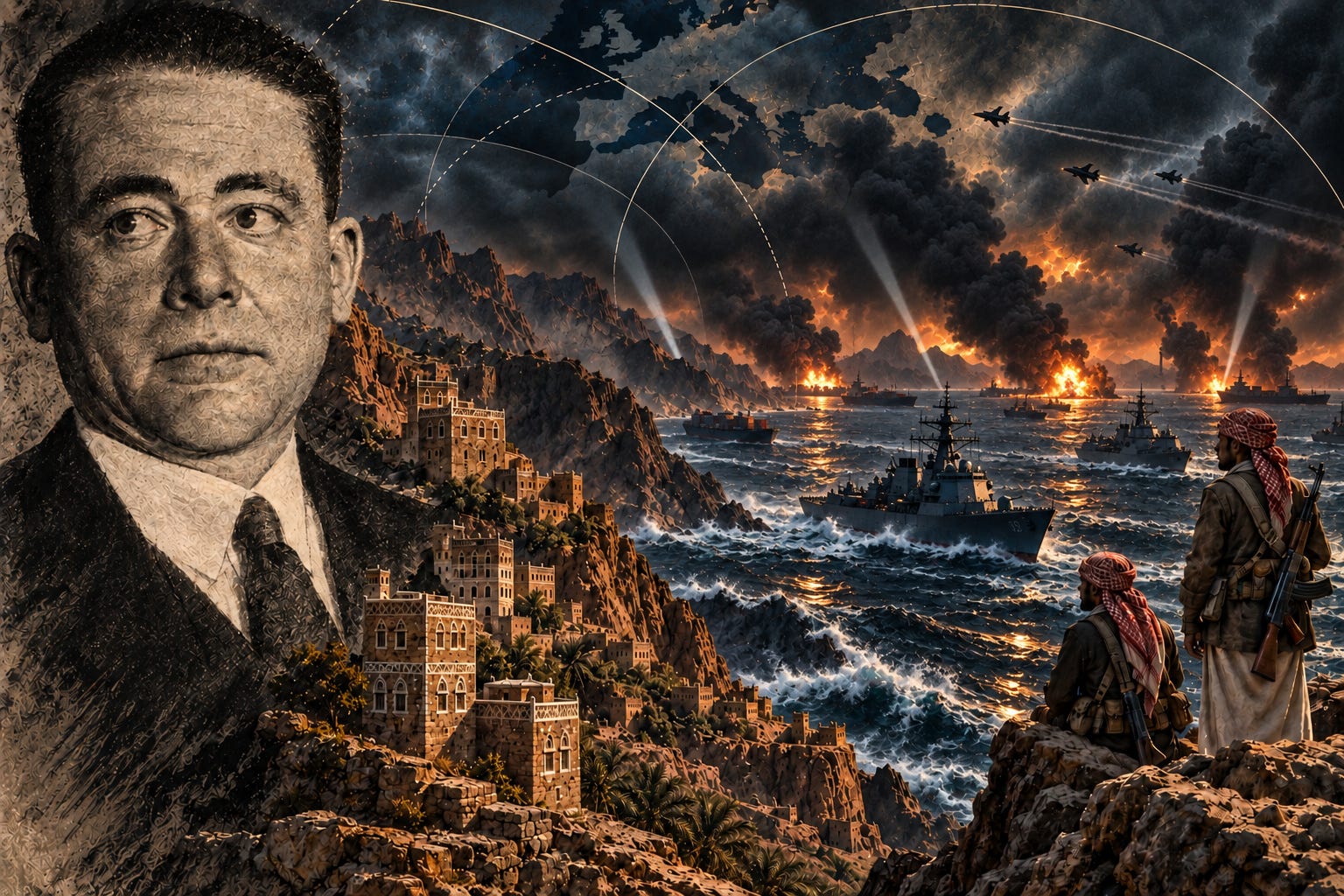
Ali-Mohammad Mohajer Nasser draws on Carl Schmitt to ask whether the Houthis are helping to turn the Axis of Resistance into an emerging large space.
Introduction: The Third Time Maritime Hegemony Has Been Forced to Retreat
On 10 September 2026, after weeks of intense fighting along Yemen’s western coast, forces of Ansar Allah—the movement more commonly, if imprecisely, known abroad as the Houthis—secured full control of the strategic port of Mokha.1 Units of the “National Resistance” and the “Giants Brigades,” both aligned with the Saudi-Emirati coalition, withdrew after sustaining heavy artillery bombardment in an unsuccessful effort to arrest the Houthi advance, retiring to reconstitute their front line elsewhere. Mokha lies a mere seventy kilometres from the Bab el-Mandeb Strait, through which some twelve per cent of the world’s seaborne trade passes.2 To hold the port is to possess the capacity to monitor, threaten, and, should the occasion demand it, interdict one of the global economy’s most consequential chokepoints.
This marks the third occasion in under eighteen months on which a military power equipped with manifest technological superiority has failed to subdue Ansar Allah. The first was the United States, which between March and May 2025 conducted more than eleven hundred airstrikes at a cost of no less than ten billion dollars without managing to eliminate the movement’s leadership or degrade its missile capability, and which eventually accepted a ceasefire in which Washington, not Sanaa, proved the true loser. The second was the Saudi-Emirati coalition, whose decade of ground war failed even to recover the lines it held in 2015. And now, in September 2026, the third.
Ansar Allah’s strategic significance, however, should not be sought in this most recent episode alone. During the Twelve-Day War between Israel and Iran in June 2025, and again in the broader war of spring 2026—which began with the joint American-Israeli strike on Iran on 28 February and lasted nearly forty days—Ansar Allah was among the few regional actors to enter the field in fact, and not merely in declaration: from 28 March 2026 it fired ballistic missiles toward Israel and announced that “our hand rests upon the trigger, whenever developments require it.” Yemen, a country that had lived under bombardment and blockade since 2015, was the one country that, at that decisive hour, answered not with a statement but with fire.
To understand this endurance, one must look further back. The Ansar Allah movement has its roots in a revival of Zaydism, a branch of Shi’a Islam that governed northern Yemen—including the mountainous province of Sa’dah—for more than a thousand years, until the republican revolution of 1962 brought the Zaydi imamate to an end.3 The movement itself took shape in the 1990s under Hussein Badreddin al-Houthi, as a response to the marginalisation of Zaydi identity and the spread of Saudi-backed Wahhabi influence. Al-Houthi was killed in 2004, but the movement, under the leadership of his brother Abdul-Malik al-Houthi, seized Sanaa in 2014 and has held its ground since 2015 against the Saudi-led coalition’s intervention.
What follows is an attempt to make sense of this threefold endurance—against the United States, against the Arab coalition, and now at Mokha—not through the familiar dyad of “land against sea” that is so often invoked in discussions of telluric versus thalassocratic power, but through three further instruments drawn from the work of Carl Schmitt which, read alongside Zaydi political theology, yield a more precise account of the phenomenon: the theory of the partisan, the temporality of qiyam bi-l-sayf, and the concept of the Großraum.
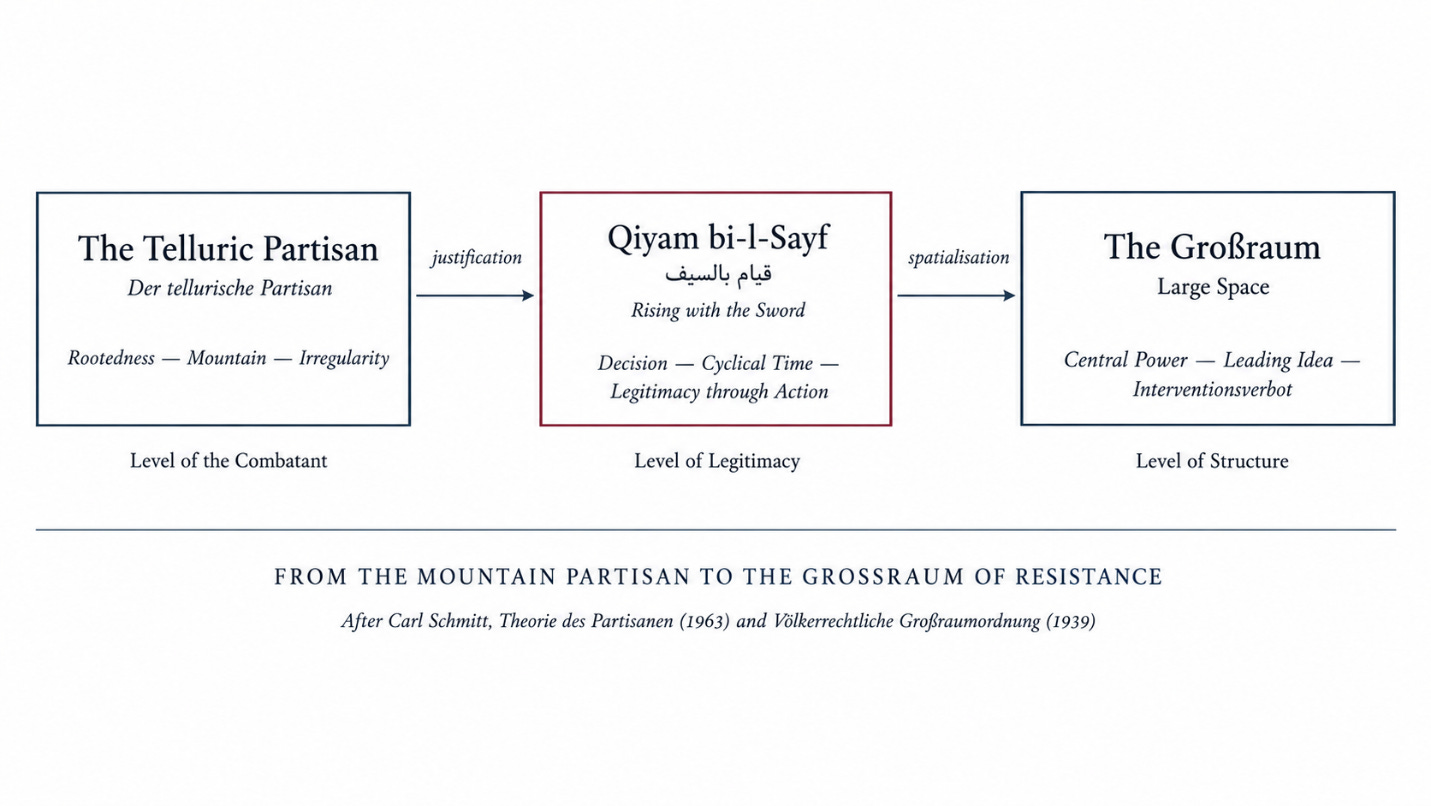
In 1963, Carl Schmitt, in his Theorie des Partisanen, attempted to furnish a theoretical portrait of the combatant who had shaped the wars of the second half of the twentieth century, from Spain to Vietnam.4 The true partisan, in his account, possesses four characteristics: irregularity (he is not a soldier of a formally constituted army); an extraordinary tactical mobility; an exceptional intensity of political commitment; and—more decisive than the preceding three—a telluric character: an organic bond to native soil, to a land he knows, inhabits, and defends. It is this fourth trait that distinguishes the partisan from the cosmopolitan revolutionary of the Leninist or Maoist type: the cosmopolitan revolutionary regards borders as merely horizontal and seeks to export revolution to any point on the globe; the telluric partisan, by contrast, wages his war in a specific place, for the defence of that same place.
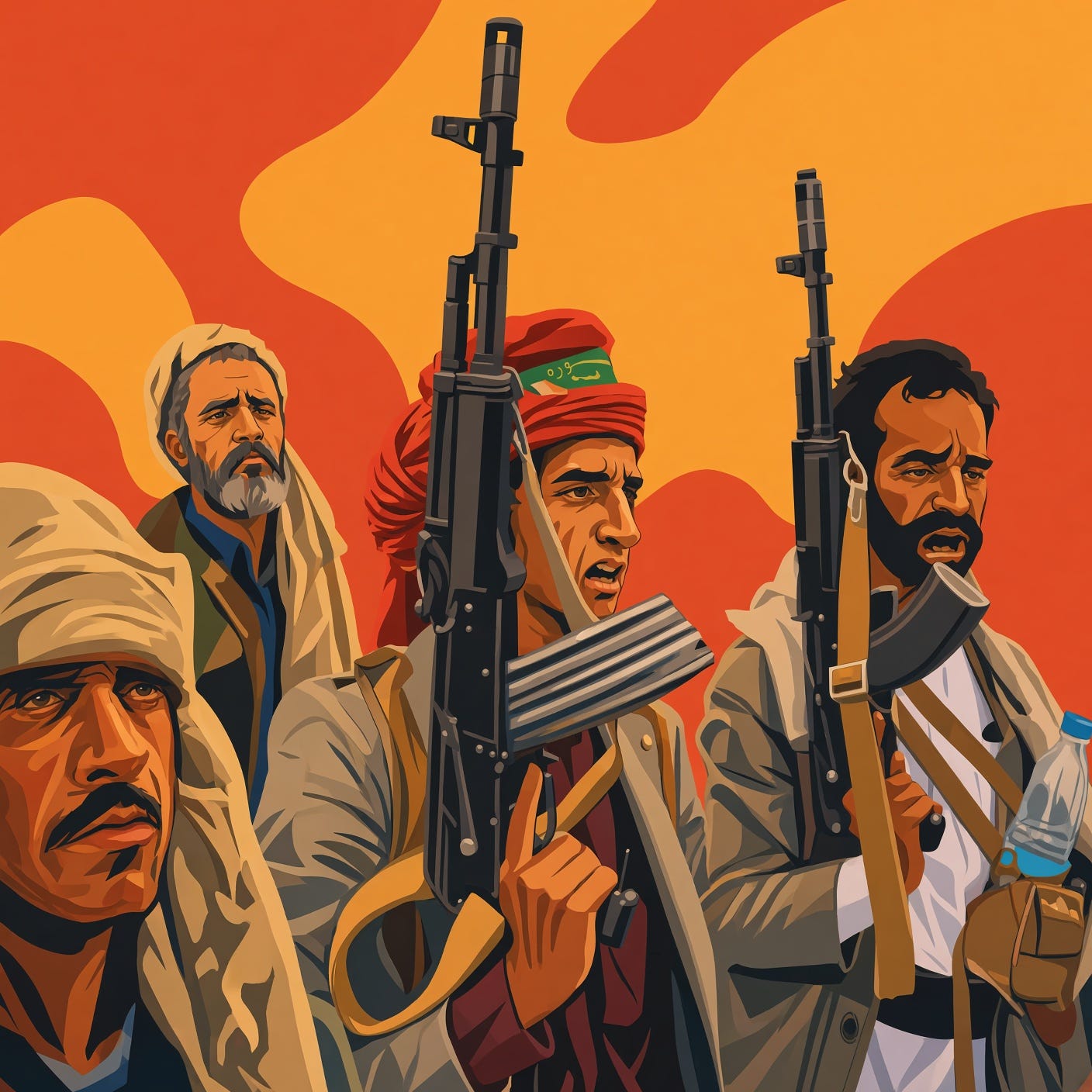
Ansar Allah is an almost textbook instance of this figure. The movement is neither a regular army with the uniforms and classical hierarchy of one—although its military structure has grown considerably more formalised in recent years—nor does it harbour any project of exporting revolution beyond Yemen’s borders; it has never made such a claim. Its fighters are rooted in precisely the same valleys and mountains of Sa’dah over which, generations earlier, the Zaydi imamate held sway. Over a decade of war, missile launchers and command centres have been concealed within this same forbidding terrain—terrain against which the absolute air superiority of the United States and the Arab coalition proved of little avail, confronted as it was by the knowledge that only an inhabitant of a land possesses. Schmitt writes that the partisan “fights with the earth, not against it”—precisely the distinction that separates the American serviceman, who operates from the deck of an aircraft carrier or from an altitude of ten thousand metres and owes no allegiance to any particular place beyond his own functional capacity, from the Yemeni fighter, for whom the mountain is home.
The recent battle for Mokha, however, indicates that this partisan character has now extended from mountain defence toward territorial, and even maritime, control—without, at least to date, forfeiting either its political intensity or its telluric bond. This is itself an answer to one of Schmitt’s own reservations about the future of the partisan in an age of technology: can the partisan endure against a fully technologised war? The Yemeni experience offers an affirmative answer, but a conditional one: every partisan movement that has passed from territorial defence to territorial control—from Tito to the Viet Cong—has faced the risk of what might be called normalisation: the risk that, in the very process of consolidating power, it acquires the same vulnerabilities of the regular army from which it was previously immune. Whether Ansar Allah proves the exception to this rule is a question that will be settled not within the text of the theory, but on the field of practice.
The Time of Qiyam bi-l-Sayf: A Rival Formulation to Western Temporality
The principle of qiyam bi-l-sayf—“rising with the sword”—must first be situated within its precise place in Zaydi theology, before any theoretical reading is attempted.5 Unlike the Imami (Twelver) tradition, which grounds the imamate in divine designation (nass) and hereditary transmission through the line of the infallible Imams, and unlike the Sunni tradition, which understands it through allegiance (bay’a) and consensus (ijma’), Zaydi jurisprudence has long held—at least since its systematisation at the hands of al-Qasim ibn Ibrahim al-Rassi in the third Islamic century—that the imamate is conditional upon a set of qualifications which, alongside lineage (descent from either Hasan or Husayn ibn Ali) and learning (independent juristic reasoning, or ijtihad), include the requirement of qiyam bi-l-sayf itself: whoever lays claim to the imamate must rise, in person and in deed, against injustice, for that claim to be considered valid. Wilferd Madelung, in his classical study of the Zaydi imamate, treats precisely this feature as the distinguishing mark of Zaydism among the Shi’a sects: unlike the Imami imamate, which was suspended by the doctrine of occultation, the Zaydi imamate has never been separated from open political action.6 More recent scholarship on the contemporary Zaydi revival—including the work of Bernard Haykel and Najam Haider—likewise demonstrates that Ansar Allah, even in its modern reinterpretation of the Zaydi inheritance, has preserved this same classical axis: legitimacy is not something bestowed from without, but something proven through action.7

This structure can be read, beyond its strictly juridical framing, as a theory of legitimacy that bears a genuine theoretical affinity with Schmitt’s political theology. Schmitt’s Politische Theologie begins from a foundational analogy: the central concepts of modern state theory are secularised theological concepts; just as the omnipotent God may, through miracle, suspend the natural order, so the political sovereign, in the state of exception, founds or refounds order through decision—not through recourse to any pre-existing rule.8 Legitimacy, in this reading, is the product of action and decision, not merely the continuation of an already established procedure. The principle of qiyam bi-l-sayf, within a tradition wholly independent of Schmitt and considerably older, articulates precisely this same logic: the Imam creates his own imamate through the decision to rise, not through lineage alone. What binds these two traditions together is not a claim that either borrowed from the other—no such claim is intended or warranted—but their structural convergence upon a shared question: from where does legitimacy derive, once the existing order can no longer answer for itself?
Out of this very structure emerges a distinct formulation of political time. Liberal-modern Western temporality is linear and developmental: history conceived as a forward-moving process, measured in calculable intervals. The time horizon of an American policymaker extends, at most, to the next electoral cycle or to the close of the annual defence appropriations period; calculations such as “shock and awe” or “regime change” are designed within precisely this short horizon. The time of qiyam bi-l-sayf, by contrast, is cyclical and revivalist: a Zaydi Imam may “rise” a thousand years after the fall of the last imamate, because the present event, within this formulation, is the direct continuation of a millennial narrative, not a reaction to a contemporary crisis. When the Ansar Allah fighter takes up arms against the United States and Saudi Arabia, he is, within his own temporal frame, re-enacting that same founding moment: the just Imam with the sword, confronting the unjust tyrant. This temporality, which measures events in generations and centuries rather than electoral cycles, lends the resistance a patience that no calculation of “shock and awe” can break: the United States was not defeated in Yemen because its army was destroyed; it was defeated because it had defined “victory” within its own temporal frame, while within its adversary’s frame the measure of victory was, from the outset, something entirely different.
From the Nomos of the Earth to the Großraum: The Axis of Resistance as an Emergent Large Space
The relationship among Iran, Ansar Allah, and Hezbollah is commonly understood through the familiar dyad of “telluric land against thalassocratic sea”—the same frame invoked in the preceding section, in relation to the partisan combatant. That dyad, while serviceable for grasping the fighter’s relation to the soil, becomes crude once one turns to the larger structure of the so-called Axis of Resistance: it tells us only that this axis is “rooted in the land,” without specifying what particular political and juridical order this rootedness produces. For an analysis at this level, Schmitt supplies a more exacting instrument: the Großraum, or “large space.”9
The Großraum, in Schmitt’s usage, is neither simply an old-fashioned empire nor a bare geographical unit, but a threefold relation among a central power, a leading political idea, and a space that is organised through that idea and that claims immunity from the intervention of powers foreign to it—the principle Schmitt terms the Interventionsverbot für raumfremde Mächte, the prohibition of intervention by powers alien to the space. Schmitt’s own paradigmatic instance of this structure is the American Monroe Doctrine: a central power that, by means of a political idea, organises a space and forbids intervention within it by powers “foreign” to that space.
The Axis of Resistance can be understood in precisely these terms—not as a loose military coalition of non-state actors, but as an emergent Großraum: its central power is Iran; its leading idea is resistance to Western-Israeli hegemony in West Asia; and now, with Ansar Allah’s control of Mokha and Bab el-Mandeb, this space has for the first time acquired a practical and enforceable boundary for that very principle of the prohibition on intervention—not at the level of theory, but at the level of missile and radar. Iranian deterrence in the Strait of Hormuz, together with Ansar Allah’s capability at Bab el-Mandeb, form the two ends of a single arc: an arc that asserts that two of the world’s most vital chokepoints for energy and trade are not spaces foreign to it, open to intervention by American and European forces.
What distinguishes this reading from the simple land/sea dyad is that the Großraum, unlike the nomos of the earth—which describes merely an ontological relation to place—furnishes an operational and juridico-political structure: who constitutes the central power, what constitutes the leading idea, and where the actual boundary of the prohibition on intervention lies. Seen from this vantage, the fall of Mokha is not a merely tactical episode; it is the moment at which the theoretical boundary of an emergent Großraum is, for the first time, tangibly inscribed upon the map.
This emergent Großraum, however, is not immune to internal strain. First, tactical and strategic rivalries among its constituent parts—Iran, Ansar Allah, Hezbollah, and the Iraqi factions—could, over the long term, weaken its coherence, particularly should any one actor place its own national interest above the leading idea of the space as a whole. Second, the internal legitimacy of the central power is not uniform across the constituencies of this space; confessional differences (Zaydi against Imami) and historical ones may harden into latent fractures. Third, the same risk of normalisation raised in connection with the partisan recurs here at the structural level: the Großraum, as it becomes institutionalised, risks transmuting into a bureaucratic empire—a fate Schmitt himself warned against in relation to the Soviet Union.10 None of these challenges negates the reality of the Großraum; they are, rather, the conditions of its persistence.
Enemy of Mankind: The Mechanism of the Terrorism Label
Why does the West call Ansar Allah not an armed political movement, but a “terrorist” organisation? The conventional answer—ideological difference or geopolitical interest—is insufficient. Schmitt, in his critique of Anglo-American imperialism, proposes a more precise mechanism. In his account, when a power presents itself not merely as one state among others, but as the representative of “humanity” as such—as the United States does through the language of human rights, democracy, and the “rules-based international order”—its political enemy ceases to be merely a political enemy and becomes instead an “enemy of mankind” (Feind der Menschheit).11
This displacement carries a consequence of the first importance. Within the classical framework of the political, the enemy is a legitimate party to a conflict—one with whom peace may be made, treaties concluded, or, at worst, war waged within the bounds of rules. But once the enemy is reduced to an enemy of mankind, hostility is released from the bounded framework of the political and becomes something moral and unlimited; for an enmity directed against the whole of humanity is, by definition, without remainder and outside any circumscribed bound. It is for precisely this reason that the “terrorist” label affixed to Ansar Allah is not, despite appearances, a legal-criminal judgment, but a declaration that the movement has been expelled from the circle of legitimate political actors—a declaration that renders any dialogue with it illegitimate in advance, and any instrument for its destruction, from naval blockade to the bombing of civilian infrastructure, correspondingly “justified.”
A concrete instance of this mechanism can be observed in the Trump administration’s decision, in January 2025, to place Ansar Allah on the list of Foreign Terrorist Organizations (FTO).12 The decision was, on its face, a legal-administrative act. In practice, it sent a political message to the entire region: Ansar Allah was no longer a party to a conflict with whom one might negotiate, but an enemy of mankind to be destroyed. The consequence of this label was not merely the closure of diplomatic channels, but the conferral of legitimacy upon any military measure. And it is here, precisely, that the connection between the terrorism label and the Großraum becomes visible: the terrorism label is an instrument by which maritime hegemony strips legitimacy from a rival Großraum; by converting a political enemy into an enemy of mankind, it invalidates in advance any claim that enemy might make to a large space and a prohibition on intervention. Yet this strategy, as Yemen’s experience has shown, proves ineffective against a Großraum grounded in qiyam bi-l-sayf and in telluric character—for its legitimacy derives not from external recognition, but from the internal act of resistance itself.
Conclusion: The Partisan of the Großraum
What occurred at Mokha, at Bab el-Mandeb, and in the skies above Israel in the spring of 2026 possesses three layers, ostensibly distinct but fundamentally interwoven. At the level of the combatant, we observe the figure of the telluric partisan—irregular, mobile, intensely political, and rooted in native soil—now extended from mountain defence to territorial and maritime control, without, at least to date, relinquishing its telluric bond. At the level of legitimacy, we observe the re-enactment of the temporality of qiyam bi-l-sayf: the founding decision of the Imam, situated not within the linear time of progress but within the cyclical time of revival. And at the structural level, we observe an emergent Großraum which, through its control of two of the world’s principal energy chokepoints, sets before maritime hegemony, for the first time, a practical claim to the prohibition on intervention.
The United States and the Arab coalition, each in turn, explained this phenomenon in the language of the enemy of mankind, precisely so as to feel no obligation to negotiate with it. But an enemy with whom one cannot negotiate is not necessarily an enemy one can defeat. Three times—against the United States, against the Arab coalition, and now at Mokha—this proposition has been tested and found wanting. What withstood superior air and naval power was not an army that could be defeated on a single battlefield; it was a figure that was, simultaneously, partisan, Imam, and founder of an emergent space.
This simultaneity, however, ought not to be read as a permanent or eternal condition. Each of the three layers this analysis has identified carries its own attendant risk: the partisan, in extending toward territorial power, risks normalisation; the Großraum, in becoming institutionalised, risks transmutation into a bureaucratic empire; and the temporality of qiyam bi-l-sayf, resilient as it has proven against shock and awe, requires constant self-renewal against gradual attrition—the long-term weapon of maritime hegemony. What occurred in Yemen is not a final victory; it is a historical opening, whose continuation will be decided not in theory, but in the daily practice of resistance.
For corroborated reporting on the fall of Mokha on 10–11 September 2026, see the coverage of Reuters, the Associated Press, and NPR, 11 September 2026.
Bab el-Mandeb (”the Gate of Tears” or “Gate of Grief” in Arabic) connects the Red Sea to the Gulf of Aden and, beyond it, the Indian Ocean; at its narrowest point it is some eighteen miles wide.
The Zaydiyya are named for Zayd ibn Ali, a great-grandson of the Imam Husayn. They constitute a branch of Shi’a Islam whose doctrine of the imamate—requiring, among other things, active political and military assertion by the claimant—places them, in matters of religious practice and law, considerably closer to Sunni jurisprudence than any other Shi’a school, a proximity often summarised in the epigram “Shi’a among the Sunnis, Sunnis among the Shi’a.” The Zaydi imamate governed parts of northern Yemen, with interruptions, from the ninth century until the 1962 revolution.
Carl Schmitt, Theorie des Partisanen: Zwischenbemerkung zum Begriff des Politischen, Berlin, 1963.
On the telluric character of the partisan and its distinction from the cosmopolitan revolutionary, see ibid., the sections concerning Lenin and Mao.
Wilferd Madelung, Der Imam al-Qāsim ibn Ibrāhīm und die Glaubenslehre der Zaiditen, Berlin, 1965; on the classical conditions of the Zaydi imamate, including qiyam bi-l-sayf, see the sections concerning imamate theory therein.
On the contemporary revival of Zaydism and Ansar Allah’s reappropriation of this inheritance, see Bernard Haykel, Revival and Reform in Islam, Cambridge, 2003; Najam Haider, The Origins of the Shī’a, Cambridge, 2011.
Carl Schmitt, Politische Theologie: Vier Kapitel zur Lehre von der Souveränität, Munich/Leipzig, 1922.
Carl Schmitt, Völkerrechtliche Großraumordnung mit Interventionsverbot für raumfremde Mächte, Berlin, 1939.
On the risk of normalisation among partisan movements that pass into territorial power, see Schmitt, Theorie des Partisanen, concluding section.
On Schmitt’s polemic against Anglo-Saxon-American imperialism and the concept of the enemy of mankind, see Falk, Hjalmar (2022). “Carl Schmitt and the Challenges of Interwar Internationalism. Against Weimar – Geneva – Versailles,” Global Intellectual History, 7:4, 765-783.
On the Trump administration’s January 2025 designation of Ansar Allah as a Foreign Terrorist Organization, see the relevant releases of the United States Department of State, January 2025.
