BOOK REVIEW: The Fate of White America
Racial consciousness in the upheavals to come
The United States Constitution, as originally ratified by the several American States, expressly stated that the new federal government was ordained and established for the Founding generation and their Posterity. The Founders were exclusively White Europeans, primarily of English descent. The 1828 edition of Noah Webster’s American Dictionary of the English Language defines “Posterity” as: “Descendants; children, children’s children, etc. indefinitely; the race that proceeds from a progenitor.” Likewise, “American,” as a title, is defined: “...now applied to the descendants of Europeans born in America.” So it was that the Americans were White Caucasians of European descent, largely of English stock and living in an extension of English culture. Other European races were added to the mix over time, which did complicate cultural matters. Still, until around 1950, White Europeans comprised roughly 90 percent of the U.S. population. Today, however, they account for little over half the population, their total numbers and relative percentage rank are falling, and, as Constantin von Hoffmeister notes, they are in a crisis. Here follows a brief look at von Hoffmeister’s new book, The Fate of White America.
Constantin von Hoffmeister is a German gentleman and scholar who studied English Literature and Political Science in New Orleans, Louisiana, USA. A multilingual intellectual, he has worked in the United States, India, Uzbekistan, and Russia. The author of Esoteric Trumpism and MULTIPOLARITY!, he is also a commentator for Russia Today and the founder and lead editor at Multipolar Press. The Fate of White America is available on Amazon.
At the outset of this review, I’d like to thank the author for his keen observations and analysis. I am reminded that an outside perspective, the more learned, the better, sometimes offers glimpses of things all around us that we, in our ordinary doings, might miss. Whites have been in the news, of course, and of late. Perhaps one read Alexander Dugin’s epic jeremiad about “Whites,” a tirade that von Hoffmeister defended, correctly, in your reviewer’s estimation.
So, what is the fate of White America? At present, as von Hoffmeister asserts, White Americans are in a crisis. And that is where The Fate of White America kicks off, addressing the situation in real, historical, and philosophical terms. The book begins with a look at Madison Grant’s 1916 book, The Passing of the Great Race. Grant’s good and not-so-good ideas are presented. Long before the postmodern age of radical demographic change, with many still refusing to acknowledge it is happening or that it is of concern, some were already concerned over 100 years ago. Their unease settled around the replacement of the principles that once guided the native stock of America, those regarding not merely ethnic identity, but also, and especially, see page 6, the “religious, political, and social foundations” of the old America. The interest was real and valid; as Jose Miguel recently noted, “By the 1900 US census no more than thirty-eight percent of the American Empire’s population was of the founding stock.”
Despite the subject matter, von Hoffmeister’s thoughtful work is not a racialist or racist screed, as I suspect some might want to portray it. He covers the differences between various views on race, and does so very well. Traditional non-White Americans, and others, may find something of value in von Hoffmeister’s words. Who will be offended by The Fate of White America? Liberals, of the First Political Theory variety, and globalists. And if they are so offended, then that will be higher praise than anything your reviewer could heap on the worthy author.
The Fate of White America then backs up and delineates the emergence of White America. The concept of standardized White people, in place of previous national identities, was a kind of compromise for early Americans. While it gave them a sense of collective identity, it came at the expense of losing parts of their various traditions. The author notes a correlation between this process and the Enlightenment ideas that helped turn the British Colonies into American States.
Chapter 3 deals with the concept of the “melting pot,” which, von Hoffmeister notes on page 20, is relatively new, emerging around 1929. He draws on Wyndham Lewis’s thoughts on racial consciousness and how the changes faced by the Western world upset long-standing customs. To wit, page 23:
In earlier eras, aristocracies, warrior castes, and cultural elites provided direction to their societies. In the modern age, according to Lewis, such figures drifted towards the margins. Political institutions and moral doctrines stripped them of legitimacy. The law they once embodied collapsed beneath democratic leveling and bureaucratic uniformity. These displaced figures wandered like prophets whose warnings fell upon deaf ears. They perceived the possibility that Western civilization might gradually merge into broader global systems, losing its distinct character in the process. Lewis compared their predicament to the tragic figure of Cassandra from Greek mythology, whose accurate prophecies earned ridicule rather than belief.
The reader probably has one or more notions, or examples, of how this process has affected some facet of Western and American life, whether it be Christianity, masculinity, athleticism, or intellectualization. If so, then one will likely wonder, alongside Lewis and von Hoffmeister, if the West can regroup, refocus, and carry on. Therein might lie a large part of the riddle facing White America.
Moving forwards, von Hoffmeister addresses America’s place in the new multipolar world order. On page 29, he writes: “Multipolarity does not herald the disappearance of the United States from the stage of history. It signals a transformation in scale, ambition, and orientation.” He is correct, though it is likely speculative whether the U.S. will continue to hold its current shape and composition. And that process, regardless of how America approaches it, is happening at this moment. The Fate of White America is a most timely book.
The book carries powerful declarative statements. On page 34, one of them is: “The true threat to mankind lies not in the recognition of racial reality but in the deliberate attempt to ignore it.” The author then proceeds to explain the rights of peoples, Whites included, and what it does and does not mean for a people asserting their identity. The book does not shy away from attacks on identity. In Chapter 7, “America’s Faustian Spirit,” von Hoffmeister tackles Emmanuel Celler’s lifelong project, the Immigration and Nationality Act of 1965. Of that sea change law, on page 46, von Hoffmeister writes and asks: “Over the following decades, the demographic composition of the United States changed at a pace unprecedented in the country’s earlier history. More than sixty years after that legislative turning point, the question arises once again: how do White Americans themselves interpret the identity of the nation?”
Pick a random White American and ask him that. The odds are that, regardless of what is said, a sense of confusion or frustration will be conveyed. And the next chapter, “Decline and Civil War,” delves into those sentiments, as stated upfront, analyzing “the internal fragmentation of the United States through a civilizational framework, drawing on [Oswald] Spengler and [Martin] Heidegger to interpret political conflict as a symptom of deeper cultural exhaustion.” Homage is paid to Julius Evola, among others. If one has not read Evola’s “American ‘Civilization,’” then one should.
The book proceeds with additional introspective treatment, some of it partly metaphorical, and with a presentation both informative and sublimely entertaining. For Americans blessed with Southern character, Chapter 13, “Spengler and the Confederacy,” will be a legitimate treat.
The final few chapters are a kind of examination of the very current happenings in America. Attention is paid to the examples of Charlie Kirk and MAGA, and von Hoffmeister revisits some of his thoughts from Esoteric Trumpism. Chapter 16, “Cimmerian America,” is a bit of genius, a combined ode to Patrick Buchanan and Conan the Barbarian, confronting “the death of the West as both an ending and a threshold.” (See page 110.) “‘Is this the end?’ The answer comes, low and steady: ‘That depends on whether we still remember how to fight.’” Id. The ending is as poetic as the body of the book is insightful. I leave the final thoughts about who might “mistake motion for mastery” to the reader’s examination.
If you, dear reader, whether you are White, American, or otherwise, enjoy a challenging ballad to the art of civilization, then do yourself a favor and read The Fate of White America. As with any great book, it will get the gears inside one’s head turning. To the White American reader, know that, though it is conditioned according to God’s designs and graces, fate is still largely in your hands. Constantin von Hoffmeister has given you, us, that is, an excellent summation of where we came from, where we are now, and where we might go tomorrow.


Great article and book review.
The dilution of the white race in the West will be the downfall of Western Civilization.
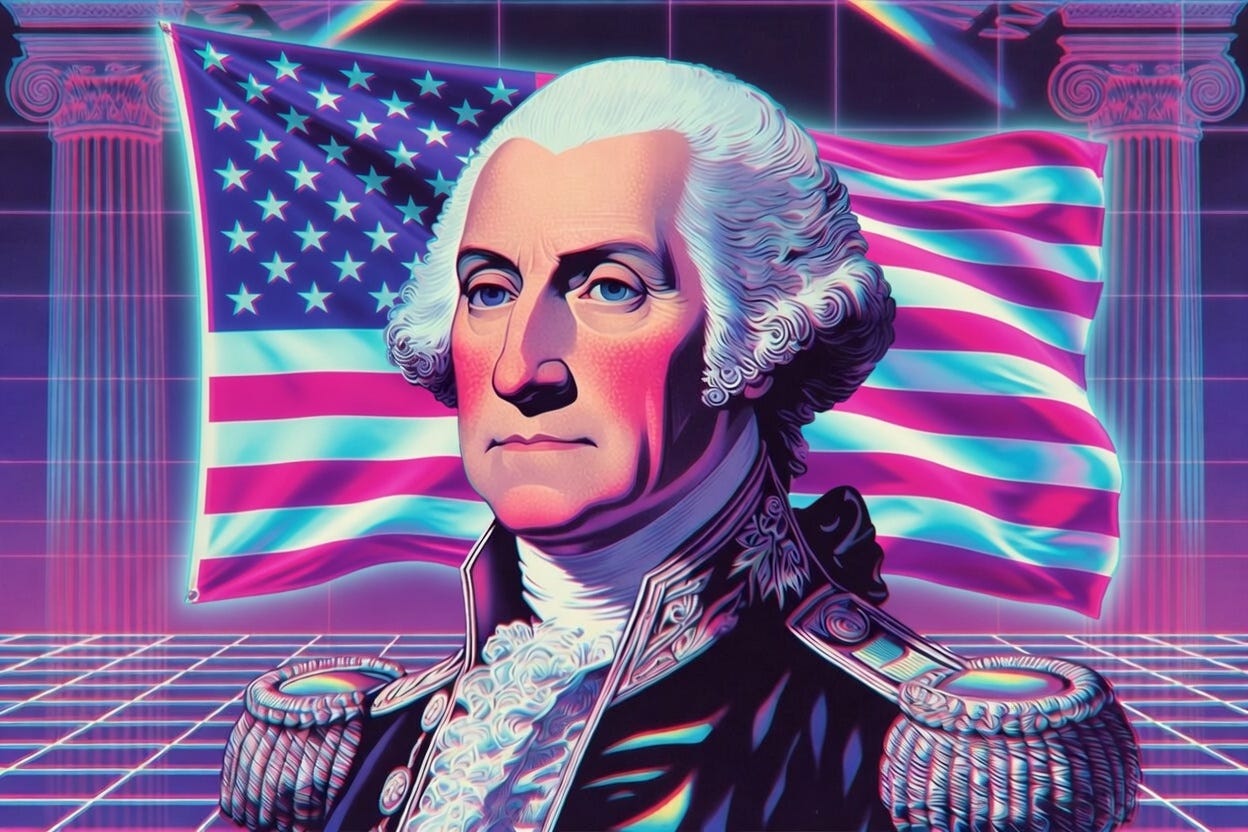
By the way: Synthwave George Washington looks cool