
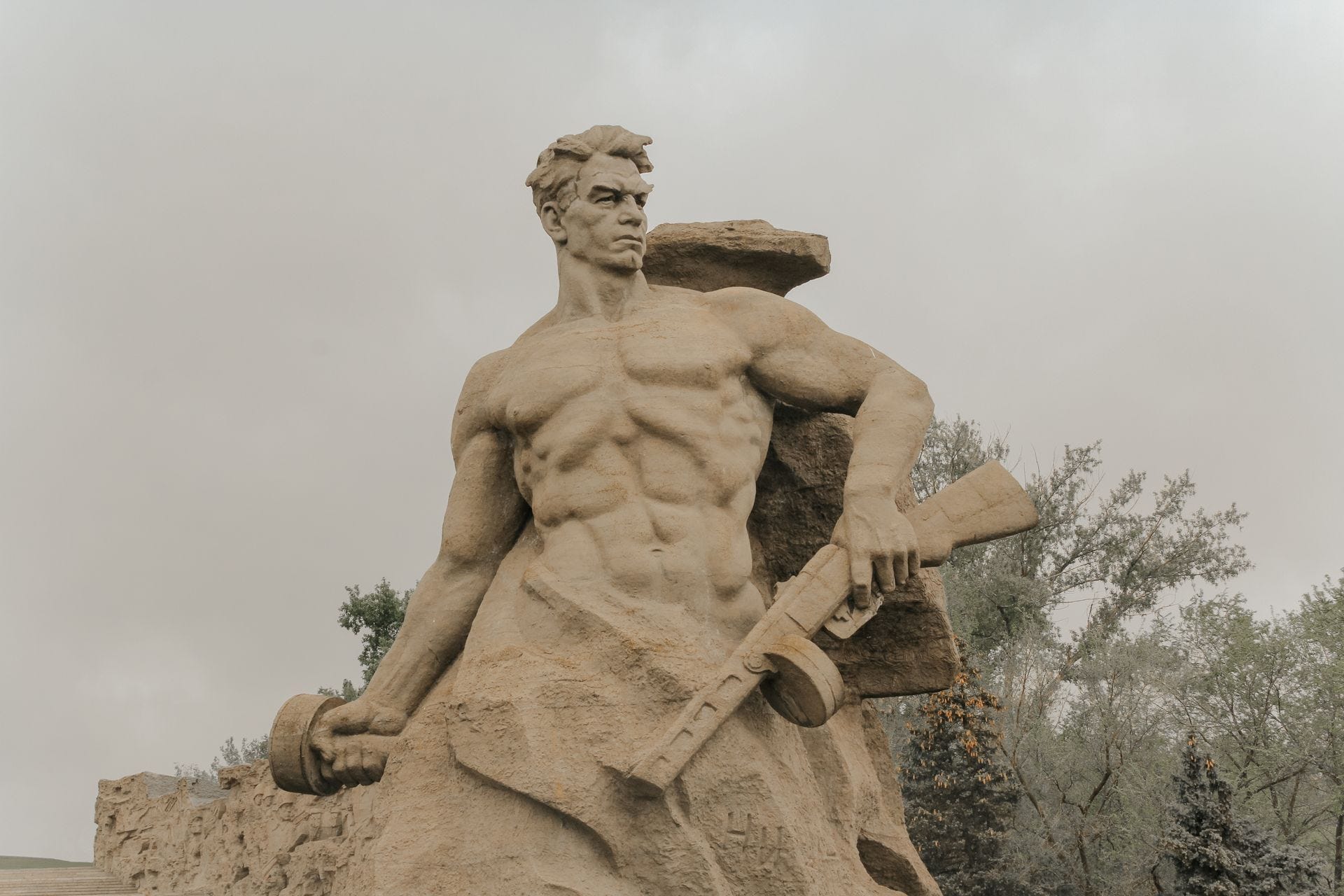
François Mauld d’Aymée visits Stalingrad, where Stalin’s name survives as a monument to an age of sacrifice, victory, and historical grandeur.
In Volgograd, it is impossible not to think of Stalingrad. The two place names coexist side by side, often mounted on the wings of some imposing Stalinist building raised from the ruins left by the war. The city has shed less of its Soviet character than many others eager to dip a finger into the cauldron of capitalism and enter the post-proletarian, post-revolutionary age: what some like to call postmodernity, and what I call post-humanity.
The imprint conferred by this historical symbolism compels the city to remain true to itself, to such an extent that it is probably here that the undoing of de-Stalinization begins. The greatest battle in the modern history of mankind took place on a site bearing the name of its supreme leader, who emerged victorious from the colossal confrontation. Few events in all recorded history carry so much immediate meaning, especially one still so close to us in time. Eighty-four years is scarcely a hop in historical terms.
Its meaning is so powerful that people have been ashamed even to think of erasing its traces. Stalin’s name alone crushed the insects who came after him. Everything was done to make every evocation of it disappear. In time, those insects perished, and still others followed them, but the weight of the name itself remains intact. In search of strength and identity, Volgograd dreams of becoming Stalingrad again.
Where history once breathed and gasped with all its lungs, modernity will always struggle to gain a foothold. A preserve large enough will endure, capable of capturing the essence of what once stood at the pinnacle of what was meant to define the future of a continent, and much more besides. Ordinary men defeated those who had proclaimed themselves the lions and abstract kings of mankind, self-appointed to rule without rival. The image is so powerful that the insects, under no circumstances, possess the means to order the bas-reliefs erased.
The Soviet Union no longer exists. To resurrect it would, according to Marx, produce a farce. The century of the workers ended in the wretched calculations of bureaucrats. In inverse proportion to the skyscrapers that sprout so diabolically upward, everything inside the mind grows smaller. What is one still permitted to dream of in 2026, on a cloudy September day in Stalingrad?
To paraphrase Vysotsky, it is I who never returned from the battles of Mariupol. I was the ideal age, possessed the perfect ambitions, and carried illusions roaming freely through my mind. Blessed, nevertheless, are the victorious. Damnatio memoriae is a fitting punishment for those who almost inevitably betray them, as though by some infallible logic of history.
Surviving victory is yet another ordeal for the fighters. Some say that those who survive wars expect too much from those who stayed behind, the ones who reap the rewards of triumph. The survivors of today’s wars probably have more in common with the dead of Stalingrad than with their own contemporaries, tattooed with Scandinavian runes, carelessly dressed in American fashion, and stupefied by thousands of hours of rap, rock, and techno.
Ideas of bravery, sacrifice, self-denial, and the like are steeped in anachronism. Zaitsev therefore died only a few days before the official end of the Soviet Union, without having seen or heard the final betrayal. Even my indignation is nothing more than an anachronism.
Thinking is as anachronistic as a bookshop. Reflection is like a broken bottle thrown into the sea. Its fragments will reach the shore, and for a brief moment, a passerby will notice them.
(Translated from the French)
François Mauld d’Aymée graduated from the Saint-Cyr military academy in Brittany. He is a soldier in the Russian army, an opera singer, and a graduate of the Tchaikovsky Moscow Conservatory. You can follow him on Telegram.
Beautiful, and a bit melancholic..... Fiery fighters live in the unity of past, present and future... And so, through the axis, in eternity..