

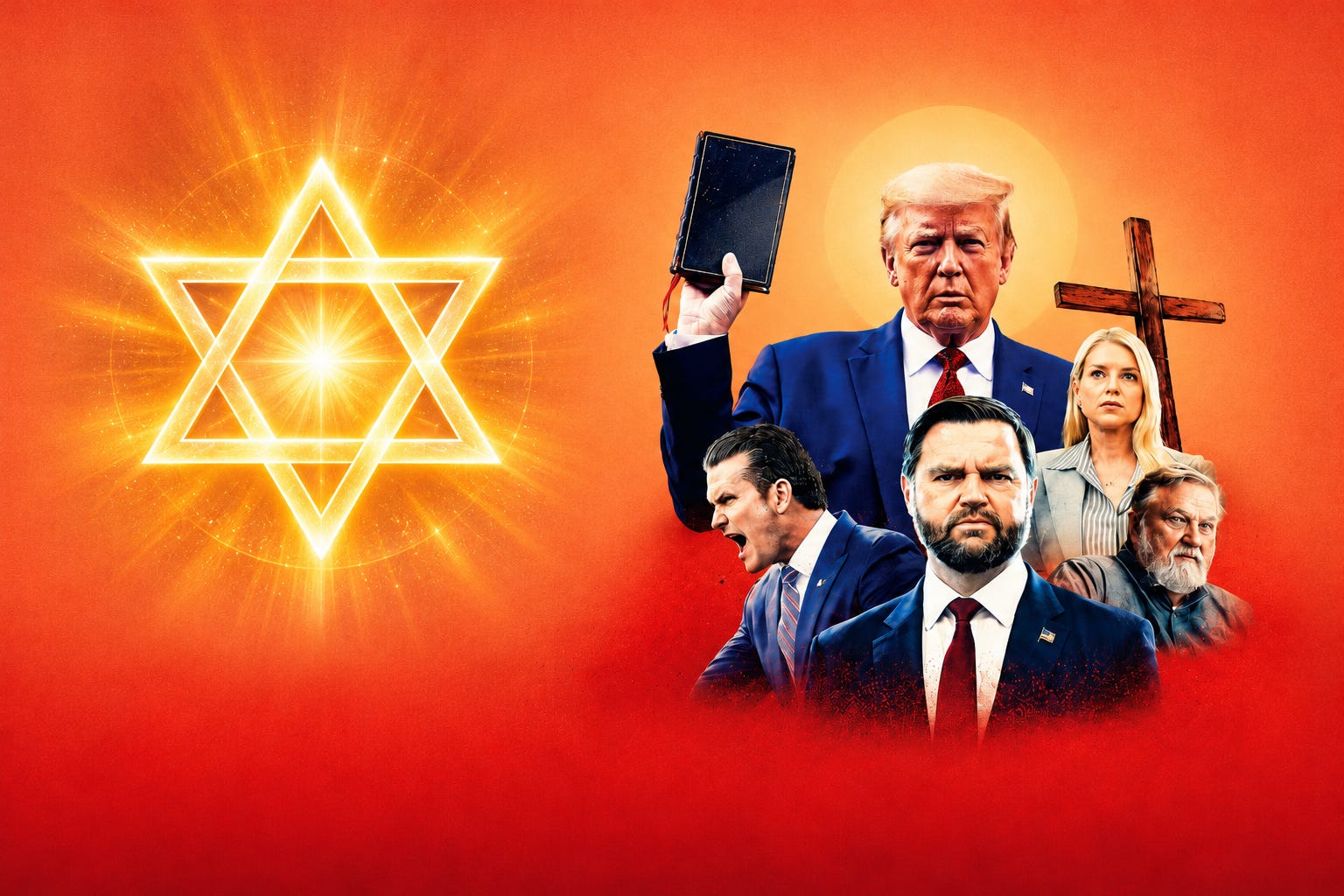
Pierre-Antoine Plaquevent examines how religious Zionism’s messianic ambitions extend far beyond the Jewish national homeland toward a vision of global domination.
How did the original Zionist project become an eschatological project?
To understand this, we must examine the movement of religious Zionism, one of whose most influential representatives was Abraham Isaac Hacohen Kook (1865–1935), the first Ashkenazi Chief Rabbi of Mandatory Palestine. Both a Zionist and a religious leader, he founded a Talmudic academy in Jerusalem, the Merkaz Harav Yeshiva, where his teachings took root and developed. Located in Jerusalem’s Kiryat Moshe neighborhood, the Merkaz Harav Yeshiva is today a stronghold of religious Zionism and Zionist supremacism. It was from this institution that the messianic political movement Gush Emunim emerged, a name that can be translated as the “Bloc of Faith” or the “Bloc of the Faithful”—an “Identitarian Bloc,” in essence…
Abraham Isaac Hacohen Kook is the spiritual father of the national-religious Zionist movement. Building upon the proto-Zionist theology of Rabbi Tzvi Hirsh Kalisher (1795–1874), he argued that “the socialist Zionists, by coming to cultivate the land in Palestine, were not participating in the self-emancipation of the Jewish people, as they believed, but were unknowingly fulfilling the ‘divine commandment.’” According to Kook, socialist Jews would eventually come to accept Halakha, Jewish religious law. It is clear that Kook was a visionary.
Rabbi Kook thus envisioned “an ideal state, with sublime ideals engraved into its very being,” a Jewish state that would become “the pedestal of God’s throne in this world.” For him, the Jewish state would be the earthly manifestation of a messianic “Kingdom of Israel,” a “Jacob’s ladder” uniting earth and heaven. Following his death in 1935, his son, Rabbi Tzvi Yehuda Hacohen Kook (1891–1982), assumed leadership of his yeshiva and continued his work, incorporating “his analysis of contemporary events” (see Charles Enderlin, Au nom du Temple [In the Name of the Temple], Seuil, 2023). In several of his writings, Rabbi Kook developed the idea that Zionists, although predominantly secular at the time, were unknowingly fulfilling the divine plan by working towards the establishment of a Jewish state.
So is Zionism essentially a religious project?
In the Babylonian Talmud, it is written that Jews are forbidden to return to the Holy Land and that they are forbidden to attempt to bring about the messianic age through political action. Yet the “activist” current of Jewish messianism defies these injunctions and has long sought to return to the Holy Land and hasten the coming of the Messiah. It pursues this goal through direct or indirect action, using the “nations” as instruments to achieve its ends.
It must be understood that the secular Zionism of the nineteenth and twentieth centuries did not emerge suddenly. It was the product of a long process of maturation and infiltration into Christian societies, where it initially presented itself, in order to gain acceptance, as a nation-state solution to the famous and recurring “Jewish question.”
Zionism emerged onto the public political stage at a time when the question of nationalities was setting the entire international political order ablaze in the wake of the French Revolution and the Napoleonic campaigns, which spread its political ideas while undermining traditional Christian authorities. Napoleon inherited the emancipation of the Jews decreed by the French Revolution and helped extend it across much of Europe through his conquests. Thus, in Italy, the ghettos were opened in Ancona, Venice, and Rome, where the walls and gates of the ghetto were symbolically demolished. In the Rhineland provinces, the Kingdom of Westphalia, the Netherlands, and other territories brought under French institutions, the introduction of the Civil Code and Napoleonic reforms was accompanied by the granting of civil equality to Jews. Although some of these measures were subsequently partially reversed after 1815, this movement represented a major historical upheaval following centuries of exceptional legal status. Contemporary political Judaism owes a lot to revolutionary France, the Empire, and the Republic.
What role did Protestantism play in the emergence of Zionism?
As early as the beginning of the seventeenth century, English Protestant theologians began advocating the resettlement of Jews in the Holy Land in order to hasten the return of Jesus and convert the Jews to Christianity. Among the Protestant theologians who promoted this idea were Joseph Mede (1586–1638), Richard Baxter (1615–1691), and the English parliamentarian Sir Henry Finch (1558–1625), who wrote a work of biblical exegesis predicting the return of the Jews to the Holy Land, The World’s Great Restauration, or the Calling of the Jews.
Around the same time, in France, the Huguenot Isaac de La Peyrère wrote Du rappel des Juifs [The Restoration of the Jews], in which he explained how the conversion of the Jews to Christianity would take place alongside their return to the Promised Land. This messianic vision, originally Jewish and subsequently transformed into a Judeo-Protestant one, would take root in English-colonized America, whose settlers regarded themselves as the new chosen people.
In the United States, this current found a particularly receptive audience because of the ideas of divine election and the concept of “Manifest Destiny,” which fostered among American elites the conviction that the United States had a special mission in history: the messianic task of establishing universal peace throughout the world. This Christian Zionist movement would truly gain momentum after the Second World War, with the establishment of the State of Israel in Palestine. Christian Zionists interpreted this geopolitical event as a tangible sign heralding the imminent return of Christ.

Indeed, there is a striking convergence between the ideology of religious Zionism and the beliefs of Christian Zionists, who would more accurately be described as Zionist evangelicals, or even millenarian Zionist evangelicals. Zionist evangelicals interpret the Bible literally and are themselves millenarians. They believe that Christ will return to earth to establish a kingdom of universal justice for a period of 1,000 years, once all Jews have gathered in the Holy Land and some of them have converted to Christianity in order to resist the Antichrist, who will persecute even the Jews.
This theopolitical catastrophism is rooted in a literalist reading of the Bible peculiar to the Protestant world.
It is an interpretation of Christianity’s sacred texts that emphasizes Old Testament law and the providential role of the Jews in history. For evangelicals, this role is not superseded by the New Covenant established through Christ’s first coming, hence their sense of theopolitical affinity with contemporary religious Zionism. Such a sentiment is unknown in Catholic or Orthodox Christianity.
If Israel stands at the center of human history for Zionist millenarians and evangelical millenarians, would religious Zionism therefore constitute a form of globalism?
In Rabbi Kook’s book Lights of Return, the national revival and establishment of a Jewish state are described in grandiose religious and eschatological terms. This revival represents not merely the national redemption of the Jewish people alone, but the prelude to the future redemption of all humanity:
The resurrection of the nation is the foundation for the establishment of the great teshuva [repentance], the supreme teshuva of Israel and the teshuva of the entire world that it will bring about.
Kook further explains that “the assembly of Israel aspires to the restoration of the world in its totality and fullness.”
This makes millenarian religious Zionism a form of national-globalism: nationalist, supremacist, exclusive, and reactionary for Zionists, but globalist, inclusive, and subversive for non-Zionists (with anti-Zionist or non-Zionist Jews likewise regarded by religious Zionists as enemies and “self-hating Jews”). An open society for non-Zionists, a closed society for themselves.
You speak of millenarian Zionism…
I use this term to better identify the true contours of the religious Zionist project. It is a project that concerns all humanity and extends far beyond the mere establishment of a Jewish national homeland. One of the defining characteristics of millenarian movements and political messianism is the combination of irrational expectations with a highly realistic, concrete, and Machiavellian political and strategic mindset. It is a mindset capable of mobilizing every resource and means necessary to fulfill its messianic ambitions. Materialism in the service of idealism.
Millenarian Zionists share with their globalist millenarian cousins a relentless determination to achieve their objectives. Having taken control of the Israeli state and transformed secular Zionism into religious Zionism, infiltrated the United States from within at a strategic level, and installed their people and networks throughout Western governments and media, millenarian Zionists are now increasingly revealing their true intentions, even going so far as to confront the resistant elements within Israeli society itself in order to accomplish their theopolitical objectives.
Interview conducted by Eugène Krampon in: Réfléchir & Agir, no. 82 (autumn 2026).
(Translated from the French)
New from Multipolar Press!
Alexander Dugin, THE EPSTEIN WARS
Get it here.

So, as usual, religion is the crux of the problem.