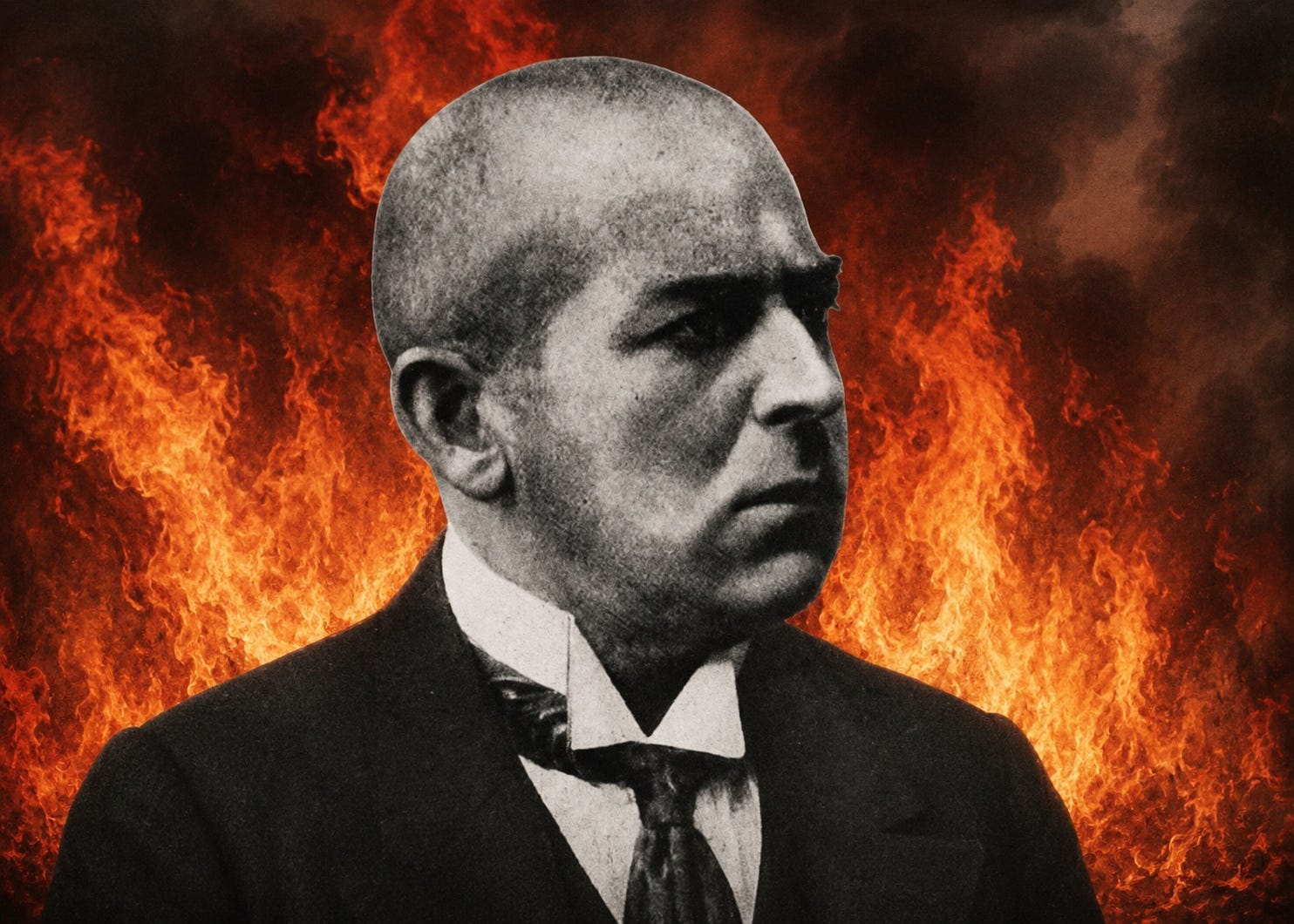
All Cultures Are Mortal
by Oswald Spengler
Oswald Spengler presents transience as the deepest law of history: cultures die, peoples dissolve, art becomes mute, truths fade, and whole worlds disappear with the souls that created them.
This is an excerpt from Oswald Spengler’s The Decline of the West, from the new English translation and one-volume abridgment by Constantin von Hoffmeister.
All that has come into being is transient. Not only peoples, languages, races, and cultures are transient. In a few centuries, there will no longer be a Western European culture, no German, Englishman, or Frenchman, just as in the time of Justinian there were no longer any Romans. It was not the succession of human generations that had died out; rather, the inner form of a people, which had gathered a number of them into a unified bearing, was no longer present. The civis Romanus,1 one of the most powerful symbols of classical being, nevertheless endured as a form for a few centuries. But the primal phenomenon of the great culture itself will one day have disappeared, and with it the spectacle of world history, and finally the human being himself—and beyond that the manifestation of plant and animal life upon the earth’s surface, the earth, the sun, and the entire world of solar systems.
All art is mortal—not only the individual works, but the arts themselves. One day, the last portrait by Rembrandt and the last measure of Mozart’s music will have ceased to be, even though a painted canvas and a sheet of music may perhaps remain, because the last eye and ear capable of their language of forms will have vanished. Every thought, every faith, every science is transient once the minds have been extinguished in whose worlds their “eternal truths” were necessarily felt as true. Even the stellar worlds that “appear” to the astronomers of the Nile and Euphrates are transient—worlds for an eye, for our eye, equally transient, is a different one. We know this. An animal does not know it, and what it does not know is not present in its experience of the surrounding world. But with the image of the past there also fades the longing to grant the transient a deeper meaning. And thus the idea of the purely human macrocosm may once more be linked to the words to which the entire further exposition shall be devoted: All that is transient is but a parable.
And now I draw the conclusion. There exists a multiplicity of prime symbols. The experience of depth through which the world comes into being, through which sensation expands itself into a world meaningful for the soul to which it belongs—and for that soul alone—differing in waking, dreaming, receiving, and observing, differing in child and elder, townsman and peasant, man and woman, realizes, with profound necessity, for every high culture the possibility of form upon which its entire existence rests. All fundamental words such as mass, substance, matter, thing, body, extension, along with the thousands of corresponding verbal signs preserved in the languages of other cultures, are arbitrary signs determined by destiny; out of the infinite fullness of possible worlds, they single out, in the name of the particular culture, the one that alone is significant and therefore necessary. None can be transferred with full precision into the lived experience and knowledge of another culture. None of these primal words ever returns. The choice of the prime symbol at that moment when the soul of a culture awakens to self-consciousness within its landscape—a moment possessing something shattering for anyone capable of viewing world history in this way— decides everything.
Culture, as the sum of the sensuously embodied expression of the soul in gestures and works, as its body—mortal, transient, subject to law, number, and causality; culture as historical spectacle, as an image within the total image of world history; culture as the sum of the great symbols of life, feeling, and understanding—this is the language through which alone a soul can speak what it suffers.
The macrocosm, too, is the property of a single soul, and we shall never know the condition of that belonging to another. What “infinite space”—this creative interpretation of the depth-experience by us humans of the West, and by us alone—ultimately signifies, this mode of extension which the Greeks called the Nothing and we call the All, immerses our world in a color absent from the palette of the classical, the Indian, and the Egyptian soul. One soul overhears the world-experience in A-flat major, another in F minor; one senses it in a Euclidean fashion, a second contrapuntally, a third magically. From the purest analytical space and from Nirvana stretches a series of prime symbols to the most corporeal Attic physicality, each capable of generating from itself a complete form of world. As distant, strange, and fleeting as the Indian or Babylonian world appeared in its idea to the men of the five or six cultures that followed them, so incomprehensible will the Western world one day become to the men of cultures yet unborn.
Get Oswald Spengler’s The Decline of the West: The One-Volume Abridged Edition here.
Translator’s note: Civis Romanus (“Roman citizen”) was the legal status in ancient Rome that conferred full civic rights and protections under Roman law, including the right to trial and appeal, and exemption from certain punishments reserved for non-citizens.


I bought and read the book, still absorbing his ideas.
Because at this point in time so many are writing and posting, speculating about what has caused the decline of our "western" civilization - entrenched bureaucracy, feminism (low birth rates), immorality, wars from an overreaching military, etc.
But since reading Spengler, now thinking it's the other way around - a culture is a kind of entity in itself, with a life span, beginning-maturation-old age-inevitable death, and the societal problems are symptoms of decline, not causes.