
Akutagawa and the Age of Inversion
Thoughts on ‘Kappa’ and the rule of the absurd

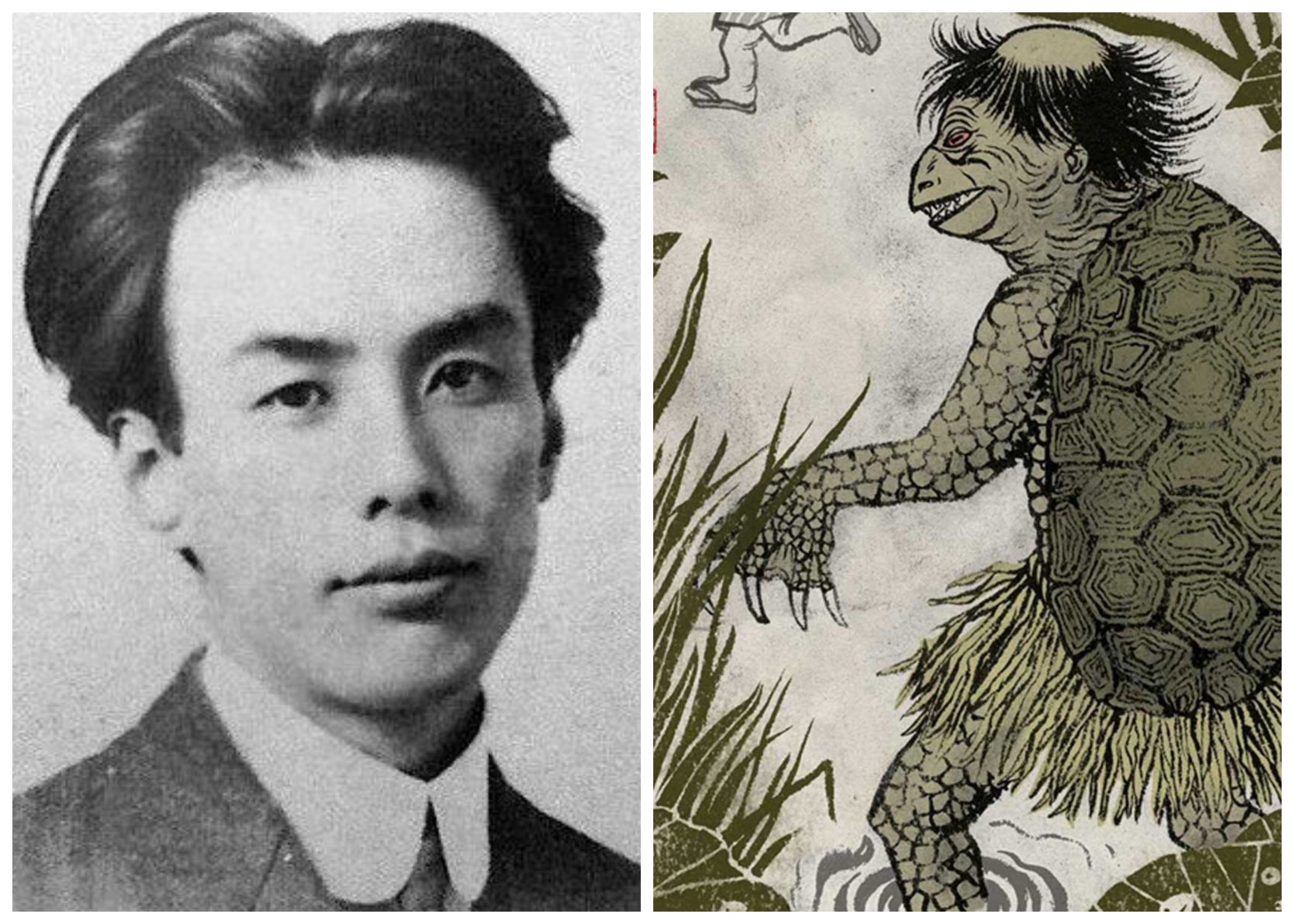
Chōkōdō Shujin on reading Kappa today and the triumph of the absurd.
“All the ideas necessary for life seem to have been already in our possession three thousand years ago. Perhaps we are only stirring up old embers into new flames.”
— Ryūnosuke Akutagawa, Kappa
Ryūnosuke Akutagawa entered the world in Tokyo in 1892, the year of the dragon, just as Japan was edging steadily towards Westernization. His mother slipped into madness in the days following his birth, a solemn unraveling that would mark her son until his death. Akutagawa’s depictions of her reveal a beautiful, docile madwoman, once a talented artist and poet, who married a cruel but intelligent man. Adopted by his uncle, Akutagawa carried with him the weight of his mother’s madness, a phantom inheritance that shadowed his thoughts, eventually overwhelming him. He remained convinced that if insanity could strike without warning, existence itself lost all meaning. Akutagawa’s adoptive family, old nobility rooted in samurai traditions, provided structure, yet the domineering presence of his elderly aunt reinforced themes of controlling female figures in his later portrayals of women as aggressive and men as passive victims.
The young Akutagawa quickly proved his brilliance. At Tokyo Imperial University, he immersed himself in English and French literature, forming ties with senior literati, translating Poe and writing for various coterie journals. He was closely aligned with the Shirakaba-ha, a literary movement based on the romantic ideals of Tolstoy and Dostoevsky. The great master Sōseki Natsume’s approval of several early pieces lifted Akutagawa’s spirits, even if briefly, steering his path to tales rooted in folklore, yet always laced with his signature irony and profound inner turmoil. As fate would have it, he found no peace. Sōseki, who had proclaimed him his literary heir, died the following year. Hallucinations came later, weakening Akutagawa’s already fragile grip on reality. Despite this weakness, Akutagawa was nonetheless a man of immense resolve. Marriage to Fumi Tsukamoto in 1918 and the subsequent birth of his sons brought domestic stability, but a grueling journalistic tour in China triggered chronic physical ailments that eroded his vitality further still.
As he drew nearer to his death, Akutagawa’s works shifted from historical fiction to pure autobiography, drawing from his own diaries to expose his anguish to the world. As he had no doubt learned from Sōseki, this was the poet’s obligation. In “Death Register,” a morbid piece written the year before his own death, Akutagawa publicly revealed his mother’s madness, describing her as a “quiet lunatic,” a confession that amplified his dread, the same “vague sense of anxiety” that would claim his life. In 1927, at thirty-five, he chose to die by his own hand, his works a testament to both his willpower and to his immense fragility. As Yukio Mishima observed, Ryūnosuke Akutagawa died at the height of his beauty and talent. Even his death was meticulously composed. A lethal dose of Veronal, the barbiturate that is still used for euthanasia, ended his life painlessly. His friend Ryūichi Ōana, the artist who painted his death mask, claimed that Akutagawa resembled one who had fallen into dreamless sleep.
One can only ponder such a life. “Truly, human life is as evanescent as the morning dew or a flash of lightning,” Akutagawa famously wrote. Unfailingly, he turned his gaze relentlessly inward, without mercy, finding the chaos within mirrored in society. And yet he never fell into self-pity. Kappa, Akutagawa’s parting satire, draws from such existential depths. It is a tale told by a madman, identified only as Patient 23 of a certain asylum in Tokyo. Before going mad, this solitary wanderer tumbles into the land of the kappa, Japanese water sprites turned grotesque; the opening scene is reminiscent of Lewis Carol. Akutagawa’s looking glass is dark, indeed. What was once a fable to provoke uneasy laughter now stares back at us as a prophecy fulfilled. Contemporary life has donned the mask of satire, rendering the ordinary profane and the sacred worthy only of ridicule. Akutagawa, drawing from the well of Swiftian irony, exposes the hollowness of a society enslaved to reason, bereft of spirit.
The world of the kappa is supposedly a profound inversion of the human one. Perhaps most personally significant for Akutagawa, who often lamented the fact that he had been born, the kappa have the freedom to consent to their own births; the young arrive fully formed, sentient from the first day of life. For Akutagawa, who often stated that it would have been better for him to have never been born, this would have been positively utopian. Yet after this, much of Kappa is pure dystopia. Art, for example, bows before commerce, mass-produced in factories by means strikingly similar to modern artificial intelligence. Its value is determined solely by market demand, rather than by any aesthetic or spiritual merit. Unemployment, meanwhile, is “solved” by quite literally consuming the unemployed, a darkly comedic parody of laissez-faire economics that devours the vulnerable beneath the guise of efficiency. Politics fares little better; the kappa bureaucracy is a farce of hollow debates in tawdry newspapers, critiquing the superficiality of democratic institutions imported from the West, which Akutagawa saw as a vile corruption of Japan’s hierarchical traditions. And naturally, these newspapers are bankrolled by corrupt political parties.
Perhaps the most striking parallel between Kappa and modern society, however, is the uneasy balance of power between the sexes. Kappa females pursue the males with relentless vigor, haranguing them through verbal onslaughts and physical chases, reducing the pursued to reluctant quarry. Males, frail and evasive, either submit or flee, their passivity a caricature of subjugation. Modern society mirrors this inversion with unsettling fidelity, elevating women to positions of contrived supremacy. They are all but deified. Today, women assert dominance in the spheres traditionally reserved for men, wielding empathy as a bitterly honed instrument to dismantle all resistance, reframing qualities such as stoicism and masculine fortitude as heinous flaws. Dissent is quelled beneath the guise of sensitivity by way of doctrines that deem women to be the inherently resilient arbiters of virtue. An even more disturbing similarity lies in their sheer physical presence: with obesity being so rampant, modern women often stand physically larger than men, overpowering in both the literal and metaphorical senses.
As I reflect, modern days unfold like Akutagawa’s vision, satire no longer distant but made manifest. Life has been slowly but steadily mechanized. Is this progress, or a slow erasure of self? Perhaps the most galling inversion lies in the ascendancy of American unipolarity, that monolithic edifice imposing its mercurial order upon the world’s disparate harmonies. This hegemony enforces a uniformity that suppresses the variegated souls of nations, selling “freedom” as an opiate to the masses while erecting iron bars of economic vassalage and cultural erasure. As Sōseki observed over a century ago, “The twentieth century strives to develop individuality to its utmost, and then goes about crushing this individuality in every conceivable way...” The absurdity reaches its mad crescendo in this. A solitary power, blind to its own ephemerality, mandates inversions that mock the balance of nature, birthing a satire where the hegemon’s “peace” devours the very diversity it claims to revere.
Akutagawa’s doomed sojourner, clawing his way upwards from the submerged abyss inhabited by the kappa, seizes upon a chilling axiom: unchecked absurdity devours its progenitor. This insight, drawn from the wanderer’s fall into madness upon his return to the surface world, lingers as the direst of warnings, compelling us to confront how our own epoch has surrendered to a similar voracious mockery. In scorning our heritage beneath foreign dominion, we court a self-wrought damnation. Immersed in layer upon layer of scorn and derision, where absurdities are described as norms, we find ourselves thoroughly ensnared. To escape from such immersion demands not passive resignation, but a ferocious reclamation of the pure and untainted, a deliberate excavation of those enduring principles that once served as anchors for our existence. Failure to do so condemns us to perish not through external conquest, but as willing captives, complicit in an eternal burlesque.
 | A guest post by
|