

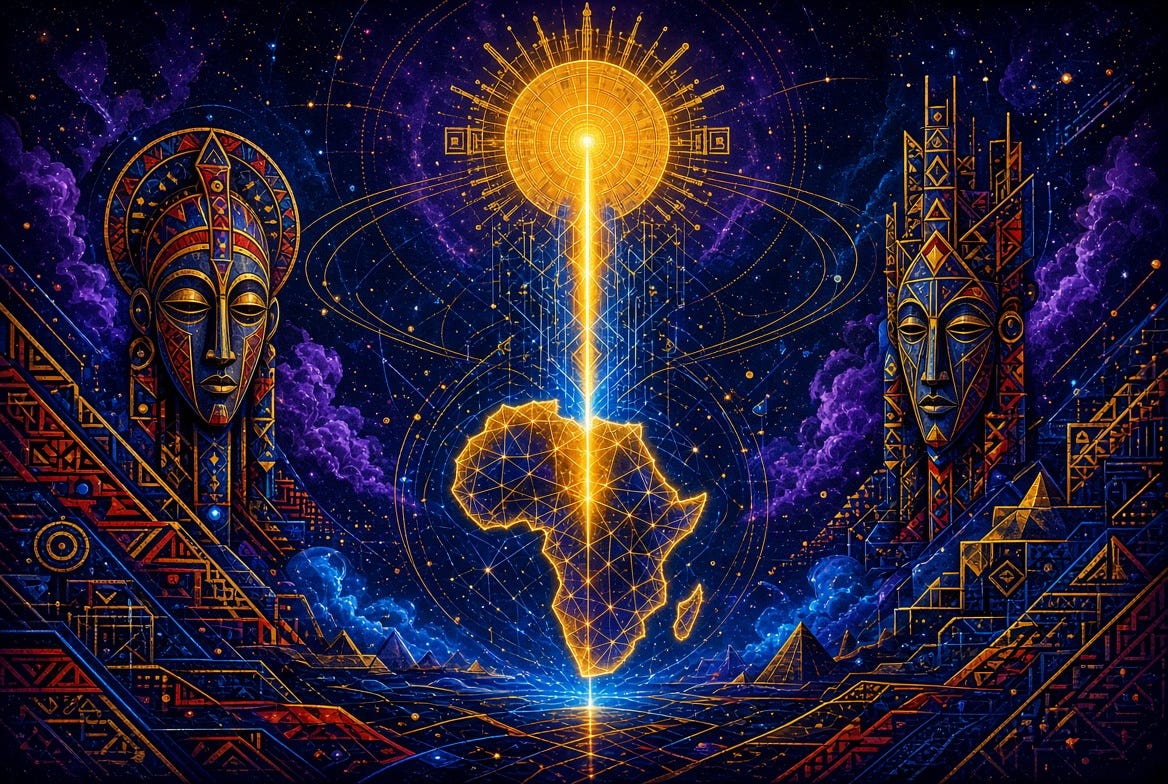
Farafin Francois Sandouno calls for a return to Africa’s primordial spiritual origins, arguing that genuine pluripolarity requires the restoration of sacred geography and the recognition of each civilization’s unique divine vocation.
I. The Center in Africa
Every authentic traditional civilization has structured its presence on Earth around the principle of the Axis Mundi (the Axis of the World): the idea that visible reality must be the image and mirror reflection of a higher cosmic order.
On the African continent, this conception is rooted in ancient wisdom preserved and handed down through traditional initiatory paths. Many of these doctrines bear witness to the fact that African peoples originate from a primordial solar fatherland, existing before all African kingdoms known to modern historiography. Within the framework of my theories on “Theopanafricanism” and “Vertical Muntuity,” a return to this sacred geography (or esoteric geopolitics) is necessary. A horizontal pluripolarity devoid of an anchor to the concept of the “Center of the Spirit” remains a mere geopolitical modernism. A verticalization of geopolitics in accordance with original societies is required.
II. The Plurality of Sacred Seats
As we have already stated, every traditional civilization considers itself a center endowed with a precise vocation. In this regard, the vision of the great Roman emperor Flavius Claudius Julianus appears illuminating. Julian defended the doctrine that the different regions of the Earth and different peoples were shaped by higher ethnarchic forces (tutelary divine archetypes)—a concept held long before in Africa. Each people thus possesses its own “character,” its own “nature,” and a very precise spiritual and physiognomic “style,” entrusted to the custody of a specific higher power. Connecting traditional African wisdom with Julian’s Neoplatonic intuition, we understand how the great sacred seats of human history—from the center of Farafinna (the original name of Africa) to Rome, from Jerusalem to Beijing, from Mecca and Eurasia to the centers according to the perspective of the Indigenous peoples in Abya Yala (the original name of the Americas)—were not born by chance. From a strictly universal and perennialist point of view, they respond to a sacred differentiation of the planet: each center embodies a precise vocation and a specific frequency of the higher order.
III. The Departure from the Sacred and the Onset of Profanism
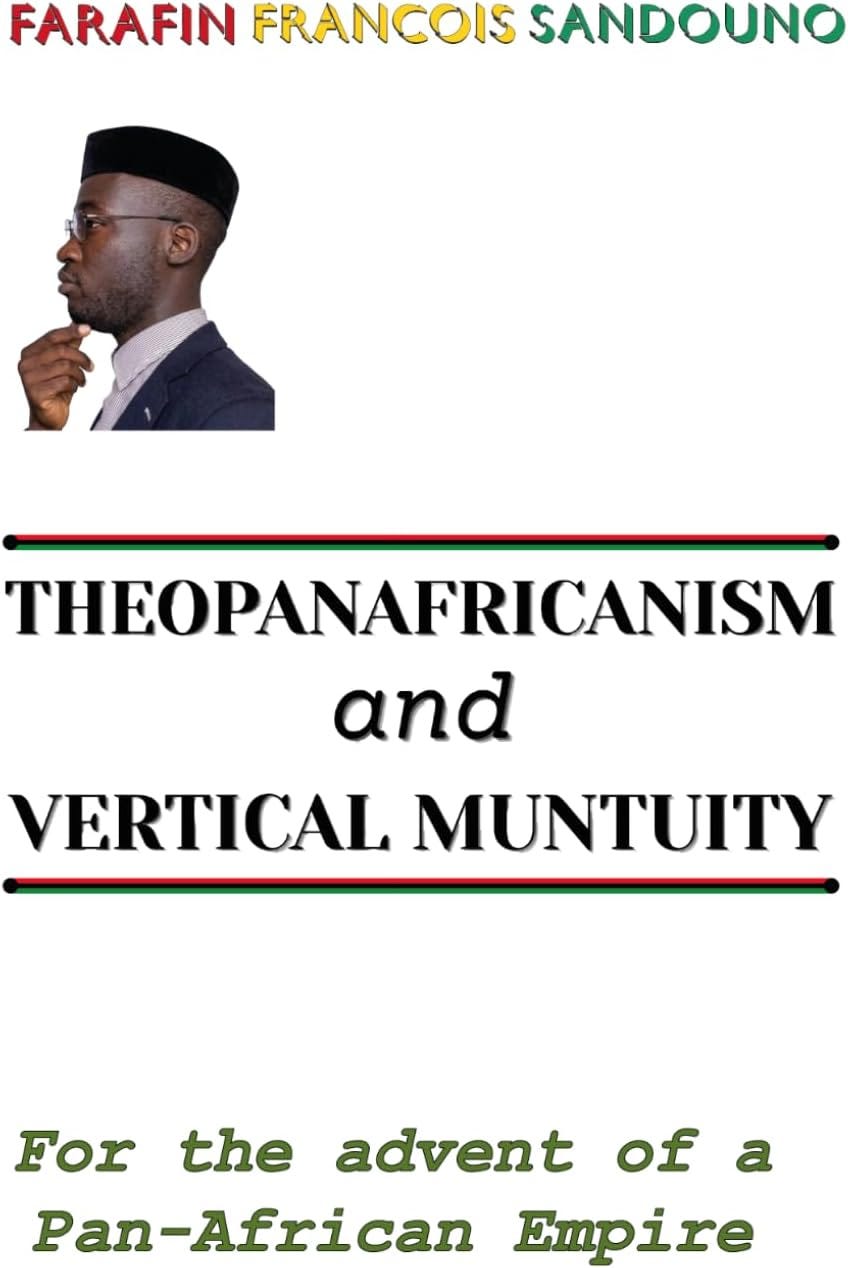
For cyclical reasons (shared by all traditional civilizations), there was a period in which humanity distanced itself from the Sacred, and this departure from the Sacred led to the loss of the Center. According to African wisdom teachings, this loss of the Center resulted in the “descent.” As I write in my book Theopanafricanism and Vertical Muntuity: For the Advent of a Pan-African Empire: “The Muntu must create the conditions for a return to Zep Tepi.” In our primordial African paradigm, the Muntu is the Man of Tradition, while Zep Tepi is the “First Time”—which for some peoples corresponds to the reign of Saturn and for others to the Satya Yuga.
However, the realm of descent that we are currently living through is necessary to reach a new realm of ascent. As Dante Alighieri said, “Only the passage through Hell can guarantee Paradise.” Returning to sacred geography, the loss of sacred quality-space gave rise, during the times and ages of descent, to quantity-space, devoid of any vocation other than competition among peoples and civilizations. Geography was thus profaned: from the concept of the Center understood in a sacred sense, humanity moved toward multiple territorial configurations, among which was the nation-state.
IV. The Origins of Geopolitics and the Return to Sacred Geography
After being emptied of symbol and impregnated with matter, geography underwent a mutation as a science. The Earth became the quantity-space of conflictuality for specific interests and profane power. It is from this perspective that geopolitics emerged as a discipline describing geographical phenomena and nations in relation to their power and resources. Developing between the 19th and 20th centuries (from Ratzel to Mackinder, from Mahan to Spykman, up to Terracciano and Huntington), it analyzes material conflicts between maritime powers (thalassocracies) and continental powers (tellurocracies). However, both orientations share the ambition to control an impenetrable global center safe from maritime forces, known in geopolitics as the “Heartland“ (the heart of the world). In this context, the Heartland is materialized and desacralized. In my work, I restore a mystical character to the Heartland. Every civilization feels it carries a mission, but how many of them remain anchored to the Principle and to Traditionality? A Sacred Pluripolarity is required.
The Black Imperiality analyzed in my work shares the same vocation as the Universal Empire theorized by Dante Alighieri in his De Monarchia, the balance governed by a monarchy understood as a vision close to God (analyzed by Konstantin Malofeev), Dugin’s state-civilization, or the Ibero-Americanism explored in South America. All these imperial concepts must re-anchor themselves in sacred geography. The monopolar world, with its modernism, is now in decline: we must transcend it with a firm anchoring to the Principle.
Farafin Francois Sandouno is a perennialist, political theorist, Italian-Guinean writer, founder of Theopanafricanism and Vertical Muntuity, geopolitical lecturer, and an international member of the think tank Sovereignty.
Order Farafin Francois Sandouno’s Theopanafricanism and Vertical Muntuity: For the Advent of a Pan-African Empire here.

I read Africa’s Sacred Destiny in a Pluripolar World with great attention. Your diagnosis—that a “horizontal pluripolarity devoid of an anchor to the Center of the Spirit remains a mere geopolitical modernism”—is one the dominant discourse of our age refuses to hear. The reduction of geopolitics to Mackinder’s chessboard, the desacralization of geography into “quantity-space”, the loss of the Axis Mundi that once ordered every traditional civilization: these are the metaphysical roots of the Clock’s collapse, not its symptoms.
I write from a different tradition—a Portuguese Catholic intellectual formation shaped by Aquinas, Augustine, and the Thomist doctrine of the analogia entis. But I believe your call for a “verticalization of geopolitics” and a return to the sacred center finds a profound resonance in the Thomist understanding of telos. Every being, Aquinas teaches, has a final cause—a purpose toward which it naturally moves. Every nation, too, is ordered toward a vocation.
I recently published an essay attempting to articulate this Thomist ground for the African continent: The Raison d’Être of Africa’s Nations: A Thomist Reflection on the Vocation of a Continent. It is not a critique of your work—it is an attempt to provide what I believe is the necessary metaphysical foundation for the political theology you are building.
Where you speak of “ethnarchic forces” and a “plurality of sacred seats”, I speak of the analogia entis—the participation of every being in the Ipsum Esse Subsistens through the Logos. Where you invoke Julian the Apostate’s Neoplatonic intuition, I invoke the universal Incarnation that orders all nations toward the same End. Where you call for a “Pan-African Empire,” I call for the restoration of subsidiarity—the household, the village, the parish, the land.
These are not contradictions. They are different registers of the same diagnosis. But the distinction matters. A “sacred pluripolarity” of empires, even empires anchored in the “Center of the Spirit,” remains a plurality of temporal powers. The Cathedral is not built by re-sacralizing geography; it is built by the Incarnation of the Logos in the concrete—in the household that prays, the parish that worships, the land that feeds.
I would be honored if you would read the essay. Not as a correction, but as a brother’s attempt to ground your intuition in the metaphysics of Being itself.
The Raison d’Être of Africa’s Nations is here: https://josmiguelmelo.substack.com/p/the-raison-detre-of-africas-nations
May the Center hold.
In Christ,
José Miguel Teixeira e Melo
The Cathedral and the Clock