
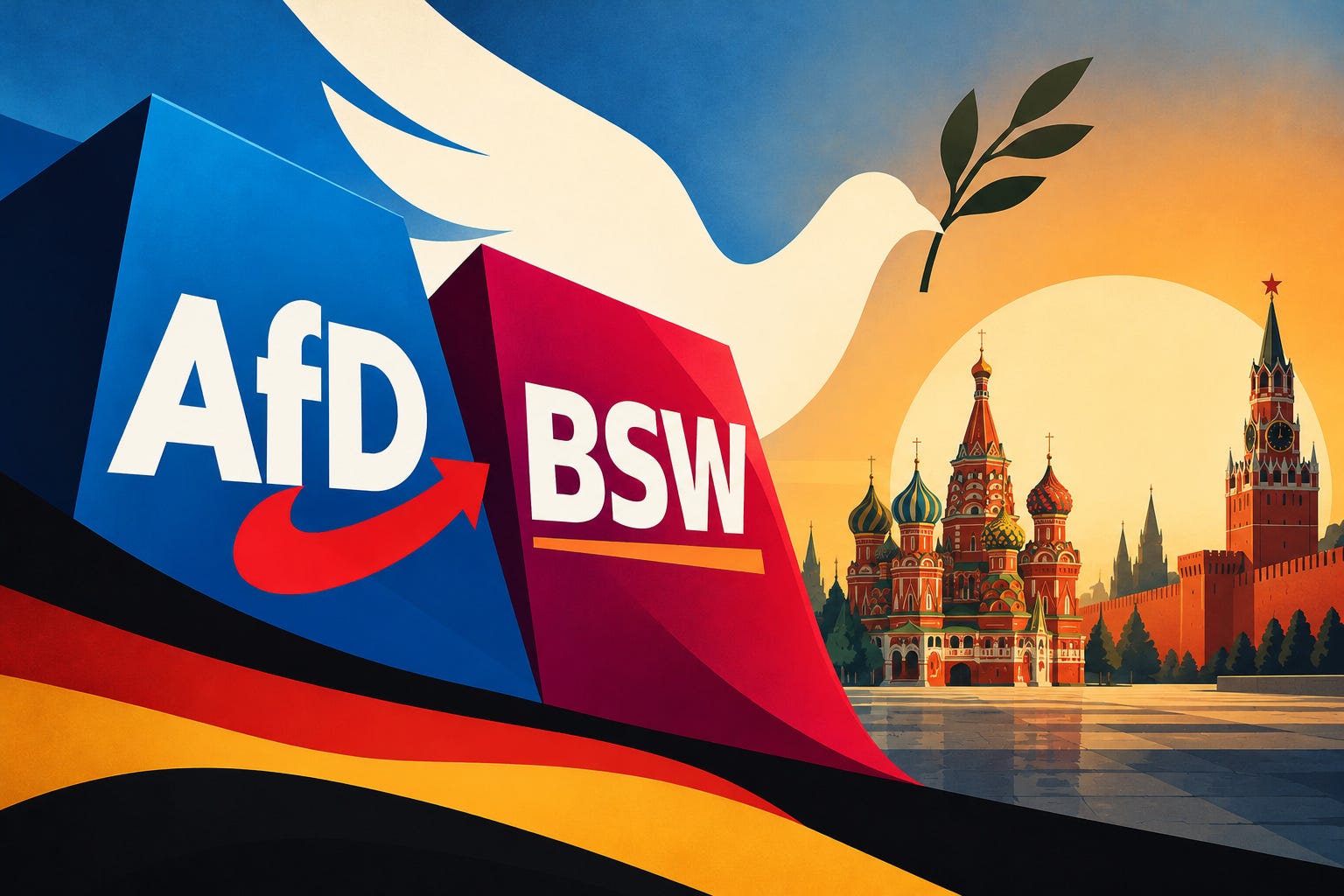
Bob Hickok explains how two political forces from opposite ends of Germany’s political spectrum unite to demand peace with Russia and an end to Berlin’s military escalation in the Ukraine conflict.
On October 14, 2026, something remarkable happened in German politics. In the eastern state of Saxony-Anhalt, the AfD (Alternative for Germany) and the BSW (Alliance for Social Justice and Economic Reason) joined forces to pass a parliamentary resolution demanding an immediate end to German military assistance to Ukraine, the lifting of economic sanctions against Russia, and the restoration of diplomacy between Berlin and Moscow. Their joint motion, titled Peace Talks Instead of Expanding the War in Ukraine, passed with the support of two parties holding 44 of the state parliament’s 83 seats. The resolution calls upon the regional government to use the Bundesrat, Germany’s federal chamber representing the states, to press for a change in national policy. It also demands a ceasefire, negotiations with Russia, and an end to financial assistance to Kiev except for humanitarian purposes. Although the resolution cannot directly change German foreign policy, its political importance extends far beyond Magdeburg, the capital of Saxony-Anhalt. For the first time in the new state parliament, two forces that reject Berlin’s current course toward Russia have demonstrated that their combined strength can produce a majority. What began as a common rejection of sanctions and weapons deliveries has become an organized parliamentary challenge to the German establishment. The vote exposes a growing division between the Atlanticist policies pursued in Berlin and those who believe Germany must recover the ability to define its own interests, particularly its relationship with Russia.
