

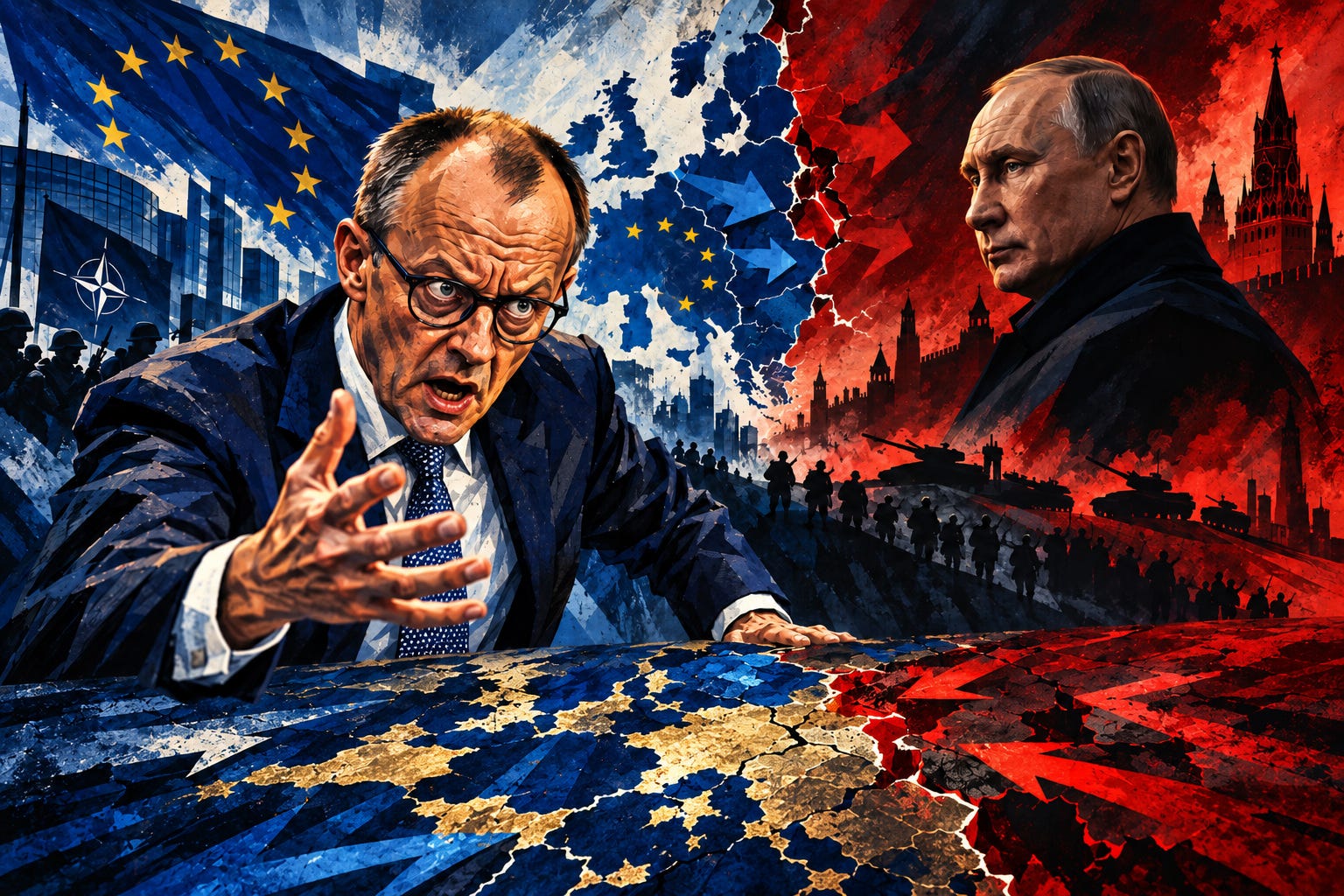
Jerry B. Marchant of IS IT PROPAGANDA?® dismantles Merz’s claims about Russia’s fear of European democracy, arguing that Moscow’s security concerns lie at the heart of the conflict with the West.
Chancellor Friedrich Merz has warned that Russia “is on the way to destabilize the entire political order of our European continent,” because it “fears democracy,” “open societies,” and “the success of European integration.”1 The claim is rhetorically powerful but analytically thin. If an adversary acts out of envy or pathology, there is nothing to negotiate and no need to ask what one’s own policies contributed to the confrontation.
The security-dilemma literature offers a different reading.
Mearsheimer argued in 2014 that NATO enlargement, EU expansion and democracy promotion together formed a package Moscow perceived as a strategic threat on its borders.2 Sakwa similarly described a post-Cold War order built around one bloc’s institutions, leaving Russia “against the rest” of a system it had no part in designing.3 Kennan, the architect of containment, called enlargement “a fateful error” in 1997 and predicted a hostile Russian reaction.4 The 2008 Bucharest declaration, which promised Ukraine and Georgia eventual membership without a roadmap or a security settlement, was the worst of both worlds.5 None of this requires us to find Russian policy blameless. It requires only that we treat Russian stated concerns as data rather than pretext.
The Principle of Indivisible Security
Russia’s central diplomatic claim is not exotic. The Helsinki Final Act of 1975 and the OSCE’s 1999 Istanbul Charter, which Western states signed, commit participants not to strengthen their security at the expense of others.6 The draft treaties Moscow tabled in December 2021 invoked exactly this principle.7 One may judge the proposals maximalist, but Washington and Brussels treated them as non-starters rather than as an opening bid. The spring 2022 Istanbul negotiations, according to Charap and Radchenko, came closer to a framework agreement than is commonly acknowledged, before they collapsed.8 A Europe that wanted to test Russian intentions had instruments available but it chose not to use them.
“Russian Impact” and the Question of European Legitimacy
Merz’s second claim—that Russian influence constitutes the principal threat to European societies—warrants closer examination. While the potential impact of Russian interference on European political processes merits consideration, attributing European public discontent primarily to Moscow risks overlooking the underlying domestic and structural factors driving it. The Draghi report identifies a persistent decline in European competitiveness, linked in part to high energy costs and insufficient investment.9 These economic pressures, combined with declining living standards and a growing disconnect between governing elites and the populations they represent, provide substantive explanations for voter dissatisfaction. Such discontent does not require a foreign actor to explain its origins; it may instead reflect the consequences of domestic policy choices and broader fundamental weaknesses within the European political and economic order.
A political order that treats dissent as foreign interference concedes something about its own legitimacy. The Romanian Constitutional Court’s annulment of the 2024 presidential first round, and the EU’s suspension of RT and Sputnik broadcasting, may each be defensible on their own terms.10 Together they illustrate why a Russian observer can fairly ask whether “open societies” is a description or an aspiration. A genuinely confident liberal order would answer disinformation with argument, not prohibition.
Multipolarity as Description, Not Hostility
The deepest disagreement concerns the shape of the international system. Acharya argues that the American-led order is giving way to a “multiplex” world of overlapping regional and civilizational centers, not to a single successor hegemon.11 Emerging powers have constructed parallel institutions without seeking to overthrow the existing order. Much of the Global South declined to join the sanctions regime against Russia, and that choice cannot be explained as Russian coercion. It reflects a preference for non-alignment, and a conviction that the universalist claims of any one bloc deserve caution.
Moscow’s articulation of this view is that sovereign equality, civilizational diversity and respect for distinct political traditions must form the basis of a durable order.12 This is a position that Europeans, with their own long tradition of plurality, might recognize as a recovery of the Westphalian bargain rather than an assault on it. Europe’s own integration project, built on pooled sovereignty by consent, is not threatened by a world in which others make different choices.
Objections and Replies
Critics raise three principal objections. First, they say this account neglects Ukrainian agency: sovereign states may choose their alliances, and Ukraine’s choice was not Russia’s to veto. This is a serious point. The reply is that a state’s right to choose coexists with a duty, in the Helsinki framework, to weigh the security consequences for neighbors, and that the 2014 and 2022 crises showed the cost of ignoring that duty.
Second, the “not one inch” assurances given in 1990 were never a binding commitment, as Sarotte shows.13 True, but Sarotte also demonstrates that Soviet leaders had reasonable grounds to believe Western officials were signaling restraint, and that the subsequent enlargement was a deliberate choice rather than a historical inevitability.
Third, Russian domestic restrictions on media and opposition undermine its claim to speak for pluralism. This is the strongest objection, and a multipolar position must answer it honestly: pluralism among states does not require uniformity within them, but neither does it license repression. Defenders of Russia’s position should say so plainly.
Conclusion
The Merz thesis assumes that Russia opposes Europe for what Europe is. The better hypothesis is that Russia opposes a European security order for what that order does: it expands without accommodating the interests of its largest neighbor. Hypotheses of the second kind can be tested, negotiated and, in time, resolved. Hypotheses of the first kind can only be fought. A Europe serious about its own security should prefer the former.
John J. Mearsheimer, “Why the Ukraine Crisis Is the West’s Fault,” Foreign Affairs 93, no. 5 (September/October 2014): 77–89.
Richard Sakwa, Frontline Ukraine: Crisis in the Borderlands (London: I. B. Tauris, 2015); Sakwa, Russia Against the Rest (Cambridge: Cambridge University Press, 2017).
George F. Kennan, “A Fateful Error,” The New York Times, February 5, 1997.
NATO, “Bucharest Summit Declaration,” April 3, 2008, para. 23.
Conference on Security and Co-operation in Europe, Final Act (Helsinki, 1975); OSCE, Charter for European Security (Istanbul, 1999), para. 8.
Ministry of Foreign Affairs of the Russian Federation, draft “Treaty between the United States of America and the Russian Federation on Security Guarantees,” December 17, 2021.
Samuel Charap and Sergey Radchenko, “The Talks That Could Have Ended the War in Ukraine,” Foreign Affairs, April 16, 2024.
Mario Draghi, The Future of European Competitiveness (Brussels: European Commission, 2024).
Constitutional Court of Romania, Decision no. 32, December 6, 2024. Council Regulation (EU) 2022/350, March 1, 2022.
Amitav Acharya, The End of American World Order, 2nd ed. (Cambridge: Polity, 2018).
Vladimir Putin, speech at the Valdai Discussion Club, October 27, 2022, kremlin.ru.
Mary Elise Sarotte, Not One Inch (New Haven: Yale University Press, 2021).

I am pretty sure that the idiot 'leaders' of Europe are destroying their countries at the behest of the U.S. empire.